|
Willus.com's Brief History of the Desktop PC back to 1970 |
| This history is a compilation that I have been keeping purely out of my own interest, so the content naturally reflects my personal bias. It is not meant to be comprehensive or all-encompassing, but if you have corrections or useful additions, please send me an e-mail. |
|
References Intel Museum --> Intel's quick reference guide: By year, By family. Intel CPU pricing | AMD CPU Pricing | AMD Opterons | AMD Desktop CPUs | Google Zeitgeist |
2024 YEAR START

PROCESSORS:
    Intel, AMD, and Apple continue to extend their performances in desktop
    and mobile CPUs this year, with the 14th-gen Core i9-14900K, Ryzen 9 7950X,
    and M3 Max all scoring about 3000 for Geekbench 6 single threaded and about
    20,000 for Geekbench 6 multithreaded.  The M3 Max has impressively low power
    consumption compared to Intel and AMD.
    Here is my latest CPU performance table, with 2023 entries higlighted.

    IPAD
    Apple's 10th-gen iPad and 6th-gen iPad Pro were released in Oct 2022 and are
    still the latest releases.  Nothing new in 2023.  See the previous year for
    details.

    IPHONE
    Apple's iPhone 15's were released in September 2023.
    The iPhone 15 has a 6.1-inch 1170x2532 or 6.7-inch 1284x2778 display, A16 CPU, 8 GB RAM,
    and up to 1 TB storage.  Battery is 3274 mAh or 4441 mAh (max).
    The iPhone 15 has the same screen sizes and resolutions as the iPhone 14
    (6.1-inch 1179x2556 or a 6.7-inch 1290x2796 display)
    Apple marketing is pushing the titanium housing.

MEMORY:
    DDR4 and DDR5 mainstream (1800 DDR4 entries and 800 DDR5 entries on NewEgg)

    Desktop memory DDR5 Newegg counts, individual memory modules (sticks)
    Sweet spot is 32-GB modules--much more available and much cheaper than last year.
    --------------------------------------------------------------
    Size   Count    Price range
    64 GB     1     $935 (HP)
    48 GB    40     $240 lowest price, best selling $660 for 4 (192 GB)
    32 GB   200     $73 lowest price, best selling $217 for 2 (64 GB)
    24 GB    40     $143 for 2 lowest price, best selling $260 for 2 (48 GB)
    16 GB   400     $40 lowest price, best selling $103 for 2 (32 GB)
     8 GB    40     $28 lowest price, best selling $70 for 2 (16 GB)

    Newegg counts for DDR3/DDR4 individual memory modules (sticks)
    16 GB and 32 GB sticks at about the same (best) price point of $2.00-2.50 per GB
    --------------------------------------------------------------------------------
    Size   Count    Price range
    128 - 512 GB    (Very difficult to tell what is out there for large-capacity--
                     prices on google were all over the place.)
     64 GB    4     Low=$149 BS/BR=$149 (Hynix); some up to $500 -- lower than last year
     32 GB  200     Low=$54  BS/BR=$154 for 2 (Corsair Vengeance)
     16 GB  500     Low=$25  BS/BR=$84 for 2 (Corsair Vengeance)
      8 GB  700     Low=$17  BS/BR=$39 for 2 (Team T-Force)

    SO-DIMMs (DDR5 count = 200; DDR4 count = 1000--now have 48 GB modules)
    Newegg counts for SO-DIMMs (32 GB sticks much less than last year)
    --------------------------
    Size   Count    Price range
    48 GB    7      Low=$170  BS=$250 for 2 (Mushkin Enhanced Redline DDR5)
    32 GB  200      Low=$52   BS=$120 for 2 (G.Skill Ripjaws DDR4)
    16 GB  400      Low=$27   BS=$67 for 2 (G.Skill Ripjaws DDR4)
     8 GB  400      Low=$15   BS=$34 for 2 (Team Elite DDR4)

    Newegg flash drive counts (high counts of USB 3.1, 3.0, 2.0 drives)
    -------------------------
    Size     Count    Price range
      2 TB      3     $126 - $130.  3.2 Gen 2 (SSK and ADATA)
      1 TB     19     Low=$68 BS=$68 3.2 Gen 2 (Team Group)
    512 GB     50     Low=$31 BS=$45 USB 3 SanDisk
    256 GB    120     Low=$12 BS=$23 USB 3.2 Gen 1 (ADATA, Kingston)
    128 GB    200     Low=$8  BS=$9  USB 3.2 Gen 1 (Team Group)
     64 GB    300     Low=$5  BS=$5  USB 2.0 (Team Group)

    Flash card counts:  CF: 120, SDXC 150
    Class 2 = 2 MB/s, 4 = 4 MB/s, 6 = 6 MB/s, 8 = 8 MB/s, 10 = 10 MB/s.
    UHS-I Speed class 1 = ~10 MB/s transfer rate.
    UHS-I Speed class 3 = >30 MB/s.  Lots of margin for typical HD video.
    "Video Speed Class" for "SDXC-II" cards just rates the card in terms of MB/s.  V30=30 MB/s; V60=60 MB/s; V90=90 MB/s

    Newegg SDHC/SDXC counts (prices definitely lower than last year)
    -----------------------
    Size     Count    Price range
      1 TB      4     Low=$55 (Team Group V30) BS=$150 (Sandisk extreme PRO V30)
    512 GB     10     Low=$30 (Team Group V30) BS=$50 (Sandisk Ultra Class 10)
    256 GB     24     Low=$16 (Team Group V30) BS=$27 (Sandisk Ultra Class 10)
    128 GB     50     Low=$9 (WinTec Write 40 MB/s), BS=$22 (Sandisk Extreme Pro V30)
     64 GB     70     Low=$8 (WinTec Write 40 MB/s), BS=$10 (Sandisk Ultra Class 10)

    Newegg Micro-SDHC/SDXC counts (top end much cheaper than last year--$50/TB)
    -----------------------------
    Size     Count    Price range
      1 TB     18     Low=$53 (Team Group Elite V30), BS=$60 (Team Group Pro+ Class 10)
    512 GB     40     Low=BS=$24 (Team Group V30)
    256 GB     50     Low=$14 (Team Group V30), BS=$30 (Sandisk 100 MB/s)
    128 GB     70     Low=BS=$8 (Team Group V30)
     64 GB    100     Low=$7 (ADATA Premier V10),  BS=$5 (Team Group Class 10)

DISPLAYS:  LED-backlit LCD monitors are dominant.
    Dell Ultrasharp at NewEgg--some prices much higher than last year
        24" 1920x1080 P2419H  $168 (last year $192 and before that $270)
        24" 1920x1200 P2423   $332
        24" 1920x1200 U2412M  $410 (last year $700 but before that $170)
        24" 1920x1200 U2415   $918(!) (last year was $690 and before that $589)
        27" 2560x1440 P2722D  $369 (best selling)
        27" 2560x1440 P2720D  $498 (last year was $575 and before that $440)
        27" 2560x1440 P2723D  $360 (same as last year)
        32" 3840x2160 U3219Q  $1200 (last year was $958 and before that $1060)
        43" 3840x2160 U4320Q  $992 (last year was $843 and before that $964)
    NewEgg:
        24-26" 1920x1080 (200)   $80 and up, BS=$120 (Asus Tuf VG249Q1R, 2281 reviews)
                                             BR=$218 (Asus ProArt PA247CV, 6 reviews)
        24-26" 1920x1200  (24)   $70 and up, BS=BR=$190 (Asus ProArt PA248QV)
           27" 2560x1440 (200)  $160 and up, BS=$230 (Gigabyte G27Q)
                                             BR=$389 (Asus ROG Strix XG27AQ-W)
           4K  3840x2160 (200)  $200 and up, BS=$429 (32-in MSI curved gaming)
                                (27")        BR=$250 (27-in LG)
                                             BR 32-inch=$350 (Samsung S70A--same as last year)
        24 OLED monitors, smallest 27-inch 2560x1440, $700
                          BS=$1300, 34-inch ASUS curved gaming, 3440x1440

STORAGE:
    Wikipedia SATA article

    Newegg counts, 3.5-inch drives
    22 TB still the max capacity but 30 TB supposedly close to coming out.
    All prices up from last year and quantities down.  More limited market?
    Best price point per TB is 20 TB (~$16/TB; $18-$24/TB for enterprise)
    ------------------------------
    Size     Count    Low Price    Best Selling           Enterprise
     22 TB     9      $420         $420 (WD Red)          $440 (Ironwolf) / $575 (Gold)
     20 TB    24      $311         $320 (Seagate Exos)    $375 (Exos) / $488 (Gold)
     16 TB    80      $247         $315 (Seagate Irn Wlf) $300 (Exos) / $360 (Gold)
     12 TB    80      $199         $240 (Ironwolf)        $215 (Exos) / $294 (Gold)
      8 TB   200      $125         $190 (Seagate BarrCud) $170 (Exos) / $225 (Gold)
      4 TB   330      $55          $85  (Seagate BarrCud) $148 (Seag) / $114 (Gold)

    Newegg counts, 2.5-inch drives (prices up from last year, quantities lower)
    ------------------------------
    Size     Count    Low Price    Best selling price
      5 TB      1      $146           $146 (Seagate Barracuda)
      4 TB      1      $175           $175 (Seagate Barracuda)
      2 TB     18       $63            $80 (WD Blue)
      1 TB     50       $37            $65 (WD Black)

    Newegg counts, SSD drives.
    SSD 3.5-inch SATA
    Nimbus still offers ExaDrive up to 100 TB (EDDCT100), $40.3k
                           100 TB (EDDCT100), "Special Order"
                           64 TB (EDDCT050), $16k    64 TB EDNLT064, "Special Orderr"
                           32 TB (EDDCT032), $8k     32 TB EDNLT032, $6.2k
                       and 16 TB (EDDCT016), $4k     16 TB EDNLT016, $3.2k
    The DC version has unlimited write endurance for 5 years.  500 MB/s write speed.
    The 32-TB NL version is $5600 and offers 0.2 - 0.6 DWPD for 5 years.

    SSD 2.5-inch SATA
    High capacity about the same quanties as last year.  Top size still 16 TB.
    Prices similar to last year--down in spots.
    Best price point is 2 TB best seller = $39/TB
    This year for the first time, at 2 TB, the best seller is cheaper than
    the best-selling magnetic HDD for laptops.
    --------------------------
    Size           Count   Low Price            Best Rated (min 10)       Best Selling
    16 TB             2      $2014 (Mushkin) and $3800 (VisonTek)
    8 TB              8       $530 (870 QVO--best selling) up to $1600 (VisionTek)
    4 TB             24       $169 (KingSpec)   $300 (WD Red)             $290 (870 EVO)
    2 TB             50        $78 (KingSpec)   $150 (870 EVO)             $78 (KingSpec)
    1 TB             70        $50 (Kodak)       $55 (TimeTec)             $90 (870 EVO)
    512 GB          100        $31 (Team Group)  $33 (TimeTec)             $50 (870 EVO)

    SSD M.2 (continues to dominate market for small-sized drives)
    8 TB M.2 2280 still top size
    KingSpec brought the low-end prices down for 2 TB and 4 TB.
    Sweet spot starting to more from 2 TB to 4 TB.
    -------------------
    Size      Count   Low Price              Best Rated (min 10)      Best Selling
     8 TB        7       $825 (Mushkin Gamma) to $999 (Fantom Venum)  $925, Corsair MP600Pro
     4 TB      120       $179 (KingSpec)     $402 (Kingston Fury)     $310 (Samsung 990 Pro)
     2 TB      200        $76 (KingSpec)     $193 (Kingston Fury)     $183 (Samsung 980 Pro)
     1 TB      250        $54 (KingSpec)     $120 (Kingston Fury)     $110 (Samsung 980 Pro)
    512 GB     100        $31 (TimeTec)       $31 (TimeTec)            $39 (Team Group)

    Didn't look at CDRW/DVD/Blu-Ray prices.  From start of 2021:
        CD/DVD reades/burners $20, 24X
        Blu-Ray readers/burners $65, 16X

O/S:
    Wikimedia browser statistics on Desktops (From StatCounter Global Stats)
        Desktop Browser   Dec23   Q422   Oct'21  Nov'20  Oct'19  Nov'18  Dec'17  Dec'16  Dec'15
       -----------------------------------------------------------------------------------------
        IE+Edge           12.4%   11.0%    9.3%   10.1%    8.9%    5.0%   11.9%   13.2%   16.7%
        Chrome            65.2%   66.5%   67.2%   67.7%   68.9%   61.8%   64.7%   62.7%   57.2%
        Firefox            7.6%    7.2%    7.9%    8.0%    9.3%    4.9%   12.2%   15.0%   15.9%
        Safari             9.0%    9.2%    9.6%    9.8%    8.7%   15.1%    6.3%    5.1%    5.0%
        Opera              3.8%    3.3%    2.9%    2.5%    2.3%    3.2%    2.3%            2.0%
        Other              2.1%    3.1%    2.0%    1.9%   10.0%    2.6%    4.1%    3.4%

        (cont.)         Dec'14  Q4'13    Nov 2012    Nov 2011     Nov 2010    Nov 2009    Nov 2008
       -------------------------------------------------------------------------------------------
        IE               18.3%  26.61%      31.23%      40.63%      48.16%      56.57%      68.14%
        Chrome           47.9%  42.01%      35.72%      25.69%      13.35%       4.66%       0.93%
        Firefox          17.1%  18.39%      22.37%      25.23%      31.17%      32.21%      25.27%
        Safari            4.4%   8.71%       7.83%       5.92%       4.70%       3.67%       2.49%
        Opera             1.5%   1.23%       1.39%       1.82%       2.01%       2.02%       3.01%
        Mobile/Other     10.8%   3.05%      13.08%       6.95%       4.02%       1.21%       --

    StatCounter Statistics as of Jan 2024:
        OS Worldwide        OS Desktop        Windows Desktop     OS X
        ---------------     -------------     ----------------    -----------------------
        Android:  41.6%     Windows: 73.0%    Win 11:    27.8%    Catalina (and up) 95.0%
        Windows:  29.0%     OS X:    16.1%    Win 10:    66.5%    High Sierra        1.0%
        iOS:      18.2%     Unknown:  5.3%    Win 7:      3.1%    Mojave             0.8%
        OS X:      6.4%     Linux:    3.8%    Win 8/8.1:  2.0%    El Capitan         0.6%
        Unknown:   2.2%     Chome:    1.8%    Win XP:     0.6%    10.10              0.5%
        Linux:     1.5%                       Other:      0.1%    Other              0.7%
        Other:     1.1%

    Windows 11 (Build 23H2 10.0.22631.3085, Jan 23, 2024)
    Windows 10 (Build 22H2 10.0.19045.3996, Jan 23, 2024)
    Windows 8.1 (6.3.9600 on 10 Jan 2023)
    Windows 7 (SP-1 + Platform update).
    Windows Vista on SP 2 + Platform update
    Windows XP support ended April 8, 2014.
    Mac OS X on 14.3.1 Sonoma
    Ubuntu at v23.10 (Mantic Minotaur)
    Redhat/CentOS final release 7.9-2009/6.10/5.1
    Rocky Linux at 9.3/8.9.
    Linux Kernel at 6.7.4 (5 Feb 2024)

LANGUAGES
    From tiobe.com,
        C# wins language of year for biggest increase.
        Python 15.16%; C 10.97%; C++ 10.53%; Java 8.88%; C# 7.53%; Javascript 3.17%; SQL 1.82%;
        Go 1.73%; VB 1.52%; PHP 1.51%; Fortran  1.40%; Delphi 1.40%; Matlab 1.26%; Assembly 1.19%;
        Scratch 1.18%; Swift 1.16%; Kotlin 1.07%; Rust 1.05%; COBOL 1.01%; Ruby 0.99%

USB-4 runs anywhere from 10 Gbps (Gen 2x1) to 120 Gbps (Gen 4).
(Haven't seen much mainstrain hardware claiming to be USB 4 compatible yet.)
|
2023 YEAR START

PROCESSORS:
    Intel and AMD are neck and neck in extending their performances in desktop
    and mobile CPUs this year, with the 13th-gen Core i9-13900HK and Ryzen 9 7950X
    posting unprecedented single-threaded and multi-threaded desktop performance numbers,
    though it's safe to say that Apple's M1/M2 CPUs are far more efficient for the
    performance they deliver, making them well suited to laptops, iPads, and minis.
    Here is my latest CPU performance table, with 2022 entries higlighted.

    IPAD
    Apple's 10th-gen iPad and 6th-gen iPad Pro were released in Oct 2022.
    The iPad has a 10.9-inch 1640x2360 retina display and an Apple A14 Bionic CPU.
    It has 4-GB RAM and up to 256-GB (new) storage and a 29-Whr battery.
    The iPad Pro has a 11-inch 1668x2388 retina display or a 12.9-inch 2048x2732 display
    and an Apple M2 CPU.  It has 8-GB or 16-GB RAM and up to 128-GB to 2-TB storage.

    IPHONE
    Apple's iPhone 14's were released in September 2022.
    The iPhone 14 has a 6.1-inch 1170x2532 or 6.7-inch 1284x2778 display, A15 CPU, 6 GB RAM,
    and up to 512 GB storage.  Battery is 3280 mAh or 4325 mAh.
    The iPhone 14 Pro has a 6.1-inch 1179x2556 or a 6.7-inch 1290x2796 display, A16 CPU,
    6 GB RAM, and up to 1 TB storage.  Battery is 3200 mAh or 4325 mAh.

MEMORY:
    DDR4 mainstream (3000 entries on NewEgg), DDR5 now more plentify (400 enties on NewEgg)

    Desktop memory DDR5 Newegg counts, individual memory modules (sticks)
    --------------------------------------------------------------
    Size   Count    Price range
    32 GB   10      $128-$500 each, best selling $130
    16 GB   40      $62-$124 each, best selling $70 (way less than 2021)
     8 GB   10      $33-$110 each, best selling $38

    Newegg counts for DDR3/DDR4 individual memory modules (sticks)
    16 GB and 32 GB sticks at about the same (best) price point of $2.80 per GB
    ---------------------------------------------------------------------------
    Size   Count    Price range
    512 GB          Saw two on Google for $2470 (HP refurbished) and $8000 (Intel)
    256 GB          Google shopping shows various options from $900 - $3250
    128 GB          Google shopping shows several in the range $500 - $1000
     64 GB   10     Low=$200 BS/BR=$200 (Crucial); some up to $500 -- lower than last year
     32 GB  200     Low=$67  BS/BR=$90 (G.SKILL Ripjaws, lower than last year)
     16 GB  500     Low=$23  BS/BR=$44 (G.SKILL Ripjaws)
      8 GB  800     Low=$11  BR=$70 (Kingston), BS=$15 (Crucial) (less than last year)

    SO-DIMMs (largely DDR4)
    Newegg counts for SO-DIMMs (32 GB sticks now at best per GB price point)
    --------------------------
    Size   Count    Price range
    32 GB   50      Low=$65   BR=$65  BS=$83 (lower prices)
    16 GB  300      Low=$31   BR=$40  BS=$40 (lower than last year)
     8 GB  150      Low=$16   BR=$27  BS=$19 (lower than last year)
     4 GB  100      Low=$10   BS=$11  BS=$28 (similar to last year)

    Newegg flash drive counts (high counts of USB 3.1, 3.0, 2.0 drives)
    -------------------------
    Size     Count    Price range
      2 TB      1     Basically an external SSD USB drive, $150
      1 TB     14     Low=$83 BS=$86 (Sandisk USB 3.1 Gen 1, Type C, 150 MB/s read speed)
    512 GB     50     Low=$34 BS=$41
    256 GB    100     Low=$16 BS=$29 BR=$33 (BR USB 3.2 Gen 2 read speed 600 MB/s)
    128 GB    250     Low=$8  BS=$8  BR=$15
     64 GB    300     Low=$5  BS=$5  BR=$5

    Flash card counts:  CF: 180, SDXC 500
    Class 2 = 2 MB/s, 4 = 4 MB/s, 6 = 6 MB/s, 8 = 8 MB/s, 10 = 10 MB/s.
    UHS-I Speed class 1 = ~10 MB/s transfer rate.
    UHS-I Speed class 3 = >30 MB/s.  Lots of margin for typical HD video.
    "Video Speed Class" for "SDXC-II" cards just rates the card in terms of MB/s.
    V30=30 MB/s; V60=60 MB/s; V90=90 MB/s

    Newegg SDHC/SDXC counts
    -----------------------
    Size     Count    Price range
      1 TB      1     $200 Sandisk extreme PRO V30 speed (last year was $250)
    512 GB     12     $58 - $280, BS=$58 (Class 10), Lowest V30 = $88 (BR)
    256 GB     30     Low=$27 (Class 10), BS=$46 (V30), Lowest V60 = $80
    128 GB     50     Low=$13 (Class 10), BS=$24 (V30)
     64 GB    100     Low=$7  (Class 10), BS=$16 (V30)

    Newegg Micro-SDHC/SDXC counts (only looked at V30 speed)
    -----------------------------
    Size     Count    Price range
      1 TB      5     Low=$90, BS=$119, BR=$90
    512 GB     16     Low=$35, BS=$50,  BR=$42
    256 GB     22     Low=$15, BS=$17,  BR=$51
    128 GB     21     Low=$9,  BS=$9,   BR=$12
     64 GB     14     Low=$5,  BS=$5,   BR=$10

DISPLAYS:  LED-backlit LCD monitors are dominant.
    Dell Ultrasharp at NewEgg--some prices much higher than last year
        24" 1920x1080 P2419H  $192 (last year was $270. BS Dell 24-inch monitor)
        24" 1920x1200 U2412M  $700 (discontinued?? last year was $170)
        24" 1920x1200 U2415   $690 (last year was $589... discontinued?)
        27" 2560x1440 P2720D  $575 (last year was $440)
        27" 2560x1440 P2723D  $360 (best selling Dell 27-inch 2560x1440)
        30" 2560x1600 U3023E  $764 (best selling 30-inch 2560x1600)
        32" 3840x2160 P3222QE $772 (best selling Dell 32-inch 4K)
        32" 3840x2160 U3219Q  $958 (last year was $1060)
        43" 3840x2160 U4320Q  $843 (last year was $964)
    NewEgg:
        24-26" 1920x1080 (200)   $95 and up, BS=$238 (Asus Tuf VG24VQ, 2281 reviews)
                                             BR=$225 (Asus ProArt PA247CV, 6 reviews)
        24-26" 1920x1200  (24)  $180 and up, BS=$190 (Asus ProArt PA248QV)
                                             BR=$690 (Dell U2415--only 2 reviews)
           27" 2560x1440 (100)  $180 and up, BS=$300 (Gigabyte G27QC)
                                             BR=$310 (AOC CQ27G2 curved)
           4K  3840x2160 (150)  $200 and up, BS=$530 (28-in Gigabyte M28U)
                                             BR=$411 (27-in LG 27UL500-W)
                                             BR 32-inch=$350 (Samsung S70A)

STORAGE:
    Wikipedia SATA article

    Newegg counts, 3.5-inch drives
    22 TB now available in enterprise form.
    Best price point per TB is 8 TB (~$15/TB, $17.5/TB for enterprise drives)
    Price per TB from $15 - $27.  Gold ~$25-$30/TB.
    ------------------------------
    Size     Count    Low Price    Best Selling           Enterprise
     22 TB     4      $530         $600 (WD Red)          $350 (Exos) / $600 (Gold)
     20 TB    10      $400         $400 (Seagate Irn Wlf) $350 (Exos) / $497 (Gold)
     16 TB    80      $230         $280 (Seagate Irn Wlf) $230 (Exos) / $390 (Gold)
     12 TB   100      $170         $220 (WD Red)          $170 (Exos) / $304 (Gold)
      8 TB   230      $115         $115 (Seagate BarrCud) $140 (Exos) / $202 (Gold)
      4 TB   350      $50          $68  (Seagate BarrCud) $ 50 (Seag) / $150 (Gold)

    Newegg counts, 2.5-inch drives (prices down from last year)
    ------------------------------
    Size     Count    Low Price    Best selling price
      5 TB      2      $117           $117 (Seagate Barracuda)
      4 TB      3      $104           $104 (Seagate Barracuda)
      2 TB     19       $65            $65 (WD Blue)
      1 TB     50       $25            $55 (WD Black)

    Newegg counts, SSD drives.
    SSD 3.5-inch SATA
    Nimbus still offers a 100 TB (EDDCT100), $40.3k
                           50 TB (EDDCT050), $13.6k    64 TB EDNLT064, $12.6k
                           32 TB (EDDCT032), $8.5k     32 TB EDNLT032, $6.6k
                       and 16 TB (EDDCT016), $4.2k     16 TB EDNLT016, $3.5k
    The DC version has unlimited write endurance for 5 years.  500 MB/s write speed.
    The 32-TB NL version is $5600 and offers 0.2 - 0.6 DWPD for 5 years.

    SSD 2.5-inch SATA
    High capacity about the same quanties as last year.  Top size still 16 TB.
    Prices down slightly from last year.
    Best price point is Team Group's 2 TB drive for $90 = $45/TB.
    --------------------------
    Size           Count   Low Price            Best Rated (min 10)       Best Selling
    15.3 TB           1      $3300 (Team Group, QLC) -- $300 less than last year
    7.6 TB            7       $640 (870 QVO)    $640 (870 QVO)            $640 (870 QVO)
    4 TB             24       $269 (Crucial)    $620 (860 EVO)            $360 (870 EVO)
    2 TB             50        $90 (Team Group) $543 (Seagate FireCuda)    $89 (Team Group)
    1 TB            100        $46 (Silicn Pwr) $339 (Seagate FireCuda)    $80 (870 EVO)
    512 GB          180        $25 (Team Group)  $37 (FanXiang)            $46 (870 EVO)
    256 GB          100        $16 (Kingsman)    $30 (FanXiang)            $17 (Team Group)

    SSD M.2 (continues to dominate market for small-sized drives)
    8 TB M.2 2280 still top size
    Prices significantly lower than last year for drives up to 4 TB
    2 TB now at sweet spot, $85 - $210 / TB
    Best price point is still 512 GB at $64/TB but 2 TB is only $88/TB
    -------------------
    Size           Count   Low Price   Best Rated (min 10)      Best Selling
     8 TB             2      $1075 Corsair     BS/BR=$1500, Sabrent Rocket
     4 TB            50       $250     $530 (Kingston Fury)     $450 (WD Black)
     2 TB           200       $173     $190 (Kingston Fury)     $175 (Samsung 970EVOplus)
     1 TB           250        $49     $100 (Kingston Fury)     $119 (Samsung 980 Pro)
    512 GB          100        $25      $40 (Intel 670p)         $32 (Team Group)
    256 GB          100        $15      $45 (Sabrent Rocket)     $22 (Team Group)

    Didn't look at CDRW/DVD/Blu-Ray prices.  From start of 2021:
        CD/DVD reades/burners $20, 24X
        Blu-Ray readers/burners $65, 16X

O/S:
    Wikimedia browser statistics on Desktops (From StatCounter Global Stats)
        Desktop Browser   Q422   Oct'21  Nov'20  Oct'19  Nov'18  Dec'17  Dec'16  Dec'15  Dec'14
       -----------------------------------------------------------------------------------------
        IE+Edge           11.0%    9.3%   10.1%    8.9%    5.0%   11.9%   13.2%   16.7%    18.3%
        Chrome            66.5%   67.2%   67.7%   68.9%   61.8%   64.7%   62.7%   57.2%    47.9%
        Firefox            7.2%    7.9%    8.0%    9.3%    4.9%   12.2%   15.0%   15.9%    17.1%
        Safari             9.2%    9.6%    9.8%    8.7%   15.1%    6.3%    5.1%    5.0%     4.4%
        Opera              3.3%    2.9%    2.5%    2.3%    3.2%    2.3%            2.0%     1.5%
        Other              2.8%    3.1%    2.0%    1.9%   10.0%    2.6%    4.1%    3.4%    10.8%

        (cont.)         Q4'13    Nov 2012    Nov 2011     Nov 2010    Nov 2009    Nov 2008
       -----------------------------------------------------------------------------------
        IE             26.61%      31.23%      40.63%      48.16%      56.57%      68.14%
        Chrome         42.01%      35.72%      25.69%      13.35%       4.66%       0.93%
        Firefox        18.39%      22.37%      25.23%      31.17%      32.21%      25.27%
        Safari          8.71%       7.83%       5.92%       4.70%       3.67%       2.49%
        Opera           1.23%       1.39%       1.82%       2.01%       2.02%       3.01%
        Mobile/Other    3.05%      13.08%       6.95%       4.02%       1.21%       --

    StatCounter Statistics as of Dec 2021:
        OS Worldwide        OS Desktop        Windows             OS X
        ---------------     -------------     ----------------    -----------------
        Android:  43.3%     Windows: 75.4%    Win 11:    15.5%    Ventura        <1.0%
        Windows:  29.4%     OS X:    15.2%    Win 10:    70.3%    Catalina       87.6%
        iOS:      17.4%     Unknown:  4.2%    Win 7:     10.4%    High Sierra     3.9%
        OS X:      5.9%     Linux:    2.8%    Win 8/8.1:  3.3%    Mojave          3.8%
        Unknown:   1.7%     Chome:    2.4%    Win XP:     0.4%    Sierra          1.6%
        Linux:     1.1%                       Other:      0.2%    El Capitan      1.1%
        Other:     1.2%                                           10.10           1.1%
                                                                  Other           1.0%

    Windows 11 (Build 22H2 10.0.22621.1194, Jan 26, 2023)
    Windows 10 (Build 22H2 10.0.19045.2486, Jan 10, 2023)
    Windows 8.1 (6.3.9600 on 10 Jan 2023)
    Windows 7 (SP-1 + Platform update).
    Windows Vista on SP 2 + Platform update
    Windows XP support ended April 8, 2014.
    Mac OS X on 13.1 Ventura
    Ubuntu at v22.10 (Kinetic Kudu)
    Redhat/CentOS final release 7.9-2009/6.10/5.1
    Rocky Linux at 9.1/8.7.
    Linux Kernel at 6.1.4 (7 Jan 2023)

LANGUAGES
    From tiobe.com,
        C++ wins language of year for biggest increase.  C is runner up.
        Python 16.36%; C 16.26%; C++ 12.91%; Java 12.21%; C# 5.73%; VB 4.64%; Javascript 2.87%;
        SQL 2.50%; Assembly 1.60%; PHP 1.39%; Swift 1.20%; Go 1.14%; R 1.04%; VB classic 0.98%;
        Matlab 0.91%; Ruby 0.80%; Delphi 0.73%; Perl 0.59%; Scratch 0.58%

USB-4 ver 2.0 spec was released in Q4 2022 and goes up to 120 Gbps.
|
2022 YEAR START

PROCESSORS:
    Never let it be said that Intel suffers from NIH (not invented here).  Intel took
    a page from Apple, with the success of Apple's M1 processor, which has both
    "performance" and "high efficiency" cores.  The latest (12th-gen) Intel CPUs have
    the exact same architecture, and it has put Intel squarely back at the top of the
    desktop CPU performance.  Notable developments over the last year are nicely
    summarized in this Anandtech article. here is a quick summary:
        * Jan--flagship mobile from AMD is Ryzen 9 5980HS.  35-W, 8-CPU.
        * Jan--Intel Core i9-10850K.  10-core Comet Lake CPU.
        * Feb--Threadripper 3995WX with 64 cores.
        * March--Rocket Lake 11th-gen Intel CPUs.  AVX-512.  High TDP.
        * March--AMD launched third-gen EPYC server CPUs.  10% higher per-core performance.
        * Oct--M1 Pro and M1 Max launched.  M1 Max has 57 billion transistors, 5 nm process,
          10-core CPU, 32-core GPU, 400 GB/s BW, and can address 64 GB memory.
        * Nov--Intel: 12th-gen Alder Lake CPUs in Nov 2021: Core i9-12900K is top end.
          Mimicking Apple with high-performance cores (P-cores) and efficiency cores (E-cores).
          i9:  8 P-cores and 8 E-cores (240 W, 24 threads)
          i7:  8 P-cores and 4 E-cores (190 W, 20 threads)
          i5:  6 P-cores and 4 E-cores (150 W, 16 threads)
          On i9 top-end, E-cores run at 2.4/3.9 GHz.  P-cores run at 3.2/5.2 GHz.
          Integrated graphics = 770.
          DDR5, PCIe 5.0.
          "Performance against AMD overall is a mixed bag..."
          "Performance per watt of the P-cores still lags Zen3."
        * Sept--AMD 5000G family of desktop CPUs, 8 cores and Vega 8 graphics.  65-W TDP.
          (First AMD with integrated graphics?)
          Top end = Ryzen 7 5700G 8-core/16-thread, 65-W TDP.

     Here is my latest CPU performance table, with 2021 entries higlighted.

    IPAD
    Apple's 9th-gen iPad, released in Sept 2021, has a 10.2-inch retina display and
    an Apple A13 Bionic CPU.  It has 3-GB RAM and up to 256-GB (new) storage and a 32-Whr battery.
    The latest iPad Pro uses Apple's M1 processor with up to 16 GB RAM and up to 2 TB storage.

    IPHONE
    Apple's iPhone 13's were released in September 2021 with a
    6.1-inch, 460 ppi OLED display, A15 bionic CPU, 4 GB RAM, and up to 512 GB storage.
    The iPhone 13 Pro goes upto 6.7-inch, 6 GB RAM, and 1 TB storage.

MEMORY:
    DDR4 mainstream, DDR5 now out but pricey
    Quantities are down and prices up from last year.  Covid-19?
    sticks up to 256 GB(!) for sale on the web.

    Desktop memory DDR5 Newegg counts, individual memory modules (sticks)
    --------------------------------------------------------------
    Size   Count    Price range
    16 GB   60      $150-$300 each, best selling $215
     8 GB    2      $90-$100 each

    Newegg counts for DDR3/DDR4 individual memory modules (sticks)
    16 GB sticks at best price point per GB
    --------------------------------------------------------------
    Size   Count    Price range
    256 GB          Google shopping shows various options from $1400 - $3780
    128 GB          Google shopping shows several in the range $1100 - $1700
     64 GB   19     Low=$305 BS/BR=$410 (Kingston) -- slightly higher than last year
     32 GB  170     Low=$117 BS/BR=$140 (G.SKILL Ripjaws, slightly higher than last year)
     16 GB  500     Low=$31  BS/BR=$60 (less than last year)
      8 GB 1000     Low=$20  BR=$40, BS=$30 (less than last year)

    SO-DIMMs (largely DDR4)
    Newegg counts for SO-DIMMs (16 GB sticks at best per GB price point)
    --------------------------
    Size   Count    Price range
    32 GB  100      Low=$100  BR=$130 BS=$110 (similar price, higher qty than last year)
    16 GB  300      Low=$50   BR=$54  BS=$55 (similar to last year)
     8 GB  300      Low=$27   BR=$30  BS=$30 (similar to last year)
     4 GB  120      Low=$17   BS=$19  BS=$20 (much lower qty than last year)

    Newegg flash drive counts (high counts of USB 3.1, 3.0, 2.0 drives)
    -------------------------
    Size     Count    Price range
      2 TB      2     These were just SSD USB drives, and USB 2.0!  $75
      1 TB     20     Low=$30 BS=$114 (USB 3.1 Gen 1, 150 MB/s read speed)
    512 GB     50     Low=$32 BS=$49 (higher qty and lower price than last year)
    256 GB    150     Low=$20 BS=$23 BR=$43 (BR read speed 400 MB/s)
    128 GB    800     Low=$11 BS=$13 BR=$33
     64 GB   1500     Low=$6  BS=$7  BR=$11

    Flash card counts:  CF: 450, SDXC 400
    Class 2 = 2 MB/s, 4 = 4 MB/s, 6 = 6 MB/s, 8 = 8 MB/s, 10 = 10 MB/s.
    UHS-I Speed class 1 = ~10 MB/s transfer rate.
    UHS-I Speed class 3 = >30 MB/s.  Lots of margin for typical HD video.
    "Video Speed Class" for "SDXC-II" cards just rates the card in terms of MB/s.
    V30=30 MB/s; V60=60 MB/s; V90=90 MB/s

    Newegg SDHC/SDXC counts
    -----------------------
    Size     Count    Price range
      1 TB      1     $250 Sandisk extreme PRO V30 speed (last year was $310)
    512 GB      3     $85 - $110 (V30)
    256 GB     30     Low=$28, BS=$57 (V30), BR=$70 (V60)
    128 GB     50     Low=$14 (Class 10), BS=$30 (V30)
     64 GB    100     Low=$10 (Class 10), BS=$18 (V30)

    Newegg Micro-SDHC/SDXC counts (only looked at V30 speed)
    -----------------------------
    Size     Count    Price range
      1 TB      3     Low=$140, BS=$184, BR=$184
    512 GB     12     Low=$50, BS=$66, BR=$95
    256 GB     17     Low=$21, BS=$36, BR=$48
    128 GB     18     Low=$12, BS=$13, BR=$25
     64 GB     12     Low=$7, BS=$7, BR=$12

DISPLAYS:  LED-backlit LCD monitors are dominant.
    Dell Ultrasharp at NewEgg--some prices much higher than last year
        24" 1920x1080 P2419H  $270 (more than last`year)
        24" 1920x1200 U2412M  $170 (same as last year)
        24" 1920x1200 U2415   $589 (double last year!)
        27" 2560x1440 P2720D  $440 (higher than last year)
        27" 2560x1440 P2719DC $610 (much higher than last year)
        30" 2560x1600 U3017   $935 (higher than last year)
        32" 3840x2160 U3219Q  $1060 (higher than last year)
        43" 3840x2160 U4320Q  $964
    NewEgg:
        24-26" 1920x1080 (150)  $150 and up, BS=$175, BR=$270 (higher than last year)
               1920x1200  (26)  $170 and up, BS=$300, BR = $435 (similar to last year)
           27" 2560x1440 (100)  $190 and up, BS=$320, BR = $605 (similar to last year)
           4K  3840x2160 (150)  $200 and up, BS=$210 (28-in) BR = $415 (27-in), BR 32-inch=$483

STORAGE:
    Wikipedia SATA article

    Newegg counts, 3.5-inch drives
    20 TB now available in enterprise form.
    Best price point per TB is 12 - 16 TB (~$17/TB for enterprise drives)
    Price per TB from $16 - $30.  Best selling drives range from $26 - $35/TB.
    ------------------------------
    Size     Count    Low Price    Best Selling           Enterprise
     20 TB     3      $600         $600 (Seagate Irn Wlf) $706 (Exos) / $680 (Gold)
     16 TB    50      $282         $282 (Seagate Exos)    $282 (Exos) / $420 (Gold)
     12 TB   100      $180         $300 (WD Red)          $215 (Exos) / $340 (Gold)
      8 TB   330      $117         $200 (Seagate Irn Wlf) $200 (Exos) / $225 (Gold)
      4 TB   650      $50          $85  (WD Red)          $ 93 (Exos) / $ 80 (Gold)

    Newegg counts, 2.5-inch drives (prices down from last year)
    ------------------------------
    Size     Count    Low Price    Best selling price
      5 TB      1      $146 (Seagate Barracuda)
      4 TB      4      $115 (Seagate Barracuda)
      2 TB     50       $60 (Seagate mobile)
      1 TB    100       $30 (Segate)

    Newegg counts, SSD drives.
    SSD 3.5-inch SATA
    Nimbus still offers a 100 TB ($40k!), 50 TB ($12.5k), 32 TB ($8k), and 16 TB ($4k) SSD drive.
    The DC version has unlimited write endurance for 5 years.  500 MB/s write speed.
    The 32-TB NL version is $5600 and offers 0.2 - 0.6 DWPD for 5 years.

    SSD 2.5-inch SATA
    High capacity more plentiful (e.g. 7.68 TB)--Samsung QVO is new at 8 TB.
    Prices down slightly from last year.
    Capacities up to 16 TB for 2.5-inch SATA for the first time (one offering)
    Best price point is actually 4-8 TB at ~$90/TB.
    --------------------------
    Size           Count   Low Price   Best Rated                Best Selling
    15.3 TB           1      $3648 (Team Group, QLC)
    7.6 TB           12       $690 (870 QVO)   $1044 (Kingston)           $690 (870 QVO)
    4 TB             27       $353 (Crucial)    $551 (Seagate FireCuda)   $365 (870 QVO)
    2 TB             50       $140 (Leven)      $294 (Seagate FireCuda)   $200 (870 QVO)
    1 TB            170        $61 (Chinese)    $200 (Seagate FireCuda)    $95 (WD Blue)
    512 GB          300        $44 (Ortial)     $106 (Seagate FireCuda)    $55 (WD Blue)
    256 GB          300        $26 (Ortial)      $35 (FanXiang)            $28 (Silicon Power)

    SSD M.2 (now dominating market for small-sized drives)
    8 TB M.2 2280 now available from multiple makers
    Enterprise drives have standardized to EDSFF E1.S and E1.L, which obsoletes Samsung's NF1.
    Prices lower than last year and quantities are higher, especially at 2 and 4 TB.
    2 TB now at sweet spot, $85 - $210 / TB
    Best price point is 512 GB at $85/TB
    -------------------
    Size           Count   Low Price   Best Rated               Best Selling
     8 TB             4      TeamGroup $1200, Sabrent $1300, Corsair $1384, PNY $1391
     4 TB            50       $415     $900 (Firecuda)          $900 (Firecuda)
                                        4TB WDBlack=$830
     2 TB           170       $173     $422 (Firecuda)          $351 (Samsung 980)
                                        2TB 970EvoPlus=$230 2TB WDBlack=$240
     1 TB           300        $79     $203 (Firecuda)          $110 (Samsung 980)
    512 GB          270        $43     $137 (Firecuda)           $43 (WD Blue)
    256 GB          150        $28      $34 (WD Green)           $40 (WD Blue)

    Didn't look at CDRW/DVD/Blu-Ray prices.  From last year:
        CD/DVD reades/burners $20, 24X
        Blu-Ray readers/burners $65, 16X

O/S:
    Wikimedia browser statistics on Desktops (From StatCounter Global Stats)
        Desktop Browser  Oct'21  Nov'20  Oct'19  Nov'18  Dec'17  Dec'16  Dec'15  Dec'14
       ---------------------------------------------------------------------------------
        IE+Edge            9.3%   10.1%    8.9%    5.0%   11.9%   13.2%   16.7%    18.3%
        Chrome            67.2%   67.7%   68.9%   61.8%   64.7%   62.7%   57.2%    47.9%
        Firefox            7.9%    8.0%    9.3%    4.9%   12.2%   15.0%   15.9%    17.1%
        Safari             9.6%    9.8%    8.7%   15.1%    6.3%    5.1%    5.0%     4.4%
        Opera              2.9%    2.5%    2.3%    3.2%    2.3%            2.0%     1.5%
        Other              3.1%    2.0%    1.9%   10.0%    2.6%    4.1%    3.4%    10.8%

        (cont.)         Q4'13    Nov 2012    Nov 2011     Nov 2010    Nov 2009    Nov 2008
       -----------------------------------------------------------------------------------
        IE             26.61%      31.23%      40.63%      48.16%      56.57%      68.14%
        Chrome         42.01%      35.72%      25.69%      13.35%       4.66%       0.93%
        Firefox        18.39%      22.37%      25.23%      31.17%      32.21%      25.27%
        Safari          8.71%       7.83%       5.92%       4.70%       3.67%       2.49%
        Opera           1.23%       1.39%       1.82%       2.01%       2.02%       3.01%
        Mobile/Other    3.05%      13.08%       6.95%       4.02%       1.21%       --

    StatCounter Statistics as of Dec 2021:
        OS Worldwide        OS Desktop        Windows             OS X
        ---------------     -------------     ----------------    -----------------
        Android:  39.5%     Windows: 73.7%    Win 10:    82.5%    Catalina 10.15 81.7%
        Windows:  31.4%     OS X:    15.3%    Win 7:     12.9%    Mojave          6.2%
        iOS:      17.4%     Unknown:  6.7%    Win 8/8.1:  3.9%    High Sierra     5.6%
        OS X:      6.5%     Linux:    2.1%    Win XP:     0.5%    Sierra          2.3%
        Unknown:   2.9%     Chome:    2.2%    Win Vista:  0.2%    El Capitan      1.7%
        Chrome:    0.9%                                           10.1            1.3%

    Windows 10 (Build 19044.1466, Jan 11, 2022)
    Windows 8.1 (6.3.9600 on 13 Jul 2021)
    Windows 7 (SP-1 + Platform update).
    Windows Vista on SP 2 + Platform update
    Windows XP support ended April 8, 2014.
    Mac OS X on 12.1 Monterey
    Ubuntu at v21.10 (Impish Indri)
    Redhat/CentOS final release 7.9-2009/6.10/5.1
        RedHat replaced CentOS with "CentOS Stream".
        The original founder of CentOS has now started Rocky Linux, which is on release 8.5.
    Linux Kernel at 5.16 (9 Jan 2022)

LANGUAGES
    From tiobe.com,
        Python wins language of year again for biggest increase.  C# is runner up.
        Python 13.58%; C 12.44%; Java 10.66%; C++ 8.29%; C# 5.68%; VB 4.74%; Javascript 2.09%;
        Assembly 1.85%; SQL 1.80%; Swift 1.41%; PHP 1.40%; R 1.25%; Go 1.04%; Delphi 0.79%;
        VB classic 0.98%; Matlab 0.96%; Groovy 0.94%; Ruby 0.88%; Fortran 0.77%; Perl 0.71%

USB-4 (20 to 40 Gbps) released its specification in late 2019 and simplifies
the naming scheme.  The devices are either 20 Gbps or 40 Gbps.  It is being seen as
equivalent to Thunderbolt 4.
|
2021 YEAR START

PROCESSORS:
    This year I made a PDF table of CPU performance, highlighting the M1 chip in blue
    and sorting by Geekbench 5 multicore performance.  Thanks to Anandtech.com for
    many of the Spec2017 CPU scores.

    Intel took it on the chin this year, with Apple moving to the ARM-based M1 CPU,
    which is showing industry-leading mobile performance, and AMD also surpassing the
    top Intel CPUs in performance with their Ryzen 9 series.  Impressively, the M1
    has the highest single-threaded Geekbench 5 and SpecFP 2017 scores.  It competes
    very well with CPUs that have a significantly higher TDP.  Anandtech has also
    shown that it performs very well even when emulating Intel CPUs in order to run
    x64 binaries--at 50% - 90% of native speed.

    Intel's tick-tock strategy.
    Interestingly, I was not able to find an Intel CPU price list this year for the
    first time that I can remember.

    IPAD
    Apple's 8th-gen iPad, released in September 2020, has a 10.2-inch retina display and
    an Apple A12 Bionic CPU.  It has 3-GB RAM and up to 128-GB storage and a 32-Whr battery.

    IPHONE
    Apple's iPhone 12's were released in October 2020 with the hexa-core Apple Bionic
    A14 chip, 4 GB RAM, and up to 256 GB storage.

MEMORY:
    DDR4 mainstream
    Quantities are down and prices up from last year.  Covid-19?
    sticks up to 256 GB for sale on the web.

    Desktop memory
    Newegg counts for DDR3/DDR4 individual memory modules (sticks)
    16 and 32 GB sticks have the lowest per-GB price point
    --------------------------------------------------------------
    Size   Count    Price range
    256 GB   1      $4500 from Samsung ($1400 more than last year)
    128 GB   7      Low=$1000 Best rating=$1700 (similar to last year)
    64 GB   18      Low=$295 Best rating=$347 (lower qty and more expensive than last year)
    32 GB  100      Low=$115 BR=$130 (same as last year)
    16 GB  400      Low=$50  BR=$93 (more expensive than last year)
     8 GB  500      Low=$30  BR=$50 (more than last year)
     4 GB  700      Low=$16  BR=$42 (more than last year)

    SO-DIMMs (largely DDR4)
    Newegg counts for SO-DIMMs (all sticks at about the same per GB price point)
    --------------------------
    Size   Count    Price range
    32 GB   40      Low=$112  BR=$128 BS=$127 (similar to last year)
    16 GB  400      Low=$34   BR=$63  BS=$65 (similar to last year)
     8 GB  400      Low=$28   BR=$33  BS=$42 (similar to last year)
     4 GB  400      Low=$14   BS=$26  BS=$17 (similar to last year)

    Newegg flash drive counts (high counts of USB 3.1, 3.0, 2.0 drives)
    128 GB at best price point per GB
    -------------------------
    Size     Count    Price range
      2 TB      1     (Could not find this drive this year...?  It came out in 2017.)
      1 TB      9     $30 - $542 BR=$165 (USB3.1) BS=$135 (Type C USB 3.1)
    512 GB     25     $58 - $370 BS=$59
    256 GB    150     Low=$22 BS=$29
    128 GB   1000     Low=$10 BS=$14
     64 GB   1500     Low=$7  BS=$9
     32 GB   1700     Low=$4  BS=$11

    Flash card counts:  CF: 447, SDXC 457
    Class 2 = 2 MB/s, 4 = 4 MB/s, 6 = 6 MB/s, 8 = 8 MB/s, 10 = 10 MB/s.
    UHS-I Speed class 1 = ~10 MB/s transfer rate.
    UHS-I Speed class 3 = >30 MB/s.  Lots of margin for typical HD video.
    "Video Speed Class" for "SDXC-II" cards just rates the card in terms of MB/s.
    V30=30 MB/s; V60=60 MB/s; V90=90 MB/s

    Newegg SDHC/SDXC counts (now up to 1 TB, 256 GB at best price point per GB)
    -----------------------
    Size     Count    Price range
      1 TB      1     $310 Sandisk extreme PRO V30 speed (last year was $400)
    512 GB      3     $76 - $150 (V30)
    256 GB     20     $32 (V10) - $150 (V90) Lowest V30=$35
    128 GB    100     $13 (V10), $19 (V30), $133 (V90)
     64 GB    130     $11 lowest, V30 $71 (V90)
     32 GB    130     $6 (V10), $8 (V30)

    Newegg Micro-SDHC/SDXC counts (now up to 1 TB)
    -----------------------------
    Size     Count    Price range
      1 TB      2     $170 for "Silicon Power" V30, $240 for SanDisk V30
    512 GB      8     $54 - $98, all V30
    256 GB     14     $24 - $72, all V30
    128 GB     13     $15 - $36, all V30

DISPLAYS:  LED-backlit LCD monitors are dominant.
    Dell Ultrasharp at NewEgg--prices similar to last year.
        24" 1920x1080 P2419H  $170
        24" 1920x1200 U2412M  $190 (more than last year)
        24" 1920x1200 U2415   $275 (more than last year)
        27" 2560x1440 P2720D  $325
        27" 2560x1440 P2719DC $399 (best rated)
        30" 2560x1600 U3017   $790
        32" 3840x2160 U3219Q  $880
    NewEgg:
        24-26" 1920x1080 (150)  $100 and up, BS=$125, BR=$123 (same as last year)
               1920x1200  (40)  $185 and up, BS=$199, BR = $435 (more than last year)
           27" 2560x1440 (100)  $220 and up, BS=$300, BR = $250 (same as last year)
           4K  3840x2160 (150)  $230 and up, BS=$320 (32-in) BR = $330 (27-in), BR 32-inch=$540

STORAGE:
    Wikipedia SATA article

    Newegg counts, 3.5-inch drives
    18 TB now available in enterprise form.
    Price per TB from $16 - $30.  Best selling drives range from $26 - $35/TB.
    ------------------------------
    Size     Count    Low Price    Best Selling           Enterprise
     18 TB     9      $450         $474 (Seagate Exos)    $474 (Seagate Exos) / $580 (WD Gold)
     16 TB    16      $340         $343 (Seagate Exos)    $365 (Exos) / $540 (Gold)
     14 TB    22      $250         $330 (Toshiba)         $290 (Exos) / $452 (Gold)
     12 TB   100      $195         $299 (Toshiba)         $300 (Exos) / $384 (Gold)
     10 TB   150      $145         $456 (WD Red)          $199 (Exos) / $310 (Gold)
      8 TB   350      $155         $252 (Seagate Irn Wlf) $220 (Exos) / $278 (Gold)
      6 TB   350      $105         $182 (Seagate Skyhawk) $196 (Exos) / $198 (Gold)
      4 TB   650      $50          $104 (Seagate Skyhawk) $157 (Exos) / $160 (Gold)
      2 TB  1000      $32           $70 (Seagate Skyhawk) $123 (Exos) / $105 (Gold)

    Newegg counts, 2.5-inch drives (fewer this year again--SSD's definitely eating this market)
    ------------------------------
    Size     Count    Low Price    Best selling price
      5 TB    (Didn't see this one this year)
      4 TB      1      $130 (Seagate Barracuda)
      2 TB     25      $153 (WD Green)   $226 (Dell)
      1 TB     30       $45              $50 (HGST Travelstar)
    500 GB     10       $56              $75 (Dell)

    Newegg counts, SSD drives.
    SSD 3.5-inch SATA
    Nimbus now offers a 100 TB ($40k!), 50 TB ($12.5k), 32 TB ($8k), and 16 TB ($4k) SSD drive.
    The DC version has unlimited write endurance for 5 years.  500 MB/s write speed.
    The 32-TB NL version is $5600 and offers 0.2 - 0.6 DWPD for 5 years.

    SSD 2.5-inch SATA
    High capacity more plentiful (e.g. 7.68 TB)--Samsung QVO is new at 8 TB.
    Prices down slightly from last year.
    Capacities up to 16 TB for some form factors, but not 2.5-inch SATA
    QLC drives now out, e.g. Samsung 860 QVO.  4-TB drives down to $115/TB.
    Prices not significantly lower than last year.  Bottom end is $100/TB.
    --------------------------
    Size           Count   Low Price   Best Rated                Best Selling
    7.6 TB            8      $880-$1211   Samsung, Micron, Kingston
    4 TB             28       $382 (AData)      $620 (Seagate FireCuda)   $480 (WD Blue)
    2 TB             50       $174 (Mushkin)    $264 (Seagate Barracuda)  $210 (860 EVO)
    1 TB            150        $79 (Timetec)    $130 (Seagate Barracuda)  $110 (860 EVO)
    512 GB          250        $45 (Team Group)  $95 (Seagate Barracuda)   $55 (860 EVO)
    256 GB          350        $27 (AData)       $55 (Seagate Barracuda)   $40 (WD Blue)

    SSD M.2 (now dominating market for small-sized drives)
    8 TB M.2 2280 now available from multiple makers
    Enterprise drives have standardized to EDSFF E1.S and E1.L, which obsoletes Samsung's NF1.
    Prices lower than last year and quantities are higher.
    The 3 GB/s versions going for ~$100 - $200/TB
    -------------------
    Size           Count   Low Price   Best Rated               Best Selling
     8 TB             3      $1250 - $1300, Sabrent, Mushkin, Corsair
     4 TB            12       $500 - $1100 (Sabrent, WD, Corsair)
     2 TB            75       $200     $240 (PNY)         970EvoPlus=$320 WDBlack=$310
     1 TB           350        $86     $120 (PNY)                $95 (Intel 665p)
    512 GB          450        $49      $70 (PNY)                $65 (WD Black)
    256 GB          350        $33     $141 (Kingston)           $60 (970 EVO plus)

    Cursory look at CDRW/DVD/Blu-Rays shows similar prices to 2016:
        CD/DVD reades/burners $20, 24X
        Blu-Ray readers/burners $65, 16X

O/S:
    Wikimedia browser statistics on Desktops (From StatCounter Global Stats)
        Desktop Browser  Nov'20   Oct'19    Nov'18   Dec'17   Dec'16    Dec'15    Dec'14
       ---------------------------------------------------------------------------------
        IE+Edge           10.1%     8.9%     5.0%    11.9%    13.2%    16.7%     18.3%
        Chrome            67.7%    68.9%    61.8%    64.7%    62.7%    57.2%     47.9%
        Firefox            8.0%     9.3%     4.9%    12.2%    15.0%    15.9%     17.1%
        Safari             9.8%     8.7%    15.1%     6.3%     5.1%     5.0%      4.4%
        Opera              2.5%     2.3%     3.2%     2.3%              2.0%      1.5%
        Other              2.0%     1.9%    10.0%     2.6%     4.1%     3.4%     10.8%

        (cont.)         Q4'13    Nov 2012    Nov 2011     Nov 2010    Nov 2009    Nov 2008
       -----------------------------------------------------------------------------------
        IE             26.61%      31.23%      40.63%      48.16%      56.57%      68.14%
        Chrome         42.01%      35.72%      25.69%      13.35%       4.66%       0.93%
        Firefox        18.39%      22.37%      25.23%      31.17%      32.21%      25.27%
        Safari          8.71%       7.83%       5.92%       4.70%       3.67%       2.49%
        Opera           1.23%       1.39%       1.82%       2.01%       2.02%       3.01%
        Mobile/Other    3.05%      13.08%       6.95%       4.02%       1.21%       --

    StatCounter Statistics as of Dec 2018:
        OS Worldwide        OS Desktop        Windows             OS X
        ---------------     -------------     ----------------    -----------------
        Android:  41.6%     Windows: 76.6%    Win 10:    75.7%    MacOS 10.15 67.9%
        Windows:  31.7%     OS X:    17.1%    Win 7:     18.0%    Mojave      12.5%
        iOS:      16.6%     Unknown:  2.7%    Win 8/8.1:  5.1%    High Sierra  9.3%
        OS X:      7.1%     Linux:    1.9%    Win XP:     0.8%    Sierra       3.7%
        Unknown:   1.2%     Chome:    1.7%    Win Vista:  0.4%    El Capitan   3.1%
        Linux:     0.8%                                           10.1         2.3%

    Windows 10 (Build 19042, Oct 20, 2020)
    Windows 8.1 ("update" on 8 Apr 2014).
    Windows 7 (SP-1 + Platform update).
    Windows Vista on SP 2 + Platform update
    Windows XP support ended April 8, 2014.
    Mac OS X on 11.1 Big Sur (ARM support)
    Ubuntu at v21.04 (Hirsute Hippo)
    Redhat/CentOS are on Enterprise Linux 8.3.2011, 7.9-2009/6.10/5.11
    Linux Kernel at 5.10.7 (12 Jan 2021)

LANGUAGES
    From tiobe.com,
        Python wins language of year for biggest increase.  C++ is runner up.
        C 17.38%; Java 11.96%; Python 11.72%; C++ 7.56%; C# 3.95%; VB .NET 3.84%;
        Javascript 2.20%; PHP 1.99%; R 1.90%; Groovy 1.84%; Assembly 1.64%; SQL 1.61%;
        Swift 1.43%; Go 1.41%; Ruby 1.30%; Matlab 1.15%; Perl 1.02%; Obj-C 1.00%;
        Delphi 0.79%; Classic VB 0.79%

USB-3.2 Gen 2x2 is still the latest USB spec at 20 Gbps.
Seeing a number of flash drives that have a regular USB connector on one end and a USB-C
connector on the opposite end, giving the user the choice.
|
2020 YEAR START

PROCESSORS:
    DESKTOP
    Core i9-10980XE:  Intel's flagship gaming CPU launched Q4 2019.  14-nm process,
                      18 cores, 36 threads, 3 GHz base freq, 4.6 GHz max freq, 165 W TDP.
                      Geekbench 5: 1169/15511    Geekbench 4: 5500/65000
    Core i9-9900KS:   Intel's top-end not-so-extreme CPU was also launched Q4 2019
                      on the 14-nm process, 8 cores, 16 threads, 4 GHz base freq,
                      5 GHz max freq, 127 W TDP.
                      Geekbench 5: 1418/ 9542    Geekbench 4: 7000/40000
   (Core i9-9900:     Geekbench 5: 1296/ 8091    Geekbench 4: 6000/32000)
   (Core i5-670:      Geekbench 5:  500/ 1150    Geekbench 4: 2700/ 5500)
    Ryzen Threadripper 3990X:  AMD flagship CPU with 64(!) cores/128 threads, based on a
                      7-nm process; base clock 2.9 GHz, max clock 4.3 GHz, 280 W TDP(!).
                      Geekbench 5:               Geekbench 4:
    Ryzen 9 3950X:    A step down from the 3990X--has 16 cores/32 threads, base clock 3.5 GHz,
                      max 4.7 GHz, TDP 105 W
                      Geekbench 5: 1275/15000    Geekbench 4: 5900/60000
    Ryzen 7 3700X:    65-W TDP, with 8 cores/16 threads, 3.6-GHz base clock
                      and 4.4 GHz max (no GPU).  Competes with i9-9900 above.
                      Geekbench 5: 1260/ 8770    Geekbench 4:

    MOBILE
    Core i9-10980HK:  Intel's flagship mobile 10th-gen high-end CU for laptops with 8 cores
                      and turbo-boost to 5 GHz (base clock is 3.1 GHz).  This is on a
                      2nd-gen 10-nm process.  45-W TDP.
                      Geekbench 5:               Geekbench 4: 5500/31500
    Core i7 1065G7:   10th-gen CPU with 4 cores and a TDP of 25 W and a turbo clock rate up
                      to 3.9 GHz has these scores:
                      Geekbench 5: 1225/ 4600    Geekbench 4: 5500/18000
    Ryzen 7 4800H:    Introduced a CES 2020--AMD top-end mobile CPU to be released in
                      early 2020 based on a 7-nm process with 8 cores/16 threads,
                      Base freq of 2.9 GHz (4.2 GHz max), 45 W TDP.
                      Geekbench 5:               Geekbench 4:
    Ryzn 7 4800U:     For ultra-thin laptops with 8 cores/16 threads, base freq 1.8 GHz
                      (4.2 GHz max), 15 W TDP.
                      Geekbench 5:               Geekbench 4: 4900/21690

    See Intel's tick-tock strategy.

    Apple's 7th-gen iPad, released in September 2019, has a 10.2-inch retina display and
    an 2.33-GHz Apple A10 Fusion CPU.  It has 3-GB RAM and up to 128-GB storage and a 32-Whr
    battery.

    Intel prices, End of 2019.


    IPHONE
    Apple's iPhone 11's were released in September 2019 with the hexa-core Apple Bionic A13 chip, 4 GB RAM, and up to 512 GB  storage.
    The A13 has 8.5 billion transistors in 98 sq-mm.
    Here is how the A13 bionic compares to Intel on Geekbench 5:
                                GB5 Single-Core    GB5 Multi-core
                                ---------------------------------
                  i9-9900             1296            8091
                  A13 bionic          1330(!)         3540
                  A12 bionic          1110            2730
    These scores are amazing when you consider that the A13 TDP is almost certainly < 10 W.

MEMORY:
    DDR4 mainstream
    Quantities are up and prices down substantially from last year, with single
    sticks up to 256 GB(!) for sale on the web.

    Desktop memory
    Newegg counts for DDR3/DDR4 individual memory modules (sticks)
    --------------------------------------------------------------
    Size   Count    Price range
    256 GB   1      $3100 from Samsung (those crazy Japanese)
    128 GB  <10     $1500 from Samsung
    64 GB  100      Low=$278 Best rating=$285
    32 GB  100      Low=$106 BR=$143 (much less than last year)
    16 GB  600      Low=$33  BR=$58 (much less than last year)
     8 GB 1300      Low=$24  BR=$27 (much less than last year)
     4 GB  700      Low=$12  BR=$17 (much less than last year)

    SO-DIMMs (largely DDR4--32 GB now available)
    Newegg counts for SO-DIMMs
    --------------------------
    Size   Count    Price range
    32 GB   30      Low=$120  Best Selling=$130
    16 GB  400      Low=$48  BS=$55 (much less than last year)
     8 GB  900      Low=$24  BS=$27 (much less than last year)
     4 GB  900      Low=$13  BS=$15 (much less than last year)

    Newegg flash drive counts (high counts of USB 3.1, 3.0, 2.0 drives)
    -------------------------
    Size     Count    Price range
      2 TB      1     Kingston, $950, USB 3.0
      1 TB      5     $145 - $540
    512 GB     21     $70 - $400 BS=$70
    256 GB    100     Low=$20 BS=$44
    128 GB    600     Low=$13 BS=$13
     64 GB   1000     Low=$6  BS=$7
     32 GB   1500     $4 and up, best selling = $6

    Flash card counts:  CF: 730, SDXC 736, everything else 999+
    Class 2 = 2 MB/s, 4 = 4 MB/s, 6 = 6 MB/s, 8 = 8 MB/s, 10 = 10 MB/s.
    UHS-I Speed class 1 = ~10 MB/s transfer rate.
    UHS-I Speed class 3 = >30 MB/s.  Lots of margin for typical HD video.
    "Video Speed Class" for "SDXC-II" cards just rates the card in terms of MB/s.
    V30=30 MB/s; V60=60 MB/s; V90=90 MB/s

    Newegg SDHC/SDXC counts (now up to 1 TB)
    -----------------------
    Size     Count    Price range
      1 TB      1     $400 Sandisk extreme PRO V30 speed
    512 GB      5     $90 - $175 (V30)
    256 GB     20     $32 (V10) - $270 (V90) Lowest V30=$50
    128 GB    100     $16 (V10), $29 (V30), $175 (V90)
     64 GB    130     $9 lowest, $17 (V30), $94 (V90)
     32 GB    130     $5 (V10), $14 (V30)

    Newegg Micro-SDHC/SDXC counts (now up to 1 TB)
    -----------------------------
    Size     Count    Price range
      1 TB      1     $260 Sandisk V30
    512 GB     20     $60 (C10), $110 (V30)
    256 GB    100     $27 (C10), $27 (V30)
    128 GB    250     $13 (C10), $16 (V30)

DISPLAYS:  LED-backlit LCD monitors are dominant.
    Dell Ultrasharp at NewEgg--prices similar to last year.
        24" 1920x1080 U2417H  $140
        24" 1920x1200 U2412M  $168
        24" 1920x1200 U2415   $223
        27" 2560x1440 UP2716D $650
        30" 2560x1600 UP3017  $1010
        32" 3840x2160 UP3216Q $1095
        34" 3440x1440 U3417W  $590 (curved, on sale)
    NewEgg:
        24-26" 1920x1080 (150)   $83 and up, best selling=$124, best rating = $110
               1920x1200  (40)  $160 and up, best selling=$160, best rating = $680
           27" 2560x1440 (100)  $200 and up, best selling=$270, best rating = $350
           4K  3840x2160 (150)  $200 and up, best selling=$245 (27-in) best rating = $370 (27-in)
                                best rated 32-inch=$800

STORAGE:
    Wikipedia SATA article

    Newegg counts, 3.5-inch drives
    16 TB now available in enterprise form.
    Price per TB from $16 - $30.  Best selling drives range from $24 - $30/TB.
    ------------------------------
    Size     Count    Low Price    Best Selling           Enterprise
     16 TB     6      $390         $390 (Seagate Exos)    $390 - $550 (Seagate Exos)
     14 TB    22      $360         $360 (Seagate Exos)    $360 (Seagate Exos) / $510 (WD Gold)
     12 TB    50      $285         $285 (Seagate Exos)    $285 (Seagate Exos) / $390 (WD Gold)
     10 TB   150      $245         $275 (WD Red)          $250 (Seagate Exos) / $350 (WD Gold)
      8 TB   240      $140         $220 (Seagate Irn Wlf) $200 (Seagate Exos) / $260 (WD Gold)
      6 TB   270      $114         $152 (WD Red)          $150 (Seagate Exos) / $214 (WD Gold)
      4 TB   600      $65          $117 (WD Red)          $90 (Seagate Entrprs) / $130 (WD Re)
      2 TB   800      $40          $55  (WD Blue)         $50 (WD RE)

    Newegg counts, 2.5-inch drives (fewer this year--SSD's likley reducing demand)
    ------------------------------
    Size     Count    Low Price    Best selling price
      5 TB      1      $133        $133 (Seagate Barracuda)
      4 TB      1      $111        $120 (Seagate Barracuda)
      2 TB     50       $72         $85 (Seagate Firecuda)
      1 TB    150       $38         $60 (Seagate Firecuda)
    500 GB    150       $21         $29 (WD Black)

    Newegg counts, SSD drives.
    SSD 2.5-inch SATA
    Capacities up to 16 TB for some form factors, but not 2.5-inch SATA
    QLC drives now out, e.g. Samsung 860 QVO.  4-TB drives down to $115/TB.
    Prices not significantly lower than last year.  Bottom end is $100/TB.
    --------------------------
    Size           Count   Low Price   Best Rated                Best Selling
    7.6 TB            3      $1050-$1500   Samsung PM883, Micron 5200 ECO, Micron 5300 PRO
    4 TB             14       $460     $580 (860 EVO)            $460, 860 QVO
    2 TB             33       $200     $280 (860 EVO)            $280, 860 EVO
    1 TB            150        $88     $146 (860 EVO)            $146, 860 EVO
    512 GB          180        $48      $80 (860 EVO)             $80, 860 EVO
    256 GB          200        $30      $58 (860 EVO)             $58, 860 EVO

    SSD M.2 (now dominating market for small-sized drives)
    Prices similar to last year; quantities much higher
    The 3 GB/s versions going for ~$200/TB
    -------------------
    Size           Count   Low Price   Best Rated               Best Selling
    16 TB NF1         1      $2700 before tax from ServerSupply.com (in stock)
     8 TB NF1         1      $1785 before tax from ServerSupply.com (in stock)
     4 TB             1       $750 Sabrent ROCKET
     2 TB            50       $215     $250 (Intel 660p)  970EvoPlus=$520 WDBlack=$360
     1 TB           200        $89     $170 (Samsung 970 EVO)   $124 (Intel 660p)
    512 GB          300        $55      $70 (Intel 660p)         $90 (970 EVO)
    256 GB          220        $32     $103 (Samsung 970 EVO)    $70 (970 EVO plus)

    Cursory look at CDRW/DVD/Blu-Rays shows similar prices to 2016:
        CDRW and DVD's about the same as last year (drives ~$20 - $40).
        Blu-Ray readers mostly at 12X, $30 - $80 on Newegg
        Blu-Ray burners mostly at 16X, $50 - $140 on Newegg

O/S:
    Wikimedia browser statistics on Desktops (From StatCounter Global Stats)
        Desktop Browser  Oct'19    Nov'18   Dec'17   Dec'16    Dec'15    Dec'14
       ----------------------------------------------------------------
        IE+Edge            8.9%     5.0%    11.9%    13.2%    16.7%     18.3%
        Chrome            68.9%    61.8%    64.7%    62.7%    57.2%     47.9%
        Firefox            9.3%     4.9%    12.2%    15.0%    15.9%     17.1%
        Safari             8.7%    15.1%     6.3%     5.1%     5.0%      4.4%
        Opera              2.3%     3.2%     2.3%              2.0%      1.5%
        Other              1.9%    10.0%     2.6%     4.1%     3.4%     10.8%

        Browser       Q4 2013    Nov 2012    Nov 2011     Nov 2010    Nov 2009    Nov 2008
       ------------------------------------------------------------------------
        IE             26.61%      31.23%      40.63%      48.16%      56.57%      68.14%
        Chrome         42.01%      35.72%      25.69%      13.35%       4.66%       0.93%
        Firefox        18.39%      22.37%      25.23%      31.17%      32.21%      25.27%
        Safari          8.71%       7.83%       5.92%       4.70%       3.67%       2.49%
        Opera           1.23%       1.39%       1.82%       2.01%       2.02%       3.01%
        Mobile/Other    3.05%      13.08%       6.95%       4.02%       1.21%       --

    StatCounter Statistics as of Dec 2018:
        OS Worldwide        OS Desktop        Windows             OS X
        ---------------     -------------     ----------------    -----------------
        Android:  40.5%     Windows: 77.6%    Win 10:    65.4%    MacOS 10.15 32.7%
        Windows:  34.2%     OS X:    16.5%    Win 7:     26.8%    Mojave      29.9%
        iOS:      14.9%     Unknown:  2.6%    Win 8/8.1:  6.2%    High Sierra 16.6%
        OS X:      7.2%     Linux:    1.9%    Win XP:     1.3%    Sierra       7.9%
        Unknown:   1.2%     Chome:    1.5%    Win Vista:  0.3%    El Capitan   6.2%
        Linux:     0.8%                                           10.1         4.0%

    Windows 10 (Build 1909, Jan 14, 2020)
    Windows 8.1 ("update" on 8 Apr 2014).
    Windows 7 (SP-1 + Platform update).
    Windows Vista on SP 2 + Platform update
    Windows XP support ended April 8, 2014.
    Mac OS X on 10.15.2
    Ubuntu at v19.10 (Eoan Ermine)
    Redhat/CentOS are on Enterprise Linux 8.1.1911, 7.7-1908/6.10/5.11
    Linux Kernel at 5.4.13 (17 Jan 2020)

LANGUAGES
    From tiobe.com,
        C wins language of year for biggest increase.  SWIFT and Ruby runners up.
        Java 16.90%; C 15.77%; Python 9.70%; C++ 5.57%; C# 5.35%; VB .NET 5.29%;
        Javascript 2.45%; PHP 2.41%; Swift 1.80%; SQL 1.50%; Ruby 1.06%; Delphi 1.00%; Obj-C 0.93%
        Go 0.90%; Assy 0.88%; VB 0.83%; D 0.83%; R 0.81%; Perl 0.75%; Matlab 0.74%

USB-3.2 Gen 2x2 is still the latest USB spec at 20 Gbps.
Type-C (reversible) connectors definitely more common than last year--some USB-C monitors now
available.
|
2019 YEAR START

NEWS:
    Intel Optane drives are up to about 1 TB now for $1200 in a PCI plug-in card form
    factor.  While the reliability is very good--typically in the petabyte range,
    traditional NAND SSDs are easily keeping pace on the performance front with
    products like Samsung's 970 Pro M.2 drive at 2 TB for only $500 with 1.5 - 3.5 GB/s
    read and write speeds.  At this point I'd go Samsung for my next SSD.


PROCESSORS:
    Intel's flagship CPU is the Coffee Lake Core i9-9900K with a base clock of 3.6 GHz,
    turbo boost to 5.0 GHz, and 8 cores / 16 threads.  This yet another iteration on Intels'
    14-nm process as the 10-nm process (Cannon Lake) continues to get pushed back due
    to process reliability issues--now until late 2019.  If you want to get really crazy,
    you can speend $2000 on a Core i9-9980XE CPU with 18 cores and 36 threads and
    a whopping 165 W TDP.
    See Intel's tick-tock strategy.

    AMD?

    The iPad Pro 3rd-gen was released in October with 12.9-inch and 11-inch
    form factors reaching memory capacities of 1 TB, Apple A12X CPUs, 260 ppi screens,
    and 4-6 GB  RAM

    Intel/AMD prices, End of 2018.
    Intel/AMD CPU release dates, 2018.

    UPDATE IPHONE
    Apple's iPhone XR and XS were released in September/October 2018 with the Apple Bionic A12 chip.

    Apple's chips continue to encroach on Intel's desktop CPUs for raw performance.
    Check out these numbers:
                                Intel Core i9-9900K      Apple A12X Bionic
                                ------------------------------------------
    Single-Core Geekbench 4           6151                    5006
    Multi-Core Geekbench 4           33248                   17932
    (It's harder to compare the built-in GPUs--there are few sites that have
     GPU comparisons on equivalent benchmarks at this time.)

MEMORY:
    DDR4 is now definitely the mainstream memory part, surpassing DDR3.
    Sizes and availability are similar, but prices for the high-end capacities have taken
    a noticeable jump from a year ago.  Low-end capacities are less expensive.
    *- Note learned to use the actual count displayed by NewEgg after selecting.
       It shows briefly in the upper right next to the page count.

    Desktop memory
    Newegg counts for DDR3/DDR4 individual memory modules (sticks)
    --------------------------------------------------------------
    Size   Count    Price range
    64 GB   10      $585 - $1300
    32 GB   15      $185 - $700, median ~$350
    16 GB  300      $50 - $400, median ~$150
     8 GB  700      $26 - $180, median ~$80
     4 GB  600      $18 - $70, median ~$40

    SO-DIMMs:  Newegg.com has 73 144-pin, 227 DDR, 999+ DDR2-DDR4 SO-DIMM
    Newegg counts for SO-DIMMs
    --------------------------
    Size   Count    Price range
    16 GB  200      $60 - $200, median $170
     8 GB  700      $32 - $200, median $75
     4 GB 1000      $16 - $110, median $45
     2 GB 2200      $4 - $38, median $15

    Newegg flash drive counts (high counts of USB 3.1, 3.0, 2.0 drives)
    -------------------------
    Size     Count    Price range
      2 TB      1     Kingston, $1270, USB 3.0
      1 TB      2     Kingston USB 3.0, $590; Corsair USB 3.1, $360, 470 MB/s read/write
    512 GB     15     $104 - $295
    256 GB     50     $35 - $200
    128 GB    800     $16 - $38, best selling = $25
     64 GB   1100     $7 and up, best selling = $15
     32 GB   1500     $4 and up, best selling = $6

    Flash card counts:  CF: 730, SDXC 736, everything else 999+
    Class 2 = 2 MB/s, 4 = 4 MB/s, 6 = 6 MB/s, 8 = 8 MB/s, 10 = 10 MB/s.
    UHS-I Speed class 1 = ~10 MB/s transfer rate.
    UHS-I Speed class 3 = >30 MB/s.  Lots of margin for typical HD video.
    "Video Speed Class" for "SDXC-II" cards just rates the card in terms of MB/s.
    Newegg SDHC/SDXC counts
    -----------------------
    Size     Count    Price range
    512 GB      4     $138 - $400, median ~$250, all Class 10 or UHS-I Class 3
    256 GB     20     $64 - $270, best selling = $88.  One V60, One V90 ($270)
    128 GB    100     $22 and up, best selling = $40
     64 GB    150     $11 and up, best selling = $22
     32 GB    250     $6 and up, best rating = $9

    Newegg Micro-SDHC/SDXC counts
    -----------------------------
    Size     Count    Price range
    512 GB      2     $150 - $220, 20MB/s-30MB/s write speeds, new capacity this year
    400 GB      5     $83 - $400, all from SanDisk
    256 GB     50     $43 - $125, best selling/rating = $50
    128 GB    250     $18 - $200, best selling = $22
     64 GB    500     $9 and up, best selling = $10
     32 GB    600     $5 and up, best selling = $7

    Compact Flash--seems to be dying out--less selection than last year.
    Newegg Compact Flash counts
    ---------------------------
    Size     Count    Price range
    256 GB     15     $170 - $1000, best selling = $270
    128 GB     30     $62 - $360, best selling = $133


DISPLAYS:  LED-backlit LCD monitors are dominant.
           Monitor prices very similar to last year.
    Dell Ultrasharp (at NewEgg--Dell doesn't sell directly anymore?)
        24" 1920x1080 U2417H  $280 ($50 more than last year)
        24" 1920x1200 U2412M  $180 - $220 (about same as last year)
        24" 1920x1200 U2413   $390 "Used like new"
        27" 2560x1440 UP2716D $450 on sale (50% off)
        30" 2560x1600 UP3017  $1100 ($250 more than last year)
        32" 3840x2160 UP3216Q $1050
        34" 3440x1440 U3417W  $660 (curved)
    NewEgg:
        24-26" 1920x1080 (150)  $100 and up, best selling=$120, best rating=$150
               1920x1200  (40)  $100 and up, best selling=$180, best rating = $180
           27" 2560x1440  (95)  $200 and up, best selling=$270, best rating = $270
           4K  3840x2160 (150)  $200 and up, best rating = $300 (27-inch)
                                best rated 27-inch=$580, best rated 32-inch=$460

STORAGE:
    Wikipedia SATA article

    Newegg counts, 3.5-inch drives
    14 TB now available in enterprise form.  4 TB = price sweet spot ($20-$30/TB)
    ------------------------------
    Size     Count    Low Price    Best Rated             Enterprise
     14 TB     6      $500         $550 (Seagate)         $610 (WD Ultrastar)
     12 TB    30      $380         $420 (WD Purple)       $470 (WD Gold)
     10 TB    50      $230         $340 (WD Purple)       $360 (WD Gold)
      8 TB    60      $175         $250 (WD Purple)       $300 (WD Gold)
      6 TB   100      $135         $190 (WD Purple)       $255 (WD Gold)
      4 TB   150      $70          $120 (WD Purple)       $200 (WD Gold)
      2 TB   300      $40          $68  (WD Purple)       $115 (WD Gold)

    Newegg counts, 2.5-inch drives
    ------------------------------
    Size     Count    Low Price    Best rated price
      5 TB      1      $160        $160 (Seagate)
      4 TB      1      $120        $120 (Seagate)
      2 TB     40       $65        $135 (Seagate spinpoint M9T)
      1 TB     50       $40         $80 (WD AV-25, on sale)
    500 GB     50       $24         $80 (WD Scorpio Black)

    Newegg counts, SSD drives.
    SSD 2.5-inch SATA
    Prices significantly lower for high-capacity drives -- down to $100-$150/TB
    4 TB now < $1000 for first time; capacities now up to 7.6 TB
    --------------------------
    Size           Count   Low Price   Best Rated                Best Selling
    7.6 TB            1      $1430, Micron 5200 ECO
    4 TB              9       $700     $990 (860 PRo)            $700, 860 EVO
    2 TB             30       $160     $420 (Crucial MX300)      $300, 860 EVO
    1 TB            100       $103     $625 (Samsung 840 EVO)    $140?, 860 EVO
    512 GB          150        $53     $400 (Samsung 840 EVO)    $90, 860 EVO
    256 GB          200        $30     $300 (Samsung 840 EVO)    $60, 860 EVO

    SSD M.2 (now dominating market for small-sized drives)
    Huge price drop and availability incrase for the high-capacity drives, but
    still nothing over 2 TB even though Samsung has announced 8 TB NF1 form factor.
    -------------------
    Size           Count   Low Price   Best Rated               Best Selling
     2 TB            18       $270     $600 (Samsung 970 EVO)   $600 (970 EVO)
     1 TB            50       $130     $250 (Samsung 970 EVO)   $250 (970 EVO)
    512 GB           80        $55     $600 (Samsung 950 PRO)   $168 (970 PRO)
    256 GB          100        $33     $430 (Samsung 950 PRO)   $88 (970 EVO)

    Cursory look at CDRW/DVD/Blu-Rays shows similar prices to 2016:
        CDRW and DVD's about the same as last year (drives ~$20).
        Blu-Ray readers mostly at 12X, $30 - $80 on Newegg
        Blu-Ray burners mostly at 16X, $50 - $140 on Newegg

O/S:
    Wikimedia browser statistics on Desktops (From StatCounter Global Stats)
        Desktop Browser  Nov'18   Dec'17   Dec'16    Dec'15    Dec'14
       ----------------------------------------------------------------
        IE+Edge            5.0%    11.9%    13.2%    16.7%     18.3%
        Chrome            61.8%    64.7%    62.7%    57.2%     47.9%
        Firefox            4.9%    12.2%    15.0%    15.9%     17.1%
        Safari            15.1%     6.3%     5.1%     5.0%      4.4%
        Opera              3.2%     2.3%              2.0%      1.5%
        Other             10.0%     2.6%     4.1%     3.4%     10.8%

        Browser       Q4 2013    Nov 2012    Nov 2011     Nov 2010    Nov 2009    Nov 2008
       ------------------------------------------------------------------------
        IE             26.61%      31.23%      40.63%      48.16%      56.57%      68.14%
        Chrome         42.01%      35.72%      25.69%      13.35%       4.66%       0.93%
        Firefox        18.39%      22.37%      25.23%      31.17%      32.21%      25.27%
        Safari          8.71%       7.83%       5.92%       4.70%       3.67%       2.49%
        Opera           1.23%       1.39%       1.82%       2.01%       2.02%       3.01%
        Mobile/Other    3.05%      13.08%       6.95%       4.02%       1.21%       --

    StatCounter Statistics as of Dec 2018:
        OS Worldwide        OS Desktop        Windows             OS X
        ---------------     -------------     ----------------    -----------------
        Android:  37.9%     Windows: 76.2%    Win 10:    52.4%    Mojave      32.4%
        Windows:  36.1%     OS X:    12.3%    Win 7:     35.6%    High Sierra 29.0%
        iOS:      13.5%     Unknown:  8.5%    Win 8/8.1:  9.0%    Sierra      14.3%
        OS X:      5.8%     Linux:    1.7%    Win XP:     2.3%    El Capitan  11.4%
        Unknown:   4.2%     Chome:    1.4%    Win Vista:  0.6%    10.1         7.3%
        Linux:     0.8%                                           Mavericks    2.5%
        Other:     1.5%

    Windows 10 (Build 1809, Nov 13, 2018)
    Windows 8.1 ("update" on 8 Apr 2014).
    Windows 7 (SP-1 + Platform update).
    Windows Vista on SP 2 + Platform update
    Windows XP support ended April 8, 2014.
    Mac OS X on 10.14.2 (Mojave)
    Ubuntu at v18.10 (Cosmic Cuttlefish)
    Redhat/CentOS are on Enterprise Linux 7.6-1810/6.10/5.11
    Linux Kernel at 4.20.5 (26 Jan 2019)

LANGUAGES
    From tiobe.com,
        Java 16.90%; C 13.34%; Python 8.29%; C++ 8.16%; VB .NET 6.46%; JavaScript  3.30%;
        C# 3.28%; PHP 2.68%; SQL 2.28%; Obj-C 1.78%; Matlab 1.50%; R 1.33%; Perl 1.22%;
        Assy Lang 1.20%; Swift 1.19%; Go 1.12%; Delphi 1.10%; Ruby 1.10%; PL/SQL 1.07%;
        VB 1.03%

USB-3.2 is the latest USB spec at up to 20 Gbps.
Type-C (reversible) connectors starting to gain traction but definitely not mainstream.
|
2018 YEAR START
NEWS:
Intel is delivering Optane SSDs now with impressive performance and endurance.
The P900 "enthusiast" line with 280 GB running about $400 and 480 GB running about $800.
Read/write on the 280 GB 900P, for example, is ~2 GB/s, and endurance is 5 PB, or 10 total
drive writes per day for five years. Samsung's VNAND cannot claim such impressive
endurance, but is far more affordable and comes in higher capacities.
PROCESSORS:
Intel's flagship CPU is the Coffee Lake Core i7-8700K with a base clock of 3.7 GHz,
turbo boost to 4.7 GHz, and 6 cores / 12 threads. This is Intels' third 14-nm process
CPU (known as 14++). It does get hard to keep track of the intel processes since
the Core-2 architecture came out, so here's a handy table from anandtech:
|
2017 YEAR START

NEWS:
    Intel missed on delivering production Optane SSDs this year and is now saying they
    will ramp up in 2017 and 2018.

PROCESSORS:
    In 2016, Intel did not do a major CPU release, but 7th-gen Kaby Lake (14 nm
    "tock refresh") was released on Jan 3, 2017 (Core i7-7700K).  To be followed in
    late 2017 by Cannonlake at 10 nm.  Preliminary Kaby Lake reviews are tepid,
    with Ars Technica claiming it has identical performance to Skylake.
    See Intel's tick-tock strategy.

    AMD's Zen core is now called Ryzen and is due out Q1 2017 with 8 cores and
    16 threads.  Ars Technica is bullish on it.

    The iPad Pro 9.7-inch was released in 2016.

    Intel/AMD prices, End of 2016 (from cpu-world.com).

    Apple's iPhone 7 went on sale Sept 16, 2016.

MEMORY:
    DDR4 now the dominant type of memory, rivaling DDR3 in availability.
    Sizes, availability, and prices very similar to a year ago except for 16 GB sticks.
    *- Note that NewEgg's count in the left column didn't usually match up with reality.
       E.g. it would say 74 available in the left column, but then when you selected
       that, it would only list 18 items. [Still that way in Jan 2017.]

    Desktop memory
    If a "part" counts as a single 2, 4, 8, 16, or 32 GB stick:
    Newegg.com has 756 DDR2 parts and > 999 DDR3 and DDR4 parts.
    That's a huge increase in DDR4 over last year.
    Newegg counts for DDR3/DDR4 memory sticks
    -----------------------------------------
    Size   Count    Price range
    64 GB    2      $1230 - $1310, DDR3 only, by Axiom
    32 GB    1      (Less than last year) All DDR3, $475 by Axiom
    16 GB   55      Almost all DDR4--way more than last year, $90 - $140 (same as last year)
     8 GB  420      Starting at $45--same as last year
     4 GB  454      Starting at $24--more than last year

    SO-DIMMs:  Newegg.com has 103 144-pin, 369 DDR, 999+ DDR2, 999+ DDR3, 248 DDR4
    Newegg counts for DDR3 SO-DIMMs
    -------------------------------
    Size   Count    Price range
    16 GB   54      Almost all DDR4 now. Starting at $92 (same as last year)
     8 GB  392      Mostly DDR3, Starting at $40--more than last year.
     4 GB  767      Mostly DDR3, Starting at $24--more than last year.
     2 GB  332      All DDR3, starting at $14--more than last year.

    Newegg flash drive counts
    -------------------------
    Size     Count    Price range
      1 TB      0     No drives this year.
    512 GB     49     Almost all USB-3.  $197 - $382 (cheaper than last year)
    256 GB    248     $49 - $240, best rating = $114
    128 GB    928     $13 - $415, best rating = $68
     64 GB    999+    $12 and up, best rating = $32
     32 GB    999+    $5 and up, best rating = $30
     16 GB    999+    $4 and up, best rating = $43

    Flash card counts:  CF: 999+, MicroSDHC 999+, SDHC 999+, SDXC 507, MicroSDXC 638
    Class 2 = 2 MB/s, 4 = 4 MB/s, 6 = 6 MB/s, 8 = 8 MB/s, 10 = 10 MB/s.
    UHS-I Speed class 1 = ~10 MB/s transfer rate.
    UHS-I Speed class 3 = >30 MB/s.  Lots of margin for typical HD video.
    New "Video Speed Class" just rates the card in terms of MB/s.
    Newegg SDHC/SDXC counts
    -----------------------
    Size     Count    Price range
    512 GB     16     $200 - $300 (cheaper than last year)
    256 GB     33     $100 and up, best rating = $100
    128 GB    141     $34 and up, best rating = $129
     64 GB    308     $18 and up, best rating = $50
     32 GB    424     $10 and up, best rating = $20
     16 GB    466     $6 and up, best rating = $7

    Newegg Micro-SDHC/SDXC counts
    -----------------------------
    Size     Count    Price range
    256 GB      1     $180 (not available last year, UHS-1/Class 10
    128 GB    205     $38 and up, best rating = $39
     64 GB    419     $17 and up, best rating = $19
     32 GB    751     $9 and up, best rating = $12
     16 GB    614     $6 and up, best rating = $28

    Compact Flash--almost no change compared to last year and the year before.
    Newegg Compact Flash counts
    ---------------------------
    Size     Count    Price range
    256 GB      4     $190 - $300 (much lower than last year)
    128 GB     68     $53 and up, best rating = $90
     64 GB     97     $36 and up, best rating = $36

DISPLAYS:  LED-backlit LCD monitors are dominant.
           Monitor prices very similar to last year.
    Dell Ultrasharp:
        24" 1920x1080 U2417H  $260 (on sale)
        24" 1920x1200 U2412M  $277 (on sale)
        24" 1920x1200 U2413   $412 ("Premier color monitor", last year was $550)
        27" 2560x1440 UP2716D $670 (on sale)
        30" 2560x1600 U3014   (discontinued?)
        34" 3440x1440 U3415W  $1000 (same as last year)
    NewEgg:
        24-26" 1920x1080 (557)  $110 and up, best rating = $190 (higher than last year)
               1920x1200 (276)  $113 and up, best rating = $350
           27" 2560x1440 (411)  $197 and up, best rating = $425 (same as last year)
           4K  3840x2160 (429)  $298 and up (24-inch), best rating = $500 (27-inch)
                                best rated 32-inch = $897

STORAGE:
    Wikipedia SATA article

    Newegg counts, 3.5-inch drives (999+ SATA 3Gb/s and 999+ SATA 6Gb/s)
    10 TB now available in enterprise form.  Big drop in 6 TB and lower qty prices.
    ------------------------------
    Size     Count    Low Price    Best Rated             Enterprise
     10 TB     7      $404         $430 (Seagate)         WD=$588
      8 TB    38      $240         $478 (HGST)            WD=$455
      6 TB    91      $200         $240 (WD Purple)       WD=$296
      4 TB   134      $116         $203 (Seagate ST4000)  WD=$218
      2 TB   410      $36          $54 (HGST)             WD=$187

    Slightly higher qty than last year.  2 TB still the top size.
    Newegg counts, 2.5-inch drives
    ------------------------------
    Size     Count    Low Price    Best rated price
      2 TB     30      $96         $130 (Samsung spinpoint M9T)
      1 TB    596      $50         $65 (WD WD10JUCT)
    500 GB    564      $35         $99 (WD Scorpio Black)

    SSD:
    Newegg counts, SSD drives.
    First appearance of 4 TB Sata SSD.  M.2 at 2 TB
    M.2 has much higher availability than mSATA.

    SSD Standard SATA 2.5-inch
    --------------------------
    Size           Count   Low Price   Best Rated
    4 TB              1      $1500     (Samsung 850 EVO--other is 850 PRO)
    2 TB              5    $550-$1000  $550 (Crucial MX300)
    1 TB             49      $260      $480 (Samsung 850 Pro)
    512 GB           62      $125      $130, SanDisk X400
    256 GB           76       $73      $330, Samsung 840 Pro

    SSD M.2
    -------------------
    Size           Count   Low Price   Best Rated
     2 TB             1      $1650     Samsung 950 PRO
     1 TB            15       $265     Intel 600p
    512 GB           23       $145     $350 (Samsung 950 PRO)
    256 GB           33        $73     $260 (Samsung 950 PRO)

    Did not look at CDRW/DVD/Blu-Rays.  From last year:
        CDRW and DVD's about the same as last year (drives ~$20).
        Blu-Ray readers mostly at 12X, $30 - $80 on Newegg
        Blu-Ray burners mostly at 16X, $50 - $140 on Newegg

O/S:
    Wikimedia browser statistics (From StatCounter Global Stats)
        Desktop Browser  Dec'16    Dec'15    Dec'14
       ---------------------------------------------
        IE+Edge           13.2%    16.7%     18.3%
        Chrome            62.7%    57.2%     47.9%
        Firefox           15.0%    15.9%     17.1%
        Safari             5.1%     5.0%      4.4%
        Opera                       2.0%      1.5%
        Mobile/Other       4.1%     3.4%     10.8%

        Browser       Q4 2013    Nov 2012    Nov 2011     Nov 2010    Nov 2009    Nov 2008
       ------------------------------------------------------------------------
        IE             26.61%      31.23%      40.63%      48.16%      56.57%      68.14%
        Chrome         42.01%      35.72%      25.69%      13.35%       4.66%       0.93%
        Firefox        18.39%      22.37%      25.23%      31.17%      32.21%      25.27%
        Safari          8.71%       7.83%       5.92%       4.70%       3.67%       2.49%
        Opera           1.23%       1.39%       1.82%       2.01%       2.02%       3.01%
        Mobile/Other    3.05%      13.08%       6.95%       4.02%       1.21%       --

    Desktop/Laptop Operating System Browsing Stats as of Nov 2016 (StatCounter):
        Win 7:    40.2% (of all OS's)
        Win 10:   27.2% (of all OS's)
        OS X:     11.0% (of all OS's)
        Win 8.1:   8.4% (of all OS's)
        Win XP:    5.0% (of all OS's)
        Win 8:     2.3% (of all OS's)
        Vista:     1.0% (of all OS's)
        Linux:     1.6% (of all OS's)
        Chrome:    0.7% (of all OS's)
        Other:     2.5% (of all OS's)

    Windows 10 (Build 1607, Jan 10, 2017)
    Windows 8.1 ("update" on 8 Apr 2014).
    Windows 7 (SP-1 + Platform update).
    Windows Vista on SP 2 + Platform update
    Windows XP support ended April 8, 2014.
    Mac OS X on 10.12.2 (Sierra)
    Ubuntu at v16.10 (Yakkety Yak)
    Redhat/CentOS are on Enterprise Linux 7.3/6.8/5.11
    Linux Kernel at 4.9.3 (12 Jan 2017)

LANGUAGES
    From tiobe.com,
        Java 17.3%; C 9.3%; C++ 6.3%; C# 4.0%; Python 3.5%; VB .NET 3.0%; Javascript 2.9%;
        Perl 2.8%; Assy 2.7%; PHP 2.6%; Delphi 2.6%; Ruby 2.5%; Go 2.3%; Swift 1.9%;
        VB 1.9%; R 1.8%; Dart 1.7%; Obj C 1.6%; Matlab 1.6%; PL/SQL 1.5%

USB-3.1 Gen2 (10 Gbps "SUPERSPEED+") and Type-C (reversible) connectors are out in small quantities.
|
2016 YEAR START

NEWS:
    Intel developing non-volatile memory (Optane/3-D Xpoint) which may be fast enough
    to replace both SSDs and RAM.  They are planning to release SSDs which are 5-7x
    faster than today's SSDs in 2016.

PROCESSORS:
    In 2015, Intel released 6th-gen / Skylake CPUs (desktop and mobile).  This is a "tock"
    in Intel's roadmap--a refresh of the 14-nm architecture, to be followed by another
    14-nm refresh (Kaby Lake) in 2016 and Cannonlake at 10 nm in 2017.
    See Intel's tick-tock strategy.

    AMD finally showed more signs of life in its CPU program, making announcements about
    its Zen core CPU development for 2016, with a 40% boost to instructions per clock.

    The iPad Pro and Mini 4 were released in 2015.
    The Pro uses the latest A9X processor.

    Intel/AMD prices, End of 2015 (from cpu-world.com).

    Apple's iPhone 6S went on sale Sept 25, 2015.

MEMORY:
    DDR4 now has more available quantity than DDR2, but DDR3 is still the most popular kind.
    available at larger sizes and mostly the same price as a year ago.
    *- Note that NewEgg's count in the left column didn't usually match up with reality.
       E.g. it would say 74 available in the left column, but then when you selected
       that, it would only list 18 items. [Still that way in Jan 2016.]

    Desktop memory
    If a "part" counts as a single 2, 4, 8, 16, or 32 GB stick:
    Newegg.com has 182 DDR2 parts, 657 DDR3 parts, and 89 DDR4 parts.
    [Newegg's site was painfully slow this year--Jan 2016.]
    Newegg counts for DDR3/DDR4 memory sticks
    -----------------------------------------
    Size   Count    Price range
    32 GB    5      All DDR3, $350 - $500 (cheaper than 2015)
    16 GB   12      DDR3 + DDR4, $105 - $120 (cheaper than 2015)
     8 GB  230      $30 - $100 (higher qty, cheaper than 2015, 40 DDR4 parts starting at $45)
     4 GB  281      $15 - $80 (cheaper than 2015, 37 DDR4 parts starting at $20)
     2 GB  100      Starting at $12.

    SO-DIMMs:  Newegg.com has 39 144-pin, 214 DDR, 808 DDR2, 999+ DDR3, 59 DDR4
    Newegg counts for DDR3 SO-DIMMs
    -------------------------------
    Size   Count    Price range
    16 GB   10      $94 - $164 (first appearance, DDR3 and 4)
     8 GB  183      $30 - $170 (cheaper than 2015, best rated = $35)
     4 GB  591      $19 - $150 (cheaper than 2015, best rated = $23)
     2 GB  795      $12 - $80 (cheaper than 2015, best rated = $30)

    Newegg flash drive counts
    -------------------------
    Size     Count    Price range
      1 TB      1     $834 (Newegg price for HyperX DataTraveler Predator)
    512 GB      5     $250 - $560 (cheaper than 2015)
    256 GB    105     $70 - $420, best rating = $87
    128 GB    380     $28 - $450, best rating = $70
     64 GB   1439     $12 and up, best rating = $35
     32 GB   2693     $5 and up, best rating = $25
     16 GB   2748     $4 and up, best rating = $9

    Flash card counts:  CF: 999+, MicroSDHC 999+, SDHC 999+, SDXC 658, MicroSDXC 675
    Class 2 = 2 MB/s, 4 = 4 MB/s, 6 = 6 MB/s, 8 = 8 MB/s, 10 = 10 MB/s.
    UHS-I Speed class 1 = ~10 MB/s transfer rate.
    UHS-I Speed class 3 = >30 MB/s.  Lots of margin for typical HD video.
    Newegg SDHC/SDXC counts
    -----------------------
    Size     Count    Price range
    512 GB      3     $300 - $450 (first appearance)
    256 GB     30     $100 and up, best rating = $125
    128 GB    124     $32 and up, best rating = $48
     64 GB    252     $19 and up, best rating = $38
     32 GB    388     $10 and up, best rating = $11
     16 GB    420     $6 and up, best rating = $7

    Newegg Micro-SDHC/SDXC counts
    -----------------------------
    Size     Count    Price range
    128 GB    129     $40 and up, best rating = $42 (much cheaper than 2015)
     64 GB    367     $15 and up, best rating = $21
     32 GB    675     $8 and up, best rating = $9
     16 GB    512     $4 and up, best rating = $8

    Compact Flash--almost no change compared to last year and the year before.
    Newegg Compact Flash counts
    ---------------------------
    Size     Count    Price range
    256 GB      3     $400 - $934 (lower prices than 2015)
    128 GB     40     $80 and up, best rating = $100
     64 GB     76     $41 and up, best rating = $55

DISPLAYS:  LED-backlit LCD monitors are dominant.
           Monitor prices very similar to last year.
    Dell Ultrasharp:
        24" 1920x1080 U2417H  $350 (new)
        24" 1920x1200 U2412M  $370 (increase over last year at $320)
        24" 1920x1200 U2413   $470 ("Premier color monitor", last year was $550)
        27" 2560x1440 UP2716D $800 (new)
        30" 2560x1600 U3014   $1400 (was $1500)
        34" 3440x1440 U3415W  $1000 (new)
    NewEgg:
        24-26" 1920x1080 (278)  $100 and up, best rating = $130
               1920x1200 (132)  $160 and up, best rating = $360
        25-27" 2560x1440 (219)  $200 and up, best rating = $260
           4K  3840x2160 (165)  $300 and up (28-inch), best rating = $345 (24-inch)
                                best rated 42-inch = $800

STORAGE:
    Wikipedia SATA article

    Newegg counts, 3.5-inch drives (999+ SATA 3Gb/s and 999+ SATA 6Gb/s)
    Big jump in quantities at the high end (4-8 TB).
    Prices range from $.03 - $.50/GB.  Typ. best rated = $.04 - $.10/GB
    Enterprise drive = $.07 - $.10/GB.
    Median prices ~$.06 - $.09/GB.
    ------------------------------
    Size     Count    Low Price    Best Rated             Enterprise
      8 TB    15      $225-$790    $570 (HGST)            Seagate=$600
      6 TB   114      $214-$550    $290 (WD Black)        WD=$440
      4 TB   134      $120-$590    $141 (Seagate ST4000)  WD=$300
      2 TB   346      $49-$370     $140 (WD Red Pro)      WD=$200
      1 TB   386      $30-$480     $137 (HGST Deskstar)   WD=$160
    500 GB   115      $30-$240     $65 (WD RE4)           WD=$65

    Laptop drives are clearly getting eaten by SSDs.
    Much smaller quantities this year than last year.
    Newegg counts, 2.5-inch drives
    ------------------------------
    Size     Count    Low Price    Best rated price
      2 TB     14     $98-$275     $98 (Samsung spinpoint M9T)
      1 TB    144     $50-$600     $76 (WD WD10JUCT)
    500 GB    251     $35-$350     $83 (WD Scorpio Black)
    320 GB    124      $39         $89 (Seagate Momentus 7200.3)

    SSD:
    Newegg counts, SSD drives.
    First appearance of 2 TB Sata SSD for less than $1000.
    Hoping for 4 TB next year.
    Intel S3700 same price as last year, but many other less expensive drives.
    Prices range from $0.24 to $1.00 per GB with ~$0.50/GB being typical
    for a good-quality SSD--a little less than a year ago.

    SSD Standard SATA 2.5-inch
    --------------------------
    Size           Count   Low Price   Best Rated
    2 TB              2    $700-$920   $700 (Samsung 850 EVO--other is 850 PRO)
    1 TB             59    $240-$990   $345 (Samsung 850 EVO)
    512 GB          148    $120-$780   $400, Samsung 840 EVO; $280, Intel 730-Series
    256 GB          196    $60-$500    $170, Samsung 840 EVO; $127, Crucial MX100
    128 GB          189    $40-$400    $174 (Samsung 840 EVO)

    SSD M.2
    -------------------
    Size           Count   Low Price   Best Rated
    512 GB           19    $165-$690   $328 (Samsung 950 PRO)
    256 GB           25    $75-$220    $189 (Samsung 950 PRO)
    128 GB           32    $54-$145    $100 (Samsung SM951)

    No change to CDRW/DVD/Blu-Ray from last year:
    CDRW and DVD's about the same as last year (drives ~$20).
    Blu-Ray readers mostly at 12X, $30 - $80 on Newegg
    Blu-Ray burners mostly at 16X, $50 - $140 on Newegg

O/S:
    Wikimedia browser statistics (From StatCounter Global Stats)
        Desktop Browser  Dec'15    Dec'14
       ----------------------------------
        IE               16.7%     18.3%
        Chrome           57.2%     47.9%
        Firefox          15.9%     17.1%
        Safari            5.0%      4.4%
        Opera             2.0%      1.5%
        Mobile/Other      3.4%     10.8%

        Browser       Q4 2013    Nov 2012    Nov 2011     Nov 2010    Nov 2009    Nov 2008
       ------------------------------------------------------------------------
        IE             26.61%      31.23%      40.63%      48.16%      56.57%      68.14%
        Chrome         42.01%      35.72%      25.69%      13.35%       4.66%       0.93%
        Firefox        18.39%      22.37%      25.23%      31.17%      32.21%      25.27%
        Safari          8.71%       7.83%       5.92%       4.70%       3.67%       2.49%
        Opera           1.23%       1.39%       1.82%       2.01%       2.02%       3.01%
        Mobile/Other    3.05%      13.08%       6.95%       4.02%       1.21%       --

    Desktop/Laptop Operating System Browsing Stats as of Nov 2015 (StatCounter):
        Win 7:    49.3% (of all OS's)
        Win 8.1:  13.0% (of all OS's)
        Win 10:   10.2% (of all OS's)
        OS X:      9.4% (of all OS's)
        Win XP:    8.5% (of all OS's)
        Win 8:     3.0% (of all OS's)
        Vista:     1.7% (of all OS's)
        Linux:     1.5% (of all OS's)
        Chrome:    0.5% (of all OS's)
        Other:     3.0% (of all OS's)

[UPDATE HERE...]
    Windows 10 (Version 1511, Jan 12 2016)
    Windows 8.1 ("update" on 8 Apr 2014).
    Windows 7 (SP-1 + Platform update).
    Windows Vista on SP 2 + Platform update
    Windows XP support ended April 8, 2014.
    Mac OS X on 10.11.2 (El Capitan).
    Ubuntu at v15.10 (Wily Werewolf)
    Redhat/CentOS are on Enterprise Linux 7.2/6.7/5.11
    Linux Kernel at 4.4.

LANGUAGES
    From tiobe.com,
        Java 21.5%; C 16.0%; C++ 6.9%; C# 4.7%; Python 3.9%; PHP 2.7%; VB.Net 2.6%;
        Javascript 2.6%; Assembly 2.1%; Ruby 2.0%; Perl 1.8%; Dephi 1.8%; VB 1.7%;
        Swift 1.4%; Matlab 1.2%; Pascal 1.2%; Groovy 1.2%; Obj. C 1.1%; R 1.1%; PL 1.0%

USB-3.1 Gen2 (10 Gbps "SUPERSPEED+") and Type-C (reversible) connectors are on the way.
Supporting devices are just starting to get released.
|
2015 YEAR START

NEWS:
    HDDs finally shipping in quantity at >4 TB (6 and 8).  Mobile devices continue to
    make large strides in CPU performance.  UHD/4K TV becoming affordable.

PROCESSORS:
    In 2014, Intel continued it's march of CPUs, releasing desktop Haswell CPUs and mobile
    Broadwell CPUs (the Haswell die-shrink from 22 to 14 nm).  The mobile Broadwells, now
    branded as "Core M," halve the TDP of their predecessors to about 4.5 W, enabling
    fanless 2-in-1 tablet/laptop solutions, which are expected to be offered in high
    quantity in 2015.  Next up for Intel will be the release of of desktop Broadwell CPUs
    as well as "Skylake" (new arch) and "Cannonlake" (die shrink to 10 nm) in Intel's
    tick-tock strategy.

    The iPad Air 2 was released on October 22, 2014,
    almost exactly 1 year after the iPad Air, and has a 1.5-GHz tri-core CPU.  This continues
    the astonishing pace of CPU performance improvement in the mobile space, with the iPad Air 2
    being over 10X faster than the original iPad, release ~5 years ago.  On GeekBench, it looks
    like the Air 2's A8X CPU holds its own against Intel's Core M.

    Intel price list, October 2014
    AMD price list, 2014

    Apple's iPhone 6 went on sale Sept 19, 2014.
    There were more rumblings this year than in the past that Apple has lot its edge in
    the phone market, with the iPhone 6 plus being a clear copy cat of Samsung's models.

MEMORY:
    DRAM now has DDR4 parts available and slowly gaining market share.  DDR3 is more
    available at larger sizes and mostly the same price as a year ago.
    *- Note that NewEgg's count in the left column didn't usually match up with reality.
       E.g. it would say 74 available in the left column, but then when you selected
       that, it would only list 18 items.

    Desktop memory
    Newegg.com counts: 343 DDR, 656 DDR2, 1821 DDR3, and 222 DDR4.
    If a "part" counts as a single 2, 4, 8, 16, or 32 GB stick:
    Newegg.com has 4 DDR parts, 193 DDR2 parts, 603 DDR3 parts, and 26 DDR4 parts.
    Newegg counts for DDR3/DDR4 memory sticks
    -----------------------------------------
    Size   Count    Price range
    32 GB    4      All DDR3, $500 - $600 (cheaper than 2014)
    16 GB    5      All DDR3, $150 - $200 (cheaper than 2014)
     8 GB  204      $60 - $130 (higher qty, same price as 2014, 12 DDR4 parts starting at $100)
     4 GB  282      $30 - $120 (higher qty, same price as 2014, 14 DDR4 parts starting at $50)
     2 GB  108      Starting at $13.  No DDR4 sticks.

    SO-DIMMs:  Newegg.com has 63 144-pin, 234 DDR, 911 DDR2, and 1004 DDR3.
    Newegg counts for DDR3 SO-DIMMs
    -------------------------------
    Size   Count    Price range
    16 GB    0      (none available--same as 2014)
     8 GB  183      $60 - $130 (more expensive than 2014)
     4 GB  353      $30 - $40 (same as 2014)
     2 GB  117      $20 - $40 (same as 2014)

    Newegg flash drive counts (speed ratings difficult to determine)
    Significant increase in qty of 256 GB flash sticks in 2013.  Also USB 3 much more common.
    -------------------------------
    Size     Count    Price range
      1 TB      1     $900 (Amazon prime price, Kingston HyperX Predator USB 3)
                            Same product as 2014, lower price.
    512 GB      2     $425 - $671 (similar to 2014)
    256 GB     18     $100 - $400, all USB-3, slightly less than 2014
    128 GB     84      $40 - $500,  62 of 84 are USB-3--much higher than 2014.
     64 GB    967       $7 - $500, Median $30, 205/967 = USB-3.
     32 GB   2248       $7 up, 247 USB-3, Median ~$25
     16 GB   2349       $10 and up, ~$15 median, 222 USB-3.

    Flash card counts:  CF: 344, MicroSDHC 728, SDHC 572, SDXC 205, MicroSDXC 246
    Class 2 = 2 MB/s, 4 = 4 MB/s, 6 = 6 MB/s, 8 = 8 MB/s, 10 = 10 MB/s.
    UHS 1 = ~10 MB/s transfer rate.  UHS 3 = 30 MB/s.  Lots of margin for typical HD video.
    Newegg SDHC/SDXC counts
    -----------------------
    Size     Count    Price range
    256 GB      3     $105 - $472, (Newegg did not have any a year ago)
    128 GB     58      $41 - $239, Class                 10  (22), UHS 1 (54)
     64 GB    135      $22 - $220, Class 4 (10), 6 ( 5), 10  (66), UHS 1 (120)
     32 GB    215      $12 - $123, Class 4 (96), 6 (14), 10 (117), UHS 1 (105)
     16 GB    179       $6 -  $20, Class 4 (99), 6 (19), 10 (129), UHS 1 (102)
      8 GB     98       $4 -   $9, Class 4 (99), 6 (21), 10  (51), UHS 1 (37)

    Newegg Micro-SDHC/SDXC counts
    -----------------------------
    Size     Count    Price range
    128 GB     53     $104 - $120, (Newegg did not have any a year ago) All 10 MB/s.
     64 GB    207      $27 -  $67, Mostly 10 MB/s
     32 GB    325      $12 -  $80, Mostly 10 MB/s, but many class 6 and 4.
     16 GB    232       $6 -  $40, About half 10 MB/s and half class 4.
      8 GB    112       $6 -  $50, Mostly class 4, but several at 10 MB/s.

    Compact Flash seems to have clearly stagnated--all counts are lower than last year.
    It would appear to be slowly on the way out.
    Newegg Compact Flash counts
    ---------------------------
    Size     Count    Price range
    256 GB      3     $780 - $940  1000X = 150 MB/s
    128 GB     26      $97 - $599, Class <=400X (  ), 600X (11), 800X (10), 1000X ( 8)
     64 GB     36      $42 - $192, Class <=400X (15), 600X (15), 800X ( 9), 1000X (11)
     32 GB     40      $21 - $137, Class <=400X (35), 600X (10), 800X (20), 1000X ( 8)
     16 GB     41      $13 - $150, Class <=400X (33), 600X ( 4), 800X ( 4), 1000X ( 5)
      8 GB     25       $9 - $106, Class <=400X (28), 600X (  ), 800X ( 2), 1000X (  )

DISPLAYS:  LED-backlit LCD monitors are dominant.
           Monitor prices very similar to last year.  Slightly more availability and
           lower cost at larger sizes.
    Dell's 24" 1920x1080 S2440L  $200 (was $260 last year)
           24" 1920x1200 U2412M  $320 (same as last year)
           24" 1920x1200 U2413   $550 ("Premier color monitor")
           27" 2560x1440 U2713HM $580 (was $800 last year)
           30" 2560x1600 U3014   $1500 (same as last year)
           32" 3840x2160 U3214Q  $2100 (new)
    Newegg:  "IPS", "AH-IPS", and "TN" are the most popular panels.
    Sizes:  7-16" (6018), 17-19" (150), 20-22" (185), 23-24" (250), 25-27" (206), >= 29 (75)
    Virtually all of them are widescreen now, particularly the LED-backlit ones.
    23-24" 1920x1080 (190)  $104 -  $590, Median = $200 (~same as last year)
           1920x1200  (28)  $230 - $1000, Median = $450 (~same as last year)
    25-27" 2560x1440  (77)  $220 - $1300, Median = $450 (~same as last year)

STORAGE:
    Wikipedia SATA article

    Newegg counts, 3.5-inch drives (358 at SATA 6.0 Gb/s vs. 401 at SATA 3.0 Gb/s)
    Finally, sizes beyond 4 TB!  Median prices ~$.06 - $.09/GB.
    ------------------------------
    Size     Count    Low Price    Median Price
      8 TB     2       $676          $676 (HGST helium filled)
      6 TB    17       $264          $430 (Seagate enterprise SATA = $420)
      5 TB    12       $190          $300
      4 TB    74       $140          $230 (was $300)
      3 TB   112        $90          $200
      2 TB   180        $60          $180
      1 TB   223        $45          $110
    500 GB   163        $34          $100

    Newegg counts, 2.5-inch drives (way higher qty of 1 TB and 2 TB drives available)
    ------------------------------
    Size     Count    Low Price    Median Price
      2 TB    85      $115          $120 (lower than last year)
      1 TB   757       $60          $100 (lower than last year)
    750 GB   102       $50          $100 (higher than last year)
    500 GB   489       $40           $70 (same as last year)
    320 GB   234       $39           $80 (higher than last year)

    SSD:
    Newegg counts, SSD drives (again virtually all MLC)
    Intel S3700 ~$1.7-$1.9 / GB up to 800 GB (was $2.5/GB last year).
    Typical prices are $0.50 to $0.80 per GB--down from $1/GB a year ago.
    Just about everybody claiming 500 MB/s read/write rates.
    Still no SATA 2 TB.
    -------------------
    Size           Count   Low Price   Best Rated
    960 - 1000 GB    37      $380        $420 (Crucial M500) (were only 5 available last year)
    480 - 512 GB    122      $170        $216 (Crucial MX100)
    240 - 256 GB    181       $80        $210 (Samsung 840 Pro Series)
    120 - 128 GB    211       $48         $81 (was $120)
     60 -  64 GB     98       $34         $60

    No change to CDRW/DVD/Blu-Ray from last year:
    CDRW and DVD's about the same as last year (drives ~$20).
    Blu-Ray readers mostly at 12X, $30 - $80 on Newegg
    Blu-Ray burners mostly at 16X, $50 - $140 on Newegg

O/S:
    Wikimedia browser statistics (From StatCounter Global Stats)
        Desktop Browser  Dec '14
       -------------------------
        IE               18.3%
        Chrome           47.9%
        Firefox          17.1%
        Safari            4.4%
        Opera             1.5%
        Mobile/Other     10.8%

        Browser       Q4 2013    Nov 2012    Nov 2011     Nov 2010    Nov 2009    Nov 2008
       ------------------------------------------------------------------------
        IE             26.61%      31.23%      40.63%      48.16%      56.57%      68.14%
        Chrome         42.01%      35.72%      25.69%      13.35%       4.66%       0.93%
        Firefox        18.39%      22.37%      25.23%      31.17%      32.21%      25.27%
        Safari          8.71%       7.83%       5.92%       4.70%       3.67%       2.49%
        Opera           1.23%       1.39%       1.82%       2.01%       2.02%       3.01%
        Mobile/Other    3.05%      13.08%       6.95%       4.02%       1.21%       --

    Windows Market Share as of Nov 2014 (Global Stats):
        All ver:  88.1%
        Win 8.X:  17.5% (of all OS's)
        Win 7:    55.8% (of all OS's)
        Win XP:   11.8% (of all OS's)
        Vista:     3.0% (of all OS's)
    Windows 8.1 ("update" on 8 Apr 2014).
    Windows 7 (SP-1 + Platform update).
    Windows Vista on SP 2 + Platform update
    Windows XP support ended April 8, 2014.
    Mac OS X on 10.10.1 (Yosemite).
    Ubuntu at v14.10 (Utopic Unicorn)
    Redhat/CentOS are on Enterprise Linux 7.0/6.6/5.11
    Linux Kernel at 3.18.

LANGUAGES
    From tiobe.com,
        C 17.6%; Java 15.0%; Obj C 9.1%; C++ 6.1%; C# 4.3%; PHP 2.7%; Javascript 2.4%;
        Python 2.3%; VB .Net 2.2%; Perl 1.8%; VB 1.8%; R 1.6%; Transact-SQL 1.5%; PL/SQL 1.3%;
        Pascal 1.2%; Delphi 1.1%; Swift 1.1%; Ruby 1.0%; F# 0.9%; Matlab 0.9%

USB-3 increasingly mainstream--offered on most PCs and laptops now (at least one port).
USB 3.1 introduced in 2013--10 Gbps to compete with Thunderbolt. "Superspeed+".  Not sure
how widely adopted it is.
|
8 Dec Seagate has, available for Christmas, 8-TB "archive" HDDs which use shingled magnetic recording (SMR) technology. The drives don't yet fit enterprise standards, with a 3-year warranty, 800 khr MTBF, and a 180 TB/year workload limit, but they are low power, with 7.5 W typical active consumption. And they are inexpensive, at $260, for an amazing cost of $.03/GB. October: Intel has released mobile Broadwell CPUs. These are the 14-nm die-shrink of the Haswell. 10 Sept: Western Digital, not to be outdone by Seagate, announces a 10 TB HDD--helium-filled with shingled magnetic recording (SMR). The same article also reveals that they are shipping a 5-platter, air-filled 6-TB HDD. 29 August: Anandtech has a review of the first Intel Haswell-E CPUs, the latest Intel tick-tock release: The core i7-5960X, 5930K, and 5820K. Ivybridge, the previous-gen chip, was the die-shrink to 22 nm, and Haswell is the architecture re-vamp on that same lithography scale. These are extreme chips with 140 W TDP and use a new LGA2011-3 socket along with new DDR4 memory. The 5960X clocks in at 3.5 GHz with 8 cores, 16 threads, and 20 MB of cache. Anand concludes that it is 8% faster than Ivy Bridge, clock for clock. 2 May: Segate has released the first non-helium-filled, enterprise 6-TB HDD. 640 Gbits/sq.in. max arial density, six platters, ~11 W typical consumption. 1.4 Mhr MTBF and 550 TB/year rated work load. Boasts over 200 MB/s transfer in 128K read/write throughput tests. 2014 YEAR START PROCESSORS: 2013 was the year of Haswell, aka the 4th-generation Core i3/i5/i7 CPUs (an Intel "tock" in their "tick-tock" strategy). Intel announced the chips starting in June and will follow with Broadwell next year, which will shrink Haswell to 14 nm. Like Ivybridge, Haswell has a top clock speed of 3.9 GHz (turbo boost) and up to 6 cores (12 threads). The integrated GPU in Haswell is probably the most improved feature. AMD, without a tick-tock strategy like Intel, seems to have a more fragmented chip lineup which is difficult to decypher. The 5th-generation iPad Air was released on October 22, 2013, and sports a 1.4 GHz dual-core ARM-based Apple Cyclone processor. Intel is going after the tablet market both with mainstream Haswell CPUs, as in the Microsoft Surface 2 Pro, and with their Atom CPU/Bay Trail platform as evidenced in the Asus T100. Intel price list, December 2013 AMD price list, May 2013 Apple's iPhone 5S was released on Sept 20, 2013. MEMORY: Interesting year DRAM--for the first time in quite a while, prices actually went up compared to last year, but quantities of higher-sized memory sticks increased, as is typical. Desktop memory: Newegg.com has 13 SDRAM parts, 107 DDR parts, 174 DDR2 parts, and over 1000 DDR3 parts. Newegg counts for DDR3 memory sticks ------------------------------------ Size Count Price range 32 GB 0 Amazon has six, mostly $500 - $700 (cheaper than 2013.) 16 GB 0 (Amazon had several in the $180 - $300 range--similar to 2013.) 8 GB 79 $60 - $100 (higher qty, but actually more expensive than 2013) 4 GB 115 $35 - $60 (higher qty, but more expensive than 2013) 2 GB 40 $20 - $30 (also more expensive) SO-DIMMs: Newegg.com has 10 144-pin, 57 DDR, 159 DDR2, and 340 DDR3. Newegg counts for DDR3 SO-DIMMs ------------------------------- Size Count Price range 16 GB 0 (none available) 8 GB 59 $50 - $100 (more expensive than 2013) 4 GB 84 $35 - $90 (more expensive than 2013) 2 GB 46 $20 - $40 (more expensive than 2013) Newegg flash drive counts (speed ratings difficult to determine) Significant increase in qty of 256 GB flash sticks in 2013. Also USB 3 much more common. ------------------------------- Size Count Price range 1 TB 1 $1310 (Amazon--Kingston Data Travler HyperX Predator, USB 3) Claims up to 240 MB/s read and 160 MB/s write. 512 GB 1 $530 (Kingston, USB 3) 256 GB 19 $190 - $370, all USB-3, much higher qty and cheaper than 2013. 128 GB 98 $48 - $150, 37 USB-2, 51 USB-3 64 GB 346 $30 - $70, 157 USB-2, 171 USB-3 32 GB 992 $14 - $60, 342 USB-2, 177 USB-3 16 GB >999 $8 - $40, 421 USB-2, 170 USB-3 8 GB >999 $6 - $25, 589 USB-2, 70 USB-3 Flash card counts: CF: 359, MicroSDHC 740, SDHC 683, SDXC 188, MicroSDXC 75 UHS Class 1 = ~50 MB/s transfer rate. Lots of margin for typical HD video. Newegg SDHC/SDXC counts ----------------------- Size Count Price range 256 GB 1 $450 Amazon, Lexar Professional, 600X = 90 MB/s (45 MB/s write) 128 GB 54 $70 - $190, Class 10 (16), UHS 1 (29) 64 GB 135 $30 - $140, Class 4 ( 3), 6 ( 3), 10 (52), UHS 1 (46) 32 GB 224 $14 - $70, Class 2 (6), 4 (42), 6 (13), 10 (88), UHS 1 (38) 16 GB 224 $10 - $50, Class 2 (7), 4 (35), 6 (18), 10 (90), UHS 1 (44) 8 GB 138 $6 - $30, Class 2 (7), 4 (44), 6 (11), 10 (38), UHS 1 ( 9) Newegg Micro-SDHC/SDXC counts ----------------------------- Size Count Price range 64 GB 73 $40 - $100, Class 10 ( 45), UHS 1 (23) 32 GB 281 $17 - $50, Class 2 (7), 4 (39), 6 (15), 10 (114), UHS 1 (35) 16 GB 226 $9 - $30, Class 2 (2), 4 (71), 6 (12), 10 ( 97), UHS 1 (25) 8 GB 135 $5 - $13, Class 4 (75), 6 (10), 10 ( 25), UHS 1 ( 5) Newegg Compact Flash counts --------------------------- Size Count Price range 256 GB 2 $999 SanDisk extreme pro, 1000X (= 150 MB/s) 128 GB 25 $130 - $730, Class <=400X ( ), 600X ( 6), 800X ( 3), 1000X ( 2) 64 GB 39 $55 - $300, Class <=400X ( 6), 600X ( 7), 800X ( 6), 1000X ( 6) 32 GB 71 $30 - $200, Class <=400X (12), 600X ( 6), 800X ( 8), 1000X ( 9) 16 GB 69 $16 - $90, Class <=400X (11), 600X ( 2), 800X ( 3), 1000X ( 4) 8 GB 40 $13 - $40, Class <=400X ( 4), 600X ( 1), 800X ( 1), 1000X ( ) DISPLAYS: LED-backlit LCD monitors are dominant. 25-27" 2560x1440 monitors are much more prevalant and cheaper than in 2013. Dell's 24" 1920x1080 S2440L $260 (was $220 in 2013 for ST2440L) 24" 1920x1200 U2412M $320 (was $370 in 2013) 24" 1920x1200 U2410 $450 (was $550 in 2013) 27" 2560x1440 U2713HM $800 (was $850 for U2711 in 2013) 30" 2560x1600 U3014 $1500 (was $1400 in 2013 for U3011) Newegg: 64 non-LED backlit LCD monitors; 695 LED-backlit. Sizes: 7-16" (53), 17-19" (195), 20-22" (210), 23-24" (215), 25-27" (170), >= 30 (47) Virtually all of them are widescreen now, particularly the LED-backlit ones. 23-24" 1920x1080 (161) $130 - $600, Median = $200 (~same as 2013) 1920x1200 (35) $240 - $1000, Median = $500 25-27" 2560x1440 (88) $350 - $1400, Median = $450(!) STORAGE: Wikipedia SATA article Newegg counts, 3.5-inch drives (2-to-1 in favor of SATA 6.0 Gb/s over 3.0 Gb/s now) ------------------------------ Size Count Price Range 4 TB 30 $170 - $400 (Median ~ $300) 3 TB 58 $100 - $320 (Median ~ $200) 2 TB 81 $85 - $230 (Median ~ $190) 1 TB 78 $60 - $150 (Median ~ $80) 500 GB 58 $50 - $90 (Median ~ $60) Newegg counts, 2.5-inch drives ------------------------------ Size Count Price Range 2 TB 2 $180 - $200 1 TB 24 $65 - $299 (Median ~ $90) 750 GB 14 $50 - $100 (Median ~ $75) 500 GB 47 $55 - $190 (Median ~ $70) 320 GB 22 $40 - $140 (Median ~ $50) SSD: Newegg counts, SSD drives (virtually all MLC) Intel S3700 ~$2.5 / GB up to 800 GB. Typical prices are a little under $1/GB. This is down from ~$2/GB in 2011. Typical speeds ~300 - 500 MB/s read and write. ------------------------- Size Count Price Range 960 - 1000 GB 5 $530 - $1200 (Mushkin, Crucial, Cavalry, Samsung, OCZ refurbished) 480 - 512 GB 59 $305 - $1100 ($400 for best rated) 240 - 256 GB 90 $130 - $650 ($215 for best rated) 120 - 128 GB 93 $90 - $350 ($120 for best rated) 60 - 64 GB 43 $60 - $100 ($75 for best rated) CDRW and DVD's about the same as last year (drives ~$20). Blu-Ray readers mostly at 12X, $30 - $80 on Newegg Blu-Ray burners mostly at 16X, $50 - $140 on Newegg O/S: Wikimedia browser statistics (From StatCounter Global Stats) Browser Q4 2013 Nov 2012 Nov 2011 Nov 2010 Nov 2009 Nov 2008 ------------------------------------------------------------------------ IE 26.61% 31.23% 40.63% 48.16% 56.57% 68.14% Chrome 42.01% 35.72% 25.69% 13.35% 4.66% 0.93% Firefox 18.39% 22.37% 25.23% 31.17% 32.21% 25.27% Safari 8.71% 7.83% 5.92% 4.70% 3.67% 2.49% Opera 1.23% 1.39% 1.82% 2.01% 2.02% 3.01% Mobile/Other 3.05% 13.08% 6.95% 4.02% 1.21% -- Windows Market Share as of Nov 2012 (Global Stats): All ver: 89.2% Win 8.X: 10.4% (of all OS's) Win 7: 54.8% (of all OS's) Win XP: 19.8% (of all OS's) Vista: 4.3% (of all OS's) Windows 8.1 released 17 Oct 2013. Windows 7 (SP-1 + Platform update). Windows Vista on SP 2 + Platform update Windows XP support ends April 8, 2014. Mac OS X on 10.9.1 (Mavericks). Ubuntu at v13.10 (Saucy Salamander) Redhat/CentOS are on Enterprise Linux 6.5/5.10/4.9. Linux Kernel at 3.12.6. LANGUAGES From tiobe.com, C 17.9%; Java 16.5%; Obj C 11.1%; C++ 7.5%; C# 5.9%; PHP 4.6%; VBasic 3.0%; Python 2.4%; Javascript 1.6%; Transact-SQL 1.6%; VB .Net 1.6%; Ruby 1.1%; Perl 0.9%; Pascal 0.8%; MATLAB 0.8%; F# 0.7%; PL/SQL 0.6%; D 0.6%; Lisp 0.6%; Delphi 0.6% USB-3 increasingly mainstream--offered on most PCs and laptops now (at least one port). |
Nov 5: HGST ships 6 TB Helium-filled HDDs. Another article. So cool. 2013 YEAR START PROCESSORS: 2012 was the year of Ivybridge, aka the 3rd-generation Core i3/i5/i7 CPUs (an Intel "tick" in their "tick-tock" strategy). Intel released the chips starting in April and will follow with Haswell next year. Ivybridge top clock speeds of 3.9 GHz (turbo boost) and they chips have up to 4 cores (8 threads). AMD brought out its Piledriver core (2nd gen Bulldozer), but continues to lag Intel in high-end CPU performance. One market I haven't captured much until this year is the mobile market. The iPad, originally released in 2010, has caused a revolution in mobile computing, with tablets and e-books being the most popular consumer items lately. The iPad and many other mobile devices use ARM CPUs. The ARM CPU in the iPad is at 1.4 GHz (A6X). (Wikipedia article) Intel's latest strategy for the mobile platform is to use its mainstream, high-performance chips and work the power consumption down to mobile-device-compatible levels. Intel price list, December 2012 AMD price list, December 2012 Apple introduced the iPad4 and iPhone 5 and upgraded their OS to Mountain Lion (10.8). MEMORY: Newegg.com has 6 SDRAM parts, 55 DDR parts, 168 DDR2 parts, and 900 DDR3 parts. Newegg counts for DDR3 memory sticks ------------------------------------ Size Count Price range 32 GB 0 Amazon has them from Kingston, Crucial, HP, $870 - $1580/each. 16 GB 1 $350 (Amazon had several from $144 - $260) 8 GB 45 $30 - $60 (much cheaper than 2012) 4 GB 79 $20 - $40 (similar to 2012) 2 GB 42 $9 - $25 SO-DIMMs: Newegg.com has 5 144-pin, 62 DDR, 89 DDR2, and 205 DDR3. Newegg counts for DDR3 SO-DIMMs ------------------------------- Size Count Price range 16 GB 0 (none available) 8 GB 31 $29 - $58 (much cheaper than 2012) 4 GB 48 $17 - $49 (similar to 2012) 2 GB 25 $12 - $18 (similar to 2012) Amazon has one 512-GB USB flash drive ($500, sold by Autero--not sure who actual mfg is) Amazon has a small number of 256-GB USB sticks, $390 - $600. Newegg flash drive counts (speed ratings difficult to determine) ------------------------------- Size Count Price range 256 GB 2 $540 128 GB 19 $74 - $191, 11 USB-2, 7 USB-3 64 GB 147 $32 - $137, 100 USB-2, 42 USB-3 32 GB 291 $19 - $60, 223 USB-2, 61 USB-3 16 GB 354 $10 - $30, 281 USB-2, 63 USB-3 8 GB 450 $6 - $21, 392 USB-2, 39 USB-3 4 GB 294 $5 - $18, 273 USB-2, 5 USB-3 2 GB 92 $5 - $64, 92 USB-2, 0 USB-3 Flash card counts: CF: 190, MicroSDHC 423, SDHC 445, SDXC 79 UHS Class 1 = ~50 MB/s transfer rate. Lots of margin for typical HD video. Newegg SDHC/SDXC counts ----------------------- Size Count Price range 128 GB 17 $105 - $135, Class 10 ( 5), UHS 1 (12) 64 GB 60 $38 - $130, Class 6 ( 1), 10 (21), UHS 1 (24) 32 GB 138 $18 - $121, Class 2 (3), 4 (25), 6 ( 9), 10 (57), UHS 1 (39) 16 GB 142 $10 - $74, Class 2 (4), 4 (20), 6 (16), 10 (59), UHS 1 (31) 8 GB 108 $6 - $87, Class 2 (5), 4 (27), 6 (16), 10 (34), UHS 1 (11) 4 GB 49 $5 - $95, Class 2 (5), 4 (23), 6 ( 8), 10 ( 6), UHS 1 ( 1) Newegg Micro-SDHC/SDXC counts ----------------------------- Size Count Price range 64 GB 35 $70 - $119, Class 6 ( 1), 10 (10), UHS 1 (18) 32 GB 155 $19 - $70, Class 4 (58), 6 (10), 10 (60), UHS 1 (25) 16 GB 137 $10 - $43, Class 4 (42), 6 (14), 10 (51), UHS 1 (25) 8 GB 80 $5 - $13, Class 2 (1), 4 (35), 6 (13), 10 (24), UHS 1 ( 1) 4 GB 50 $5 - $7, Class 2 (5), 4 (26), 6 ( 6), 10 ( 7) Newegg Compact Flash counts --------------------------- Size Count Price range 128 GB 6 $165 - $875, Class 600X ( 4), 800X ( 1), 1000X ( 1) 64 GB 18 $83 - $465, Class <=400X ( 4), 600X ( 7), 800X ( 1), 1000X ( 1) 32 GB 29 $34 - $250, Class <=400X (11), 600X ( 8), 800X ( 1), 1000X ( 1) 16 GB 37 $20 - $150, Class <=400X (19), 600X ( 7), 800X ( 1), 1000X ( 1) 8 GB 25 $13 - $20, Class <=400X (11), 600X ( 1), 800X ( ), 1000X ( ) 4 GB 24 $10 - $21, Class <=400X ( 9), 600X ( ), 800X ( ), 1000X ( ) DISPLAYS: LED-backlit LCD monitors are the standard. Now there are different types. There are edge-lit (most common) and array-lit. Here's an article. Dell's 24" 1920x1080 ST2440L monitor is $220 24" 1920x1200 U2412M $370 (was $330 in 2012) 24" 1920x1200 U2410 $450 (was $550 in 2012) 27" 2560x1440 U2711 $850 (was $900 in 2012) 30" 2560x1600 U3011 $1400 (same as last year, 110 W) Newegg: 165 non-LED backlit LCD monitors; 374 LED-backlit. Sizes: 7-16" (25), 17-19" (144), 20-22" (170), 23-24" (160), 25-27" (59), 30 (5) Virtually all of them are widescreen now, particularly the LED-backlit ones. 23-24" 1920x1080 (140) $110 - $780, Median = $190 1920x1200 (20) $300 - $2400, Median = $400 25-27" 2560x1440 (6) $680 - $1000, Median = $770 STORAGE: Wikipedia SATA article Newegg counts, 3.5-inch drives (split evenly between SATA-2 (3 Gb/s) and SATA-3 (6 Gb/s)) ------------------------------ Size Count Price Range 4 TB 6 $310 - $500 3 TB 33 $140 - $900 (Median ~ $200) 2 TB 54 $110 - $600 (Median ~ $180) 1 TB 55 $70 - $470 (Median ~ $120) 500 GB 50 $60 - $800 (Median ~ $140) Newegg counts, 2.5-inch drives ------------------------------ Size Count Price Range 2 TB(!) 1 $190 1 TB 13 $70 - $700 (Median ~ $95) 750 GB 10 $70 - $140 (Median ~ $85) 500 GB 31 $60 - $320 (Median ~ $80) 320 GB 25 $50 - $110 (Median ~ $70) SSD: Intel brought out a 3rd-gen controller to good reviews (S3700 drive). Newegg counts, SSD drives (virtually all MLC) ------------------------- Size Count Price Range 1 TB 1 $2550 600 GB 4 $870 - $960 (all Intel 320's, ~270 MB/s read, 220 MB/s write) 512 GB 18 $390 - $500 (significantly less than 2012, up to 500 MB/s read and write) 480 GB 27 $299 - $750 256 GB 31 $165 - $330 240 GB 40 $160 - $700 128 GB 38 $95 - $280 120 GB 50 $95 - $200 64 GB 32 $70 - $150 60 GB 29 $65 - $129 Samsung announced production of 10-nm NAND in Nov 2012. CDRW and DVD's about the same as last year (drives ~$20). Blu-Ray readers mostly at 16X, $30 - $80 on Newegg Blu-Ray burners at up to 15X (mostly 12X), $70 - $115 on Newegg O/S: Wikimedia browser statistics (Global, from StatCounter): Browser Nov 2012 Nov 2011 Nov 2010 Nov 2009 Nov 2008 ------------------------------------------------------------------------ IE 31.23% 40.63% 48.16% 56.57% 68.14% Chrome 35.72% 25.69% 13.35% 4.66% 0.93% Firefox 22.37% 25.23% 31.17% 32.21% 25.27% Safari 7.83% 5.92% 4.70% 3.67% 2.49% Opera 1.39% 1.82% 2.01% 2.02% 3.01% Mobile 13.08% 6.95% 4.02% 1.21% -- Windows Market Share as of Nov 2012 (Global Stats): All ver: 86.3% Win 7: 53.2% (of all OS's) Win XP: 26.2% (of all OS's) Vista: 7.0% (of all OS's) Windows 8 released 26 Oct 2012. Windows 7 on SP-1 still. Windows Vista on SP 2 + Platform update Windows XP support ends April 8, 2014. Mac OS X on 10.8 (Mountain Lion). Ubuntu at v12.10 (Quantal Quetzal) Redhat/CentOS are on Enterprise Linux 6.3/5.8/4.9. Linux Kernel at 3.7.1. LANGUAGES From tiobe.com, C 17.9%; Java 17.4%; Obj C 10.3%; C++ 9.1%; C# 6.2%; PHP 5.5%; VBasic 4.7%; Python 4.2%; Perl 2.3%; Javascript 2.0%; Ruby 1.8%; VB .Net 1.0%; Lisp 0.9%; Pascal 0.9%; Delphi 0.9%; Ada 0.7%; Matlab 0.6%; Lua 0.6%; Assembly 0.6%; Bash 0.6% USB-2 (40 MB/sec) and Firewire-2 (80 MB/sec) still mainstream. USB-3 increasingly standard, but mostly on high-end stuff. |
Nov 9: Intel releases 3rd-gen SSD controller. Nov 8: Intel releases 32-nm "Poulson" Itanium CPU. Up to 2.53 GHz, 256 kB data and 512 kB instruction L2 cache, 20-32 MB L3 cache, 6.4 GT/s QPI bus, 170 W max TDP, up to 8 cores. 3.1 billion transistors on a 544 square-mm die. Nov 5: AMD launches Opteron 6300 with Piledriver cores. Max clock rate of 2.8 GHz and 140 W TDP. Sep 27: WD releases 4 TB enterprise HDD. May 15: Intel is launching Ivybridge-based Xeon parts. A brief list of the new parts is here. If you are confused by the new naming scheme introduced w/Sandybridge, you might want to read this. It appears that Ivybridge Xeons are differentiated from Sandybridge with a "v2" after the part name (lame!). May 15: AMD launches Trinity with Piledriver cores. Anandtech has a review. The initial release is focused on mobile chips, with APU's coming in five flavors for notebooks. The A10-4600M leads the way with 4 cores, 2.3 GHz clock (max 3.2 GHz), and 35 W TDP. Trinity is fabbed with a 32 nm process on a 246 sq.mm. die with 1.3 billion transistors. Ivybridge appears to trounce Trinity in Anandtech's benchmarks, but Trinity does have good integrated GPU performance and a lower TDP. Apr 23: Intel launches Ivybridge. Anandtech has a review. There are eight new parts, all beginning with a 3, e.g. the top-end Core i7-3960X with 6 cores, 12 threads, a 3.3 GHz clock rate (3.9 GHz turbo) and 130 W TDP for $999. Ivy shrinks Sandybridge to a 22 nm process and has several other benefits, largely in GPU performance, plus lower TPD than Sandybridge. The 4-core version has 1.4 billion transistors on a 160 sq.mm. die. Mar 20: When will HDD's reach 10 TB and beyond? Apparently, when it's HAMR time! Jan 9: Has SSD capcity finally caught magnetic? How about this 4 TB bad boy! 2012 YEAR START PROCESSORS: 2011 was the year of Sandybridge, aka the 2nd-generation Core i3/i5/i7 CPUs (an Intel "tock" in their "tick-tock" strategy). Intel released the chips starting early in the year and they now dominate high-end desktop and laptop offerings, with top clock speeds of 3.9 GHz (turbo boost) and up to 6 cores (12 threads). For 2012, Intel is promising innovative 3-D transistors in their Ivy Bridge platform ("tick"). AMD moved to 32 nm with Bulldozer but still generally trails Intel in high-end CPU performance. AMD is hoping to continue chasing Intel with PileDriver in 2012. Intel price list, December 2011 AMD price list, November 2011 Apple introduced the iPad2 and iPhone 4s and upgraded their OS to Lion (10.7). MEMORY: CDW has a low-power HP 32 GB DIMM for $3300(!). Crucial sells one for $2800. 16 GB DDR3 sticks are $240 - $580 at Amazon.com (I found two) and Crucial (4). 8 GB DDR3 sticks are approx. $70 - $150 and much less expensive and more common than they were a year ago. 4 GB DDR3 sticks are plentiful and in the $20 - $30 range, another significant drop compared to a year ago. They are definitely the sweet spot. 4 GB DDR2, on the other hand, are running $60 - $70. 2 GB DDR3 sticks are $10 - $15. DDR2 sticks are $20 - $30. 16 GB SO-DIMMs do not appear to be available. 8 GB SO-DIMMs are $80 - $140 (7 on NewEgg). 4 GB SO-DIMMs are $20. The sweet spot. 2 GB SO-DIMMs are $20 - $30 (200-pin), $10 - $15 (204-pin). 1 GB SO-DIMMs are approx. $15. Newegg doesn't have 256 GB USB sticks this year, but a Google product search finds them for $500 - $1000. 128 GB sticks are $200 - $270 on NewEgg.com (5 available) 64 GB sticks are $50 - $150 on NewEgg.com (20 available) SDXC 64 GB cards are $75 - $120 on NewEgg.com (5 available, Max speed Class 10) SDHC 32 GB cards are $24 - $44 on NewEgg.com (25 available, Max speed Class 10) Micro-SDHC 32 GB cards are $34 - $99 on NewEgg.com (21 available, Max speed Class 10) Compact Flash 128 GB from SanDisk is $900 w/100 MB/s max write speed and 20 MB/s min. Compact Flash 64 GB are $140 - $400 on NewEgg.com (3 available). Pricewatch 2011 year-end system memory list. Pricewatch 2011 year-end flash memory list. DISPLAYS: LED-backlit LCD monitors continue to be more and more popular. Pricewatch Monitor list. Dell's 24" 1920x1080 ST2420L monitor is $260 24" 1920x1200 U2412M $330 24" 1920x1200 U2410 $550 (same as last year, 75 W) 27" 2560x1440 U2711 $900 (same as last year) 30" 2560x1600 U3011 $1400 (same as last year, 110 W) (Other prices from newegg.com) 23" 1920x1080 LCD: $130 - $450, Median $200 (16 available) 1920x1080 LED-backlit: $140 - $500, Median $200 (~30 available). STORAGE: Pricewatch HD list. Pricewatch optical drive list. SATA-2 is still the dominant type (87 on newegg), but SATA-3 (6 Gbps) now has almost as many entries (55). One 4 TB drive is now available (Hitachi for $400), 12 3 TB drives, and 26 2 TB drives. There are some issues conspiring to make prices higher at the moment, including floods in Thailand (causing a shortage) and hikes in rare-earth element costs. NewEgg prices: 3 TB SATA HDDs run from $220 (low end) to $500 (enterprise). 2 TB SATA HDDs run from $120 (low end) to $490 (enterprise). 2 TB WD RE4-GP is $380 on Newegg (was $250 last year!). 1 TB SATA HDDs run from $120 (low end) to $360 (enterprise). SSD: SLC drives have virtually vanished from NewEgg. MLC dominates with 231 units. MLC 960 GB: $2400 and $3200 (2 available) 600 GB: $1050 - $1130 (4 available) 500 GB: $670 - $1150, 19 available, up to 500 MB/s read/write speeds claimed 256 GB: $260 - $500, 45 available 160 GB: $250 - $440, 9 available 128 GB: $140 - $280, 53 available 64 GB: $100 - $150, 38 available 40 GB: $80 - $100, 10 available SSD drives with 25-nm NAND MLC flash are now mainstream, and 19-nm chips were expected to ship in products late in 2011 or early in 2012. Controllers are evolving fast enough that I haven't been keeping track of revisions, and read/write rates of 500 MB/s are commonly claimed now. CDRW and DVD's about the same as last year (drives ~$20). Blu-Ray burners at 12X std $65 - $135 (12 available), readers from $55 - $135. O/S: e-janco.com browser numbers: Browser Nov 2011 Nov 2010 Change -------------------------------------------------- IE 59.87% 65.31% -5.45% Firefox 14.15% 18.50% -4.36% Google 11.55% 6.82% 4.73% Konqueror 7.78% 4.32% 3.47% Safari 3.72% 2.10% 1.61% Opera 1.49% 0.50% 0.98% Other 1.45% 2.44% -0.98% Windows 7 is mainstream. SP-1 released Feb 9, 2011. Windows Vista on SP 2 + Platform update Windows XP support ends April 8, 2014. Mac OS X on 10.7 (Lion). Ubuntu at v11.1 (Oneiric Ocelot) Redhat/CentOS are on Enterprise Linux 6.2/5.7/4.9. Linux Kernel at 3.1 (2.6.39.4 = 2.6.x EOL) LANGUAGES From tiobe.com, Java 17.5%; C 17.0%; C# 8.8%; C++ 8.1%; Obj C 6.9%; PHP 5.7%; VBasic 4.5%; Python 3.2%; Perl 2.8%; Javascript 2.3%; Delphi 1.6%; Ruby 1.4%; Lisp 1.1%; Pascal 0.8%; Transact-SQL 0.8%; PL/SQL 0.7%; Ada 0.6%; Logo 0.6%; R 0.6%; Lua 0.6% USB-2 (40 MB/sec) and Firewire-2 (80 MB/sec) still mainstream. USB-3 finally getting mainstreamed into PCs and laptops, but still not standard--you have to look for it. Digicams: Screens and features continue to evolve slowly. |
Oct 12: AMD's Bulldozer benchmarked at Anandtech. The AMD FX-8150 is the flagship Bulldozer server chip with 8 cores that finally puts AMD in the 32-mm transistor space. It has 1.2 billion transistors on a 315 sq.mm. die. and runs at 3.6 GHz with turbo boost to 4.2 GHz. TDP is 125 W. Benchmarks against Sandybridge show that it closes the gap, but not all the way. Sep 7: Seagate ships world's first 4 TB HDD (external, with 5 platters), while Hitachi ships the first 1 TB/platter HDDs. Apr 21: Flash NAND memory pushes to 19 nm. Mar 8: Samsung is showing off 3.5-inch HDDs with 1 TB per platter at CeBit. The high density process enables 2-platter, 2 TB drives, as well as future 4 TB drives with 4 platters. In addition, Samsung will use the process to bring out a 2.5-inch x 9.5-mm 1 TB laptop drive--the first 1 TB 9.5-mm thick laptop drive. Since Seagate claims 444 - 488 Gb/sq.in. on its 5-platter, 3 TB drives, presumably this means Samsung is up to 740 - 810 Gb/sq.in. (Effective 2.5-in platter area is ~5 sq.in.; 3.5-in platter area is 10-12 sq.in.) Jan 5: How about 500 MB/s for SSD drive speed? It's the Vertex Pro 3 with SF-2000 controller. Jan 5: Intel announces Sandy Bridge CPUs. Anandtech has a nice review. The top-end (non-extreme desktop chip) 32-nm, 4/8 core/thread Core-i7 2600 has 995 million transistors on a 216 sq.mm. die with 95 W TDP, 3.4 GHz nominal, 3.8 GHz turbo, 8 MB L3 cache, for $317. It also has on-die Intel HD 3000 graphics that max out at 1350 MHz. There are many, many other flavors. See the review for more. Jan 4: How does 400 MB/s sound for an SSD drive speed? It's the Micron RealSSD C400. 2011 YEAR START PROCESSORS: 2010 began with the release of Westmere--the 32-nm die shrink of Nehalem, (Intel's "tock") and 2011 will likewise begin with the release of Sandybridge (Intel's "tick"), the architecture refresh of Westmere. The top-end Nehalem chips run at ~3.46 GHz with turbo modes up around 3.7 - 3.8 GHz. The top-end Nehalem-based Xeons have 6 cores and 12 threads. AMD remains at 45 nm, ~3.4 - 3.7 GHz on their 4 and 6-core Phenom II's. They are promising big things for 2011. Intel price list, November 2010 AMD price list, December 2010 Apple continues to set the style trend with the iPad dominating (and creating) the emerging tablet market and the iPhone 4 selling well. They refreshed their Macbooks (Macbook Air) at the end of the year--all flash storage, very light (2-3 lbs) and thin, 5-7 hour battery life. Apple is still on O/S X Snow Leopard (10.6). MEMORY: Samsung is supposedly shipping 32 GB sticks as of March, but I couldn't find any prices. No 16 GB sticks are listed on pricewatch or newegg, but they are available from Buy.com (e.g. Kingston ValueRAM KVR1333D3D4R9SK2/16G for $520). [Correction: The Kingston part above is a kit of 8 x 2.] 8 GB DDR2 and DDR3 sticks are approx. $200-$400 and uncommon (there are eight DDR3 pieces listed on newegg under server memory, averaging about $250. There is one $350 DDR2 stick under desktop memory and one $670 DDR2 stick (FB-DIMM) under server memory). 4 GB DDR3 sticks are more common (26 available on newegg desktop memory) and going for $40-$90--a big drop from last year when they were ~$150 and up. This moves them into the sweet spot for memory. 4 GB DDR2 is more expensive and less common (6 on newegg, $75 - $135) 2 GB DDR3 sticks are around $25, DDR2 around $50. 4 GB SO-DIMMs for laptops run from $40 - $140 on newegg (30 listed). 2 GB SO-DIMMs run from $21 - $75 on newegg (62 listed). 1 GB SO-DIMMs run from $13 - $60 on newegg (50 listed). USB sticks are up to 256 GB for ~$700 (2 on newegg); 128 GB for ~$300 (5 on newegg). 64 GB USB sticks from from $110 to ~$300 (high-end USB 3.0; 16 on newegg). SDXC cards at 64 GB are out now and going for $220 - $350 (4 on newegg). SDHC 32 GB runs from $50 low-end to $200 for high-end (faster) cards (24 on newegg). Micro-SDHC 32 GB cards for ~$110 (6 on newegg). Compact Flash 64 GB from Super Talent is $200, from SanDisk is $600. Pricewatch 2010 year-end system memory list. Pricewatch 2010 year-end flash memory list. DISPLAYS: LED-backlit LCD monitors are the high-end of monitors now, making them thinner and more power efficient. 1920 x 1080 is the most common resolution now, supplanting 1920 x 1200 due to HDTV specs. Pricewatch Monitor list. Dell's 24" LED-backlit 1920x1080 monitor is $190 (20 W typ.) 24" 1920x1200 U2410 $550 ($50 less than last year) (75 W) 27" 2560x1440 U2711 $900 30" 2560x1600 U3011 $1400 (same) (110 W) (Other prices from newegg.com) 23" 1920x1080 LCD: Low as $140. Average ~$250. LED backlit low as $190. STORAGE: Pricewatch HD list. Pricewatch optical drive list. SATA-2 is the dominant type (~160 on newegg) and SATA-3 (6 Gbps) is making inroads (20 on newegg). 3 TB drives were introduced this year but need new hardware/software support to be used as boot drives because of issues surpassing 2 TB in one partition. The lone 3 TB "Green" drive from WD is $230 at newegg. 2 TB SATA HDDs run from $90 (low end) to $270 (enterprise) at newegg (20 entries). 2 TB WD RE4-GP is $250 on Newegg (~$40 less than last year). 1 TB SATA HDDs run from $50 (low end) to $150 (enterprise) at newegg (36 entries). SSD: SLC 64 GB: ~$700, 3 on newegg, 250 MB/s read, 170 MB/s write 32 GB: $200-$400, 3 on newegg MLC 500 GB: $1300 - $1700, 3 in stock on newegg, ~250 MB/s read, ~200 MB/s write 256 GB: $500 - $650, 230-350 MB/s read, 180-270 MB/s write (20 on newegg) 160 GB: $280 - $580, 250-280 MB/s read, 100-250 MB/s write (9 on newegg) (Intel X25-M 160 GB = $400 -- $100 less than last year) 128 GB: $200 - $300, 200-350 MB/s read, 110-270 MB/s write (32 on newegg) 64 GB: $95 - $200 (~30 on newegg) 32 GB: $75 - $150 (~10 on newegg) SSD drives continued to evolve, with 34-nm memory out in 2010 and 25-nm memory to be introduced in 2011, pushing drives to bigger sizes and next-gen controllers (e.g. SandForce) pushing performance. On 1-4-11, Micron announced a 25-nm, 512 GB SSD drive for $825 that reads 400 MB/s and writes 250 MB/s. CDRW and DVD's about the same as last year (drives ~$20). Blu-Ray up to 12X, readers down to $50 (was $60), writers down to $100 (was $160). O/S: e-janco.com browser numbers: Browser Dec 2010 Dec 2009 Change -------------------------------------------------- IE 66.01% 67.63% -1.61% Firefox 18.50% 14.92% +3.57% Google 6.56% 3.96% +2.60% Konqueror 3.80% 1.94% +1.85% Safari 2.22% 1.53% +0.70% Opera 0.45% 2.11% -1.66% Gecko 0.12% 0.84% -0.72% Mozilla nm 4.93% nm Windows 7 is mainstream. SP-1 due Q1 2011. Windows Vista on SP 2 + Platform update Windows XP on Service Pack 3. Mac OS X on 10.6 (Snow Leopard). Ubuntu at v10.10 (Maverick Meerkat) Redhat/CentOS are on Enterprise Linux 6.0/5.5/4.8. Linux Kernel at 2.6.37 and 2.4.37 (no change to 2.4 in last two years). LANGUAGES From tiobe.com, Java 18.0%; C 16.1%; C++ 9.0%; PHP 7.5%; C# 6.7%; Python 6.5%; VBasic 5.1%; Obj C 3.2%; Perl 2.3%; Delphi 2.2%; Ruby 1.8%; Javascript 1.5%; Lisp 1.1%; Transact-SQL 0.8%; RPG 0.8%; Pascal 0.8%; Assembly 0.7%; Ada 0.7%; SAS 0.6%; Matlab 0.6% USB-2 (40 MB/sec) and Firewire-2 (80 MB/sec) still mainstream. USB-3 more common in USB sticks and external SSD drives now, but, surprisingly, not quite mainstreamed into consumer computers (e.g. Dell) yet. Digicams: HD video and large optical zooms on smaller cameras more and more common. Example: Fujifilm's F550-EXR. |
Oct 19: Western Digital releases a 4-platter 3 TB 3.5" HDD (750 GB/platter) which sets the current mark in data density. Aug 2: Samsung announces a 3-platter 2 TB 3.5" HDD. That means each platter holds 667 GB. June 29: Seagate announces a 3 TB drive with 5 platters and 600 GB/platter. Jul 1: USB 3.0 HDD docks are becoming more common. Mar 30: WD announces a 750 GB 2.5" HDD for mobile computers. It has 2 platters at 375 GB/platter and presumably a density around ~540 Gb/sq.in. 640 GB 3.5" drive platters are also expected soon. Mar 29: Not to be outdone by Intel and IBM, AMD has released its 12-core Opterons, the Magny-Cours, or Opteron 61xx family. They have a 346-sqmm die and 1.8 billion transistors with 12 MB L3 cache. The high-end 6176 SE runs at 2.3 GHz and has an ACP of 105 W. The ACP goes down to 65 W for the 6164 HE at 1.7 GHz. Mar 16: Intel answers "big iron day" in x64 space with a 6-core 32-nm process Xeon, topping out with the W5680 at 3.3 GHz, 12 MB cache, 3200 MHz QPI bus speed (supporting DDR-3 1333 memory) and 130 W TDP. Or you can have 4 cores at 3.46 GHz with the X5677. The 6-core CPU has 1.17 billion transistors in a die size of 240 sq.mm. Feb 8: A big day for big iron as Intel and IBM duke it out. IBM releases their POWER7 processor at up to 4.14 GHz with 8 cores (4 threads/core), 32 MB shared eDRAM L-3 cache, 567 sqmm, 1.2 billion transistors, 45 nm process, and dual 4-channel DDR3 memory controllers supporting up to 100 GB/s. Meanwhile, Intel releases the Itanium 9300 (hardware info article) at up to 1.73 GHz with 4 cores (2 threads/core), 24 MB cache (6 MB per core), 700 sqmm, 2 billion transistors, 65 nm process, and dual integrated DDR3 memory controllers supporting up to 34 GB/s. It will be interesting to compare these to Intel's 8-core Nehalem, expected to be released this quarter also. Jan 7: Intel releases Clarkdale Core i5 and Core i3 CPUs, the first to be manufactured on a 32 nm process and with an integrated GPU (on a 45 nm process). Anandtech and TR have reviews. The Core i5-6xx's have a turbo mode, higher clock rates, and higher prices. The i5-670 tops out at 3.46 GHz with 3.76 GHz in turbo mode. The Core i3-5xx's are priced lower, run at lower clocks (up to 3.06 GHz), and do not have a turbo mode. All CPUs have 2 cores/4 threads, and 73 W TDP (except for the i5-661 which has a slightly faster graphics core that bumps the TDP to 87 W). They all have 4 MB L-3 cache and use DDR3-1333 dual-channel memory. The die size/transistor counts for the CPU and GPU are 81 sqmm/383 million and 114 sqmm/177 million, respectively. 2010 YEAR START PROCESSORS: 2009 was not a very exciting year for cpus. Intel ended the year on the same process they began the year on--the core-i7 at 45 nm, though, in fairness, they are releasing a 32 nm chip (Clarkdale core-i5--originally Westmere) on January 7, 2010. In 2009, Intel released mainstream (core-i5/LGA1156 socket) versions of Nehalem, as well as notebook versions, and pushed the speed to 3.6 GHz in their new turbo-boost mode. The core-i5 uses dual-channel rather than triple-channel DDR-3 memory. AMD pushed their 4-core Phenom X4 to 3.4 GHz (45 nm). Intel pushed the Nehalem architecture to their Xeon chips early in 2009 with their 4-core/8-thread W5500/W3500 chips which reach 3.33 GHz. Both companies have 6-core server processors that top out close at 2.66 (Intel, one thread per core) and 2.8 (AMD) GHz. AMD has a 4-core Opteron (2393/8393SE) which goes to 3.1 GHz. Intel price list, November 2009 AMD Pricing: Opteron | Phenom AMD CPU Speeds/TDP: Opteron 4-core | Opteron 6-core Apple has pushed the iMac to a 27-inch display and now offers it with a core i5 processor (quad core). The Mac Pro can be purchased with dual Nehalem-based quad-core Xeons for 8 total cores and 16 threads. Apple ends the year on O/S X Snow Leopard. MEMORY: The memory prices I listed in 2009 were not correct. I listed 8 GB for $80, which is a great price no matter how you cut it, but that most certainly wasn't for a single stick of DDR2 since pricewatch.com doesn't do a good job of verifying that their "single piece" memory is actually not a kit of two or more. This year 4 GB DDR2 and DDR3 sticks are available for $200-$400, and yes, actual 8 GB single modules are available, typically for around $500 or more. 2 GB DDR3 sticks are the sweet spot and tend to be around $50/each. Flash memory USB drives up to 128 GB (for ~$400). 64 GB sticks are ~$200. SDHC and Compact Flash have 32 GB cards typically for under $100. You can get a 64 GB Compact Flash from SanDisk, but you'll have to plunk down over $600 for it. Still haven't seen any SDXC cards. Pricewatch 2009 year-end system memory list. Pricewatch 2009 year-end flash memory list. DISPLAYS: LCD monitors continued to drop in price, but not by much. Pricewatch Monitor list. Dell's 20" 1600x1200 2007WFP $369 ($70 less) 24" 1920x1200 U2410 $600 ($90 less) 30" 2560x1600 3007WFP LCD display: $1400 (same) 30" 2560x1600 3008WFP LCD display: $1459 ($540 less) (Other prices from shopper.com.) 17" 1280x1024 LCD: Low as $99. Average ~$150. 20" 1600x1200 LCD: Low as $80(!). Average ~$350 23-24" 1920x1200 LCD: Low as $180. Average ~$350 CRT's are on the way out. Shopper.com doesn't even list them, and pricegrabber.com only had about 20. 17" CRT for $50. STORAGE: Pricewatch HD list. Pricewatch optical drive list. SATA-2 is the dominant type, with 6 Gbps SATA-3 controllers now starting to appear on motherboards. 2 TB drives were introduced early this year and can now be had for less than $200, pushing 1 TB drives into the sweet spot in terms of dollars per GB. Toshiba's 512 GB SSD drive never materialized, but OCZ did bring out a 500 GB SATA SSD drive if you have $1600 to spare. Intel drives, which are the cream of the crop in terms of overall performance, go for ~$550 for 160 GB (MLC). SLC drives are still outrageously expensive at about $11/GB, but the performance is top notch. Latest 2 TB WD RE4-GP drive typically goes for $300. CDRW and DVD's about the same as last year. Blu-Ray readers down to $60 (was $100), writers down to $160 (was $250). O/S: e-janco.com browser numbers: Browser Aug 2009 Aug 2008 Change -------------------------------------------------- IE 67.98% 69.61% -1.63% Firefox 19.22% 18.79% +0.43% Google 3.73% 4.05% -0.33% Mozilla 2.10% 3.83% -1.73% Opera 1.10% 0.43% +0.68% Netscape 0.87% 0.46% +0.41% Safari 0.60% 0.44% +0.16% Windows 7 released 10-22-09 with many positive reviews. Microsoft promised not to break anything in Vista with the upgrade. Windows Vista on SP 2 + Platform update Windows XP on Service Pack 3. Mac OS X on 10.6 (Snow Leopard). Ubuntu at v9.10 (Karmic Koala). Redhat/CentOS are on Enterprise Linux 5.4/4.8. Linux Kernel at 2.6.32 and 2.4.37 (no change to 2.4 in last year). LANGUAGES From tiobe.com, Java 17.1%; C 16.3%; PHP 9.8%; C++ 9.2%; VBasic 7.8%; C# 6.3%; Python 5.2%; JavaScript 3.5%; Perl 2.7%; Ruby 2.7%; Delphi 2.3%; PL/SQL 1.1%; Obj-C 1.2%; SAS 0.9%; Lisp 0.9%; ABAP 0.7%; Pascal 0.7%; ActionScript 0.7%; D 0.6%; Lua 0.6% USB-2 (40 MB/sec) and Firewire-2 (80 MB/sec) still mainstream. USB-3 just appearing on some motherboards (more due with Clarkdale intro) and in some devices (e.g. USB-3 flash memory drives). Digicams: HD video more common. Panasonic has a 12X zoom camera which zooms and autofocuses while shooting 720p video and storing in AVCHD format. |
Dec 21: Intel releases Pine Tail/Pineview, the next generation of Atom CPUs with integrated DDR2 memory controller and graphics. The N450 (5.5 W TDP) and D410 (10 W TDP) are single-core, and the D510 (13 W TDP) is a dual core. All chips are 1.66 GHz and built on a 45 nm process. They perform about like a high-end CPU from 2004. Nov 5: Toshiba claims 516 Gb/sq.in for its latest 1.8" HD. For comparison, the first WD 2 TB drives were 400 Gb/sq.in. Nov 3: The Phenom II X4 965 has been revised. The TDP has been reduced from 140 W to 125 W. See a chip TDP comparison here. Oct 28: USB 3.0 motherboards, after a false start in July, finally appear to have arrived from Gigabyte and ASUS. And how about a USB 3.0 RAID flash drive to go with that motherboard? Oct 22: Microsoft releases Windows 7, the successor to Vista which has received many positive reviews. Oct 6: Clarksfield, the notebook version of Lynnfield, is released. Model names are Core i7-720QM, 820QM, and 920XM with 1.6, 1.73, and 2.0 GHz and 45, 45, and 55 W TDP, respectively. All of the processors have 4 cores, 8 threads, 8 MB L3 Cache, 774 million transistors, a 296-sqmm die, 45 nm fab in a 988-pin PGA988A package. Memory is dual-channel DDR3-1333. The CPUs can vary their clock speed widely depending on thermal load and how many cores are in use. The top-end 920XM, for example, can range from 1.2 GHz all the way to 3.2 GHz. Sep 8: Intel releases mainstream Nehalem chips. These chips use the new LGA-1156 socket/P55 chipset with dual channel DDR3-1333 memory (rather than triple channel, like the Core i7). 4-cores, turbo-boost, but no hyperthreading (Core i5). 8 MB L-3 shared cache per core, 256 KB L-2 cache per core, 32 KB instruction/32 KB data L-1 cache per core. Core-i5 has 774 million transistors packed into 296 square mm (versus 731 million in 263 millimeters for the first Core i7s). Initial speed/pricepoint is 2.66 GHz for the Core i5-750 at Intel also released two Core i7's for the LGA-1156 socket, the Core i7-870 (2.93 GHz) and Core i7-860 (2.8 GHz). The i7's have hyperthreading enabled. The i5 and i7's have turboboost up to 3.2 GHz, 3.46 GHz, and 3.6 GHz for single core performance. Prices are approximately $200 (i5) to $300 (i7). June 18: Samsung debuts first 32 GB DDR3 DIMM. June 1: AMD releases Instabul 6-core Opterons. Model numbers are 24XX and 84XX. The 2427, 2431, and 2435 run at 2.2, 2.4, and 2.6 GHz, respectively, with 75 W power envelopes. It has 904 million transistors in 346 sqmm on a 45-nm SOI process. The hypertransport clock is at 2.4 GHz, typically used with registered DDR2-800 memory. Aug 13: AMD's Phenom II X4 965 "Black Edition" pushes their top clock speed to 3.4 GHz (140 W TDP, though!). Apr 23: The AMD Phenom II X4 955 has pushed AMD's 4-core speeds to 3.2 GHz. Apr 20: Western digital releases a 2 TB Enterprise HD. Similar specs to the desktop version, but with a 5-year warranty and a 1.2 million hour MTBF. Mar 30: Intel announces Nehalem/Core-i7-based Xeon 5500/3500 series. Key features are up to 4-cores, 3.2 GHz/1333 MHz bus, 3-channel memory, 130 W TDP, 8 MB cache (W5580 for 2-socket systems and W3570 for 1-socket systems are the top-end performers). Mar 19: Samsung ships first 16 GB DDR3 stick. Mar 1: IDC and Gartner post server sales for Q4 2008 and 2008. Figures are from IDC unless otherwise mentioned. Q42008: $13.5B in server sales (Gartner=$13.1B) Windows=$4.8B, Unix=$4.9B, Linux=$1.8B, Other=$2.0B IBM=$4.9B, HP=$3.9B, Dell=$1.4B, Sun=$1.3B, Fujitsu=$0.6B x64=$6.5B (1.8M units) Gartner: x64=$6.7B (2.0M units) RISC/Itanium=$3.8B (89K units) IBMUnix=$1.4B, HPUnix=$1.1B, SunUnix=$1.1B HPx64 = $2.5B (672K units), Dellx64=$1.4B (464K units) IBMx64=$1.05B (256K units) All of 2008: Tot=$53.3B (8.1M units), x64=$27.8B (7.7M units) IBM=$17B, HP=$15.7B, Dell=$6.2B, Sun=$5.4B, Fujitsu=$2.6B Feb 8: AMD launches Phenom II X3 and X4 CPUs w/DDR3 support. 45 nm DSL SOI fab, 758 million transistors, 258 sq.mm die, 3 (X3) or 4 (X4) cores. Supports DDR3 1333 MHz memory. 95 W TDP, 2.5-2.8 GHz clock speeds, 512KB L2 Cache per core, 4-6 MB L3 Cache. Feb 2: Seagate follows suit with a 2 TB Enterprise HD announcement, though the drive won't ship until Q3. Jan 27: Western Digital announces a 2 TB HD (4 platters at 500 GB/platter and 400 Gb/sq.in.) It will start in the Green family. Here is the EE Times article. In stock at newegg.com for $300 as of 1/30/09. Jan 7: The SD Association announces the SDXC card format, capable of 2 TB storage and with a top theoretical speed of 300 MB/sec. 2009 YEAR START PROCESSORS: 2008 saw the release of Intel's newly named core-i7 (was Nehalem) at 45 nm with built-in DDR3 memory controller. Speeds presently go up to 3.2 GHz with a 1066 MHz bus. The core-i7 chip shows anywhere from 5% to 50% improvement over a Core-2 CPU with the same clock speed. AMD, meanwhile, steadily increased the clock speed on its Phenom processor line (now Phenom II on the 45 nm process) to 3 GHz by the end of 2008. Intel also released the first 6-core Xeons in 2008. Intel price list, December 2008 AMD price list, December 2008 Apple is pushing its Macbooks hard, delivering an ultraslim version and an environmentally conscious version. The Macbook Pro continues to offer a high-end version with dual 3.2 GHz "Harpertown" Xeons. iMacs come in 20" and 24" screen flavors with up to 3.06 GHz Core-2 CPUs. Apple ends the year still on O/S X Leopard. MEMORY: Memory prices are insane. DDR-2 comes in sticks up to 8 GB for as low as $80 (turned out to be a pricewatch error/misinterpretation). Sticks of 2 GB can be found for as low as $15 (pricewatch error/misinterpretation). DDR-3 has entered the fray but is quite a bit more expensive than DDR-2. Flash memory USB drives up to 64 GB, CF up to 32 GB (low as $80), and SDHC up to 32 GB ($75 - $150 at NewEgg.com). Here is the pricewatch 2008 year-end system memory list. Here is the pricewatch 2008 year-end flash memory list. DISPLAYS: LCD monitors continued to drop in price, but not by much. Dell's 20" 1600x1200 2007WFP $439 (slight increase over last year) 24" 1920x1200 2408WFP $689 (about the same as last year) 30" 2560x1600 3007WFP LCD display: $1400 (same as last year) 30" 2560x1600 3008WFP LCD display: $2000 (same) (Other prices from pricegrabber.com.) 17" 1280x1024 LCD: Low as $105. Average ~$200 20" 1600x1200 LCD: Low as $150. Average ~$350 23-24" 1920x1200 LCD: Low as $250. Average ~$400 19" CRT low as $75 - $225. Only three available on pricegrabber.com. STORAGE: Pricewatch HD list. Pricewatch optical drive list. SATA-II the dominant type. 500 GB drives down to $50, and 1 TB drives have come down under $100. 1 TB drives are down to 3 platters. Seagate has a 1.5 TB drive out (375 GB per platter x 4 platters). Toshiba has announced SSD drives up to 512 GB (for early 2009; no price yet). Latest 1 TB WD GP RE-2 drive at NewEgg is $200 (3 platters). CDRW and DVD's about the same as last year. Blu-Ray now the only choice for hi-def DVD (beat out HD-DVD). Blu-Ray readers down to $100, writers down to $250-$300. O/S: e-janco.com browser numbers: Browser Nov 2008 Nov 2007 Change -------------------------------------------------- IE 73.01% 71.92% +1.09% Firefox 16.70% 18.97% -2.27% Google 3.11% 2.92% +0.19% Mozilla 2.34% 1.16% +1.18% Opera 0.60% 0.49% +0.11% Netscape 0.55% 1.69% -1.14% Safari 0.48% 0.64% -0.16% Windows Vista (released 1-31-07) up to 17.3% market penetration (was 8% at end of 2007). Windows XP on Service Pack 3. Apple OS X on 10.5 (Leopard). Ubuntu at v8.10. Redhat/CentOS are on Enterprise Linux 5.2/4.7. Linux Kernel at 2.6.28 and 2.4.37. LANGUAGES From tiobe.com, Java 19.4%; C 16.2%; C++ 10.9%; PHP 9.5%; VBasic 9.5%; C# 4.6%; Python 4.6%; Perl 3.6%; JavaScript 3.2%; Delphi 3.1%; Ruby 2.3%; D 1.2%; PL/SQL 1.1% USB-2 (40 MB/sec) and Firewire-2 (80 MB/sec) still mainstream. USB-3 specs finalized (~5 Gbps). Products expected late this year (my guess). Digicams: Nikon has introduced a touch-screen digicam, following the i-phone's success. Blackberry copied i-phone's touch screen w/Storm. |
Dec 19: SAP publishes benchmark on the yet-to-be-released Core-i7-based Xeon (the X5570), running at 2.93 GHz with 8 MB L3 cache and 4 cores. It looks very fast. Dec 8: AMD to launch 3 GHz Phenom II (45 nm quad-core). Nov 17: Intel releases the Core i7 (Nehalem) today at 2.66 (Core i7-920) and 2.93 GHz (Core i7-940), and 3.20 GHz (Core i7-965 "extreme"). These are desktop versions with 4 cores, 8 threads, 8 MB L3 Cache, 3 DDR3 memory channels at 1066 MHz, and 731 million transistors over a die size of 263 mm2. This is the 45-nm "tock" in Intel's tick-tock strategy and represents Intel's first chip with an integrated memory controller a la AMD. Here is a a nice summary of reviews. Nov 13: AMD releases Shanghai processors--the 45 nm versions of Barcelona with speeds up to 2.7 GHz (the 2384 and 8384). Shanghai increases the L3 cache from 2 MB to 6 MB, and memory speed from 667 MHz to 800 MHz. TDP 75 W. Faster clockspeeds are expected Q1 2009 (higher dissipation). Sep 14: Intel launches the first 6-core Xeons: The X7460 being the top dog. 2.67 GHz, 16 MB cache, 1066 MHz FSB, 45 nm, 130 W TDP, mui expensive ($3 - $4K). The E7450 and L7455 run at 2.4 and 2.13 GHz and have 90 W and 65 W TDP, respectively. July 27: WD ships 750 GB and 1 TB 2.5" HDDs with 333 GB/platter. (12.5mm high.) July 14: Intel releases Centrino 2, which will give laptops faster, Core 2 processors (up to 3.06 GHz and 44 W TDP with the X9100) with a 1066 MHz FSB, DDR-3 memory, X4500 graphics, and 802.11n wireless. July 10: Hard drive capacity gets a bump: 1.5 TB from Seagate. The drive has four platters, hence 375 GB/platter. The drive is expected to ship in August. July 1: AMD releases the Phenom 9950 at 2.6 GHz and 140 W TDP. March 27: AMD releases new CPUs including the Phenum X4 9750 and 9850 running at 2.4 and 2.5 GHz, respectively. 125 W TDP. The Phenom X4 9100e (e=energy efficient) will run at 1.8 GHz with a 65 W TDP. And Phenom X4 8400 and 8600 (2.1 and 2.3 GHz) will be budget-minded, triple-core procs with 95 W TDP targeted for use with the 780G chipset. All CPUs are 65 nm. Anandtech has a nice table. March 25: Intel releases energy efficiency Xeons, the L5400 series, with quad-cores and running up to 2.5 GHz and 50 W TDP. They are promising a 40 W, 3.0 GHz dual core Xeon for next quarter. March 10: AMD releases 780G Chipset with high performance integrated graphics. March 2: Intel announces the Atom processor, a very low power Core-2 compatible CPU w/47 million transistors, 25 sqmm die, 0.6 - 2.5 W TDP, 45 nm process, and up to 1.8 GHz speed. Feb 22: Western Digital has released 320 GB per platter hard drives. Jan 24: VIA Isaiah details released. Due to ship mid-2008. x86-64, 1333 MHz bus, up to 2 GHz clock, 1 MB L2 cache. Emphasis in design is on conserving power. Jan 14: Infoworld begins a Save Windows XP campaign. Jan 8: Panasonic releases 32 GB SDHC card. Jan 7: Intel releases notebook versions of 45 nm chips. Datasheets; Specs; List (from specs doc) 2008 YEAR START PROCESSORS: During 2007, despite AMD's release of their 65-nm K10 quad-core chips (Barcelona/Phenom), the general feeling is that Intel more than held their ground, particularly with the release of the 45-nm Penryn core, to be followed in 2008 by Nehalem. Based on my own analysis of several benchmarks which were posted on the Tech Report, the 3 GHz quad-core Penryn-based Xeon E5472 w/1600 MHz FSB and 12 MB cache was, on average, 12% faster than the 3 GHz Core-2 Duo Xeon x5365. It was 26% faster than a yet-to-be-released Opteron 2360SE (2.5 GHz quad-core Barcelona). The top-end Xeon is the X5482 at 3.2 GHz, 1600 MHz FSB. Mobile Penryn chips topping out with the dual-core X9000 at 2.8 GHz, 800 MHz FSB, and 6 MB shared L2 cache, are due in January 2008. AMD's top offering from Barcelona/Phenom is 2.3 GHz, while the older Opteron core (1224SE/2224SE/8224SE) is up to 3.2 GHz. The top Turion processor is dual core at 2.4 GHz. The AMD X2 6400+ is at 3.2 GHz (125 W dissipation). Intel price lists: Sept 2007, Nov 2007 AMD price list at beginning of 2008 Apple continues with x86 chips in the Mac architecture and the release of O/S X Leopard. They just introduced an 8-core power Mac (two 4-core Xeons). MEMORY: DDR-2 is now dominant and very inexpensive. DDR-3 just starting to gain some traction. As can be seen in the price list, a 2 GB stick of DDR-2 can be had for as little as $30 (not sure about this in hindsight--may be pricewatch error/misinterpretation). Here is the pricewatch 2007 system memory list. Here is the pricewatch 2007 flash memory list. Flash memory continues to grow exponentially in capacity. SDHC cards now offer 16 GB while USB flash drives can be found with 32 GB for $200 (pricegrabber.com). DISPLAYS: LCD monitors continued to drop in price, but not by much. Dell's 20" 1600x1200 2007WFP $422 (5-yr warranty) 24" 1920x1200 2407WFP $700 (5-yr warranty) 30" 2560x1600 3007WFP LCD display: $1400 30" 2560x1600 3008WFP LCD display: $2000 (higher contrast, faster response) (Other prices from pricegrabber.com.) 17" 1280x1024 LCD: Low as $130. Average ~$200 20" 1600x1200 LCD: Low as $275. Average ~$450 23" 1920x1200 LCD: Low as $350. Average ~$600 19" CRT low as $55. Average ~$150 STORAGE: (Prices from pricegrabber.com.) SATA the dominant type. 400 - 500 GB is sweet spot in price. 750 GB has dropped quite a bit in price with 1 TB drives now out. Hybrid drives have yet to take off, but SSD's are the new thing (all-flash drives in a 3.5 or 2.5" form factor with a SATA interface). Pricing on SSD's is very high, though--much higher than on USB sticks, presumably because the flash memory has to be faster. 64 GB SSD drives are typically > $1000. 80 GB low as $25 200 GB low as $50 500 GB low as $100, WD's top-end RE-2 $130 at newegg.com 750 GB low as $150 1 TB low as $250 (Newegg has WD Caviar GP for $275) CDROMs basically not sold anymore (they're all CDRW). CDRW at 52x/32x/52x for as low as $15. DVD's: +RW at 16x/8x/20x, -RW at 16x/6x/20x, +/-R DL at 16x, ~$40. Dual-Layer same specs as low as $32.a Blu-Ray writers: 2x/2x/2x for $400. 4x/2x/4x for $600. Blu-Ray readers run ~$250 for 5x. No HD-DVD writers on pricegrabber.com yet. LG has HD-DVD and Blu-Ray reader in one drive: $320. O/S: e-janco.com browser numbers: Browser Jan 2008 Jan 2007 Change -------------------------------------------------- IE 66.96% 68.77% -1.18% Firefox 15.87% 14.28% +1.59% Netscape 8.97% 11.89% -2.92% Google Desktop 3.00% 1.47% +1.53% Mozilla 1.34% 0.86% +0.48% Safari 1.18% 1.03% +0.15% Opera 1.16% 0.94% +0.22% Windows Vista released on Jan 31. Acceptance has been "slow" according to e-janco.com, with ~9% of the O/S market share as of the end of 2007. Windows XP still on Service Pack 2, has 75% of the O/S market. Apple OS X 10.5 (Leopard) released this year. Redhat/CentOS are on Enterprise Linux 5.0/4.6. Linux Kernel at 2.6.23 and 2.4.36. LANGUAGES From tiobe.com, Java 20.8%; C 13.9%; VBasic 11.0%; PHP 9.2%; C++ 8.7%; Python 5.5%; Perl 5.2%; C# 4.8%; Delphi 3.3%; JavaScript 3.2% USB-2 (40 MB/sec) and Firewire-2 (80 MB/sec) still mainstream. Digicams: 8-10 megapixel cams have 84 reviews at Steve's. 6-7 megapixels cams have over 140 reviews. Panasonic has released a compact HD camcorder, the HDC-SD5BNDL (seriously, could they make the model number any harder to remember?) that takes SDHC cards and writes AVCH at 13 Mbps. |
Dec 18: Stanford breakthrough could mean 10X lithium-ion battery life. Nov 19: AMD releases Phenom, the desktop version of Barcelona (Sep 10). Early reviews are underwhelming. Clock speeds are 2.2 GHz (the Phenom 9500) and 2.3 GHz (Phenom 9600). The Phenom 9700 and 9900 at 2.4 GHz and 2.6 GHz, respectively, are due out Q1 next year. Nov 12: Intel has unveiled its 45-nm "Penryn" chips. Specifications/Pricing are here. Anandtech also has a review from October 23 out. The top-end desktop model is the quad-core QX9650 at 3 GHz, 12 MB L2 cache, 1333 MHz bus speed with a Thermal Design Point (TDP) of 130 W. The top end Xeon is the quad-core X5482 at 3.2 GHz, 12 MB L2, 1600 MHz bus speed, and 150 W TDP. A 3.4 GHz dual-core Xeon (X5272) is expected in about a month with a TDP of 80 W. Each dual-core die is 107 sq.mm (Conroe was 143 sq.mm) with 410 million transistors (Conroe was 291 million). The increase in transistor count is mostly cache. Oct 2: David Kanter of Real World Tech posted a couple links to some excellent PDF presentations on IBM's Core architecture, including details on POWER 4, 5, and 6 and information on their compiler performance history. POWER7 is predicted to be released 2010-11. POWER6 is 341 sq.mm., > 750 M transistors, with a 2-way SMT core and 4 MB L2 cache per core (8 MB total) and 32 MB of L3 cache. Sep 10: After a lot of speculation, AMD has released their third-generation Opteron product, code-named Barcelona (desktop ver = Phenom). Anandtech has a review. It is being released at speeds up to 2.0 GHz (the 8350 and 2350) quad-core. The hypertransport bus runs at 1000 MHz. TDP is 95 W, but actual dissipation under typical loads is expected to be 75 W. It is built on a 65 nm process, has 463 million transistors on a 285 sq.mm. die, 128KB L1-cache per core, 0.5 MB L2-cache per core, and 2 MB of shared L3 cache. Anandtech concludes that the 2.0 GHz Barcelona is roughly equivalent to a 2.2-2.4 GHz Intel Quad-core Core-2 chip. Not especially impressive since Intel has 3 GHz offerings and will be answering with a 45-nm based chip next quarter, but AMD is pricing Barcelona very aggressively (2350 is under $400) and has certainly improved their competitive position against Intel. Aug 22: Toshiba now has a 320 GB, 2.5" hard drive that ups the storage density ante to ~250 Gb/sq.in. July 25: Western Digital has jumped on the 1 TB, perpendicular recording technology bandwagon with their more environmentally friendly Caviar "GreenPower" drives which use less average power than a normal drive (~7 W vs. ~10 W) by moving the head more smoothly and some other tricks. They also now have a 750 GB RE-2 drive. June 11: Seagate is shipping 250 GB-per-platter 3.5" HDDs (180 Gb/sq.in.). This will result in Seagate's first 1 TB drive (Hitachi already has one out). First generation perpendicular recording technology drive was 188 GB/platter (presumably ~133 Gb/sq.in.). WD's Caviar RE-2 drives are 100 and 125 GB/platter (400 and 500 GB drives, respectively). June 11: AP News article lists Apple Mac shipments at 3.3 million in 2004, 4.5 million in 2005, and 5.3 million in 2006, attributing some of the growth the popularity of the iPod. Feb 26: IDC has posted a 2006Q4 server sales summary. Entire 2006: $52.3B, 7.5M units (highest since 2000) 2006Q4 (increases are rel. 2005Q4): ---------------------------------- Total server sales = $15.2B (5.2% increase) MS Windows servers = $5.3B (9.4% increase) Linux servers = $1.8B (15.3% increase) x86 sales = $7.2B (7% increase) Itanium sales = $1.1B (71.5% increase, first quarter over $1B) Opteron sales = $1.4B (20% of x86 market for 3 straight quarters) IBM market share = 37.9% (#1) HP market share = 26.8% (#2) Sun = 9.7%, Dell = 9.4%, Fujitsu/Siemens = 4.1% Feb 20: AMD intros Athlon 64 X2 6000+ on 90 nm process at 3.0 GHz. Uses a lot of power but competes reasonably well with Intel's 65 nm Core 2 (generally within 10% of an Intel E6700 at 2.66 GHz). This probably AMD's last hurrah before the K10 core (formerly K8L). 2007 YEAR START PROCESSORS: 2006 was the year of the Intel comeback, with Intel releasing their 65 nm core-2 duo line in the middle of the year to take back the performance crown from AMD while AMD made only modest improvements to their CPUS. The top-end Core-2 chip is a 3 GHz Xeon with 2 cores, a 1333 MHz FSB, and 4 MB of shared cache. Intel even released a quad-core desktop chip at 2.66 GHz with 8 MB shared cache. The top-end desktop frequenc is the 2.93 GHz Core-2 duo with a 1066 MHz FSB. The top-end laptop chip is 2.33 GHz with a 667 MHz FSB and 4 MB cache. AMD did manage to release 65 nm parts late in 2006, but most are eagerly awaiting their K8L core due out in H2, 2007. The top-end Opteron is the 2220SE at 2.8 GHz with PC2-5300 DDR-2 memory and 1 MB cache per core. High end desktop chips include the FX-74, intended for two socket systems at 3 GHz w/2 MB cache and a 2000 MHz hypertransport bus. Also the FX-62 at 2.8 GHz. Apple made a bold move at the beginning of 2006 to switch from IBM/Motorola PowerPC processors to Intel x86 processors. The release of Core-2 Duo Macs later in the year made this decision look like a smart one. Intel Price List at beginning of 2007 AMD Price List at beginning of 2007 MEMORY: DDR-2 is now supported by both Intel and AMD high-end CPUs and is slowly becoming the dominant type of memory, though DDR is still quite common. Here is the pricewatch 2007 system memory list. Here is the pricewatch 2007 flash memory list. Flash memory has really taken off. Compact and SD cards have 8 GB for as low as $100, while USB flash drives have 16 GB for as low as $300 and compact flash has 16 GB for $550 (SanDisk). Meanwhile, pathetic xD finally broke 2 GB in 2006 (but it's still quit slow compared to SD). DISPLAYS: LCD monitors continued to drop in price. Dell's 20" 1600x1200 2007WFP $450 (5-yr warranty) 24" 1920x1200 2407WFP $800 (5-yr warranty) 30" 2560x1600 3007WFP LCD display: $1500 (Other prices from pricegrabber.com.) 17" 1280x1024 LCD: Low as $140. Average ~$200 20" 1600x1200 LCD: Low as $260. Average ~$500 23" 1920x1200 LCD: Low as $540. Average ~$800 19" CRT low as $50. Average ~$150 STORAGE: (Prices from pricegrabber.com.) SATA the dominant type. 400 - 500 GB is sweet spot in price. 750 GB available from Seagate via perpendicular recording technology. There is starting to be some buzz about hybrid drives which use some flash memory as a sort of super cache which Windows Vista can use to make desktop and laptop boot times faster. 80 GB low as $35 200 GB low as $50 300 GB low as $85 400 GB low as $110 500 GB low as $140, WD's top-end RE-2 $180 at newegg.com CDROMs as low as $4! CDRW at 52x/32x/52x for as low as $18 (virtually same as year before). DVD's: +RW at 16x/8x/16x, -RW at 16x/6x/16x, +/-R DL at 8x, ~$55. Dual-Layer same specs as low as $32.a Blu-Ray/HD-DVD is just starting to see dual-format players, recorders, and discs come out that "make peace" between the two formats. O/S: e-janco.com browser numbers: Browser Jul 2006 ----------------------- IE 75.9% Firefox 13.7% Netscape 5.0% AOL 3.0% Mozilla 0.8% Opera 0.7% Other 1.0% Windows XP still on service pack 2, with Windows Vista's release date being January 31. Apple still on OS X 10.4 (Tiger) with 10.5 (Leopard) due out in the spring promising full 64-bit x86-64 support. From reading Apple's web site, it seems like a fairly evolutionary change to OS X. Redhat/CentOS are on Enterprise Linux 4.4. Linux Kernel at 2.6.19 and 2.4.34. LANGUAGES From tiobe.com, Java 19.2%; C 15.8%; C++ 10.4%; VBasic 9.1%; PHP 7.9%; Perl 7.9%; C# 3.5%; Python 3.5%; Javascript 2.8% USB-2 (40 MB/sec) and Firewire-2 (80 MB/sec) still mainstream. Digicams: 8-10 megapixel cams have 33 reviews at Steve's. 6-7 megapixels cams have 94 reviews. Canon now has the HV10, a consumer, compact HD camcorder for ~$1000. |
Dec 5: AMD releases 65 nm X2 processors. Also see the article at geek.com and the Tom's Hardware article. TDP of 65 W. Clock speed expected to eventually reach 3 GHz (with the 6000+ moniker). This is the "Brisbane" core. The "Kuma" core will be the new K8L core and is expected in Q3 2007. Nov 22: 2006 Q3 Server Market Total: $13B (x86/x86-64 has typically been ~50% of this) 2.2M units (increase of 4.4% year-on-year). Itanium: Up by 24% over Q3 '05 ==> $770M by my estimate. Opteron: 20% of x86 market ==> $1.3B by my estimate. Intel is the remaining 80% of the x86 market. Nov 14: Intel announces Quad core chips. These are presumably on their 65 nm process. The table below has details. Model GHz TDP FSB Cache Price --------------------------------------------------------- Xeon X5355 2.66 120 W 1333 MHz 8 MB $1172 Xeon E5345 2.33 80 W 1333 MHz 8 MB $851 Xeon E5320 1.86 80 W 1066 MHz 8 MB $690 Xeon E5310 1.60 80 W 1066 MHz 8 MB $455 Core 2 QX6700 2.66 120 W 1066 MHz 8 MB $999 Sep 13: 50th anniversary hard drive article on PC World. Plot of hard drive price history from the article. Aug 28: Intel officially announces Core 2 laptop (Merom) chips. Aug 24: SPEC 2006 benchmark is released. 12 integer benchmarks and 17 FP. 1 GB minimum RAM. Aug 23: IDC 2nd Quarter 2006 Worldwide Server Statistics 2Q06/2Q05 2Q06 Market 2Q05 Market Revenue Vendor Revenue Share Revenue Share Growth ------------------------------------------------------------------------ IBM $3,808M 31.0% $3,893M 31.9% -2.2% Hewlett-Packard $3,420M 27.8% $3,480M 28.5% -1.7% Sun Microsystems $1,585M 12.9% $1,372M 11.2% 15.5% Dell $1,269M 10.3% $1,286M 10.5% -1.3% Fujitsu/Fujitsu Siemens $554M 4.5% $551M 4.5% 0.5% Others $1,651M 13.4% $1,638M 13.4% 0.8% ------------------------------------------------------------------------ All Vendors $12,287M 100.00% $12,219M 100.00% 0.6% x86: $5.9B (48% of market, 3.3% growth over 2Q05--slowest growth in 11 quarters) Itanium/EPIC: $740M (11.7% of non-x86 market) AMD: 20.2% of x86 market = $1.2B 1-socket and 32+-socket saw the most growth. 1-socket probably because dual-core is catching on and taking business from 2-socket systems. Linux: $1.5B (6.1% growth over 2Q'05) Unix: $4.3B (1.6% decline) Windows: $4.2B (3.1% growth) Volume server (<$25K) revenue increased 6.2% -- 3 consecutive quarters of increase. Mid-range server ($25K-$500K) revenue declined 3.5% -- 3 consecutive quarters of decline. High-end server (>$500K) revenue declined 7% -- 7 consecutive quarters of decline. Aug 15: AMD releases next-gen AMD Opterons. Model numbers are explained here. The numbers are 82XX, 22XX, and 12XX, where the XX ranges from 10 (1.8 GHz) to 20 (2.8 GHz). These processors use a new socket which will be quad-core drop-in compatible. They are fabbed with a 90 nm process in Dresden and have 1 MB L2 cache. They work with DDR2-667 memory and have max TDP of around 100 W. Spec scores are within a few percent of earlier models (at the same clock speeds). Jul 27: Intel officially releases Core 2 Duo processors. These are the desktop (Conroe) and mobile (Merom) versions of the already released Xeon 5100 series (see June 26 entry). They are produced on a 65 nm process and have 2-4 MB shared L2 cache. The desktop chips have a 1066 MHz FSB and range from 1.86 GHz (E6300) to 2.93 GHz (E6800 Extreme). The mobile chips have a 667 MHz FSB and range from 1.66 GHz (T5500) to 2.33 GHz (T7600). Benchmarks have been impressive. Intel is claiming "40% better performance and 40% lower TDP," which is probably not much of an exaggeration. This is a big day for Intel. They're also slashing Pentium-4 prices to try and dump their inventory. Jul 18: Interesting numbers from a C-Net article on Montecito. 1. Intel Itanium revenue is ~$1.5B per year (this is Intel's revenue, not the total server system revenue). 2. Intel presently ships fewer than 100K Itanium processors per quarter. Assuming they're close to that, then the average # of chips per Itanium server is around 10. Jul 18: Intel releases dual core "Montecito" Itanium 2 processor. Montecito is on a 90 nm process and has two cores, 12 MB L-3 cache per core, 1.72 billion transistors, and 596 sq.mm of die size. Est. dissipation is 100 W. The high-end "9050" version clocks in at 1600 MHz with a 533 MHz FSB. See the wikipedia article for more info. Early single-CPU SPEC scores (SPECint and SPECfp) are not as good as Woodcrest's, but a record SPEC-int-rate score of 4236 was posted from SGI (128 chips/256 cores). Jun 26: Intel releases Xeon 5100 series (Woodcrest). The top-end 5160, running at 3 GHz with a 1333 MHz FSB and 4 MB shared L3 cache has a thermal design point (TDP) of 80 W. This is Intel's first official release of the Woodcrest/Conroe/Merom core. It is build on a 65 nm process. Peak spec scores exceed 3000 on both SPECint and SPECfp (the SPECfp score got over 3000 on Redhat Linux). A very impressive performer, but word is that the 4-processor version will experience bottlenecks due to Intel's inferior memory bus design. May 29: Here's an interesting paper on the potential of the Cell microprocessor. With the right compiler, it could be truly impressive--nearly an order of magnitude faster than today's mainstream processors. May 26: World server market stats, Q1 2006 from IDC and Gartner IBM: $3.53B 299kunits x86/x86-64: $6.1B (51% of market) HP: $3.46B 538k AMD: 15.3% of x86/x86-64 ($933M) Dell: $1.31B 431k 25.7% of U.S. market Sun: $1.29B 88k 36% of 4-socket Fujitsu: $0.79B 76k 48% of U.S. 4-socket Other: $2.0B 555k Itanium: $640M ----------------------- Total: $12.4B 1990k Windows=$4.4B; Unix=$3.9B; Linux=$1.5B May 24: Dell has posted Intel Woodcrest (Xeon 5160) SPEC numbers. The Woodcrest in this case is called a Xeon 5160. It runs at 3 GHz, 1333 MHz FSB, with 4 MB shared L3 cache. 3059 peak SPECint (nearly 50% higher than AMD Opteron 256). 2673 peak SPECfp (7% higher than AMD Opteron 256). May 23: AMD launches AM2 and FX-62. A review at The Register. AM2: 667 MHz or 800 MHz DDR-2 (PC2-5300 or PC2-6400), 940 pins (AM2 will unify by replacing Sockets 940, 939, and 754.) FX-62: 2.6(?) GHz, SSE-3, 125 W TDP, 90 nm SOI, 2 MB L2-cache, 227M transistors, 230 sq. mm. Apr 12: AMD's latest Opteron 256 (3 GHz, single core) breaks the 2000 SPECint barrier. See the story on geek.com. Feb 22: Server market stats, 2005 (Excite, Inquirer) Gartner: Shipments up 12.5% in 2005, revenues up 4.5% to $51.7B. Non-x86 server shipments down 5.3%, revenues up 0.5%. $$ Units --------------------- IBM $16.6B 1.2M HP $14.6B 2.09M Dell $5.4B 1.7M Sun $5.0B 0.34M IDC: Shipments up 11.6% in 2005, revenues up 4.4% to $51.3B. Volume servers up 7.3% over 2004. Midrange servers down 11.5% over 2004. High-end servers down 1.7% over 2004. Q4'05 revenue declined over Q4'04 by 0.2% to $14.5B. Windows revenues up 4.7% to $17.7B. Linux revenues at $6.7B, Unix at $17.5B. Q4'05 Q4'04 ------------------------- IBM $5.6B $5.5B HP $3.9B $3.7B Dell $1.4B $1.3B Sun $1.2B $1.3B Fujitsu $0.6B $0.7B Other $1.9B $2.0B ------------------------- Total $14.5B $14.5B Jan 10: Apple unveils Intel-based Macs. These are based on Intel's "Core Duo" 65 nm Yonah chips. Jan 10: AMD releases FX-60 dual-core AMD64 chip at 2.6 GHz. 90 nm SOI, 233 million transistors, 199 sqmm die-size, socket 939, 128KBx2 L1 cache, 1 MBx2 L2 cache, 135/225 W idle/full total system power consumption (includes hard drives, memory, graphics, etc.). Jan 6: Intel releases Core Duo chips, quietly dropping the "Pentium" name. 2.16 GHz, 667 MHz FSB, 2 MB shared L2 cache, 65 nm tech, 31 W TPD. 2006 YEAR START PROCESSORS: 2005 was the year of dual-core, with both Intel and AMD bringing out dual-core versions of their popular chips. The AMD64 X2 series and dual core opterons seem to perform better than Intel's 9XXD series, with significantly lower power consumption. For clock rates, it was another year of very little increase. Intel's stop official clock speed is still 3.8 GHz (same as 2005 year start), and AMD bumped up their flagship FX speed by only 200 MHz to 2.8 GHz (AMD FX-57). Intel's top dual core offering is the "Presler" P4 XE 955 at 3.46 GHz w/2 MB cache and a 1066 MHZ FSB (65 nm). AMD's top offering is the AMD64 X2 4800+ at 2.4 GHz (90 nm). AMD is still at 90 nm process technology, with 65 nm expected late 2006, but Intel has already released 65 nm silicon and it's looking like 2006 will be the year of 65 nm for Intel. The Pentium name is supposed to be near expiration, with Intel supposedly turning to names like "Core Solo" and "Core Duo" for their "Yonah" (65 nm) laptop line, which is to be officially introduced very shortly. Intel is expected to introduce their eagerly anticipated Conroe/Merom chips this year, supposedly combining the best of the P4's and the Pentium-M's. Intel 1-2-06 Price List from Intel price list link (see top of page). AMD 1-3-06 Price List from AMD price list link (see top of page). MEMORY: DDR-II and DDR still reign. I haven't been keeping up on the latest standards and flavors as I probably should have, though. Here is the pricewatch 2006 system memory list. Here is the pricewatch 2006 flash memory list. DISPLAYS: LCD monitors continued to drop in price. Dell's 20" 1600x1200 LCD display: $650 24" 1920x1200 LCD display: $880 on special 30" 2560x1600 LCD display: $2200 (Other prices from pricegrabber.com.) 17" 1280x1024 LCD: Low as $150. Average ~$250-$300 20" 1600x1200 LCD: Low as $350. Average ~$600 23" 1920x1200 LCD: Low as $875. Average ~$1200 19" CRT low as $75. Average ~$150-$200 STORAGE: (Prices from pricegrabber.com.) Serial ATA the dominant type. EIDE still popular. SATA-II available. 80 GB low as $50 120 GB low as $54 200 GB low as $85 300 GB low as $150 400 GB low as $200-$250. 500 GB low as $350, more typically $400. HD transfer rates up to 64 MB/s. CDRW at 52x/32x/52x for as low as $16 (virtually same as year before). DVD's: +RW at 16x/8x/16x, -RW at 16x/6x/16x, +/-R DL at 8x, ~$40. O/S: e-janco.com browser numbers: Browser Sep 2005 ----------------------- IE 85.1% Firefox 9.5% Mozilla 2.7% AOL 1.4% MSN 0.6% Opera 0.2% Netscape 0.15% Windows XP still on service pack 2, with Windows Vista (was Longhorn) do out this year (2nd half?). Apple on OS X 10.4 (Tiger) and has released Intel-based Macs in early January of 2006 based on Intel's "Core Duo" (Yonah) 65 nm chips. The ad campaign Jobs came up with is "until now, Intel chips have been in boring PC's doing boring jobs. Set your Intel chip free." Redhat/CentOS are on Enterprise Linux 4.2. Linux Kernel at 2.6.15 and 2.4.32. LANGUAGES From tiobe.com, Java, 22.2%; C, 19%; C++ 11.4%; PHP 9.4%; VBasic 9.1%; Perl 7%; C# 3.6%; Python 2.6% USB-2 (40 MB/sec) and Firewire-2 (80 MB/sec) still mainstream. Digicams at 6-8 megapixels commonly. |
Nov 23: Q3 2005 server sales estimates. Looks like Opterons have just about caught Itaniums in sales dollars. Opteron: 174K units/$620M* (vs. 76K units/$240M* in 3Q'04) Itanium: 9K units*/$620M (vs. $358M in 3Q'04) Intel x86: 1.56M units (vs. 1.44M in 3Q'04) HP sold $423M/6200 units of Itanium servers. Total server market: $12.5B. x86 up by 12% over Q3'04, Itanium/RISC off by 2%. IBM $4.1B, HP $3.5B, Dell $1.3B, Sun $1.1B, Fujitsu $0.7B, Other $1.8B * - my estimates Oct 20: Intel ships its first 65 nm CPU, Pentium D 900 series (Presler). This is a dual-core P4-based CPU with ~85 W max dissipation. See Tom's Hardware review of the 65 nm P4. Oct 17: Intel has released the first dual-core Itanium (Montecito). I think this is a 90 nm process. The top-end Montecito, with 2 GHz clock, 24 MB cache, and a 667 MHz FSB, isn't coming until 2006, though. No benchmarks yet. Jul 26: While C and Java duke it out at ~20% "share", tiobe.com has C# at an all-time high of 3.1%. Ack! Why are people supporting a Microsoft-invented language? Top 10: 1 C 19.846% +2.70% A 2 Java 19.659% +2.61% A 3 C++ 11.060% -2.38% A 4 PHP 9.172% -1.15% A 5 Perl 7.828% -1.05% A 6 (Visual) Basic 6.069% -4.53% A 7 C# 3.142% +1.48% A 8 Python 2.525% -2.44% A 9 JavaScript 1.779% +0.17% A 10 Delphi/Kylix 1.738% -2.75% A Jul 26: Intel releases Pentium-M 780 at 2.26 GHz and 27 Watts TPD. Jul 22: 2Q'05 PC shipment estimates from Gartner World (Thousands of Units) 2Q05 2Q05 2Q04 2Q04 2Q05-2Q04 Company Shipments Market Shipments Market Growth (%) Share (%) Share (%) --------------- --------- --------- ----------- ---------- ----------- Dell Inc. 8,756 17.9 7,083 16.6 23.6 Hewlett-Packard 7,123 14.6 6,115 14.3 16.5 Lenovo 3,529 7.2 3,179 7.5 11.0 Acer 2,116 4.3 1,262 3.0 67.6 Fujitsu/Fujitsu Siemens 1,737 3.6 1,517 3.6 14.5 Others 25,660 52.5 23,472 55.1 9.3 Total 48,920 100.0 42,628 100.0 14.8 --------------- --------- --------- ----------- ---------- ----------- U.S. Company 2Q05 2Q05 2Q04 2Q04 2Q05-2Q04 Shipments Market Shipments Market Growth Share (%) Share (%) (%) --------------- ----------- ---------- ---------- ---------- --------- Dell Inc. 4,988 32.0 4,295 30.3 16.1 Hewlett-Packard 2,711 17.4 2,547 18.0 6.4 Gateway 890 5.7 703 5.0 26.6 Apple Computer 663 4.3 505 3.6 31.4 Lenovo 607 3.9 668 4.7 -9.1 Others 5,708 36.7 5,439 38.4 4.9 Total 15,567 100.0 14,157 100.0 10.0 --------------- ----------- ---------- ---------- ---------- --------- Note: Data includes desk-based PCs, mobile PCs and X86-32 servers. Source: Gartner Dataquest (January 2005) Jul 13: Inkjet printer maket share. Q1'05: HP 35.0%, Lexmark 20.2%, Epson 15.8%, Canon 13.5%, Dell 15.6% Q1'04: HP 47.4%, Lexmark 21.1%, Epson 17.5%, Canon 17.5%, Dell 1.5% Jun 27: Over six months after the introduction of the FX-55, AMD increases the clock speed by a whopping 200 MHz and announces the FX-57, based on the San Diego core (E4 stepping), a 90 nm SOI process, 113 M transistors. It has the standard 1 MB of L2 cache and dissipates 104 W. It supports SSE-3. More at geek.com and Tom's hardware. Jun 6: Apple announces the switch from IBM PowerPC CPUs to Intel. Jun 1: Latest Itanium/Opteron/Total server sales and unit shipments. Total Opteron Itanium Q1 2005: $12.3B $314M/91K units $472M/6.9K units Q1 2004: $11.8B $99M/33.1K units $287M/6.45K units Quick comments: Both are still small players in the overall market. Itanium is shifting towards the high end--the mean price per server is now ~$68K. Compare that to 2004 (~$45K) and 2003 (~$26K). May 31: AMD and Intel virtually simultaneously launch their desktop dual-core processors. The AMD64 X2 tops out with the model 4800+, which runs at 2.4 GHz and has dual 1 MB L2 Cache. The memory bus supports PC3200 memory. It is based on 90 nm SOI technology, has 233 million transistors, a die size of 199 sq. mm., and dissipates up to 110 W. The Intel Pentium D has very similar specs and tops out at 3.2 GHz. Comparisons are at Anandtech and Tom's Hardware. Apr 21: AMD and Intel both launched dual-core processors this week. The Intel version is called the P4 Extreme Edition Dual Core. The model number is 840 for a 3.2 GHz clockrate and 800 MHz FSB. Each core gets 1 MB of its own L2 cache and has hyper- threading for a total of four logical CPU's. The AMD top-end dual-core Opteron is Model 275, running at 2.2 GHz. It also has 1 MB of L2 cache per core. It dissipates 95 Watts. Links: Intel dual-core page; Intel's benchmarks AMD's Opteron Page; AMD's benchmarks Mar 10: AMD introduces Turion 64 Mobile Technology. This is their Pentium-M/Centrino competitor. Initial offerings are the ML-30,32,34,47 (35 W dissipation @ 1.6 - 2.0 GHz w/varying cache from 0.5 - 1.0 MB) and the MT-30,32,34 (25 W dissipation @ 1.6 - 1.8 GHz w/varying cache from 0.5 - 1.0 MB). Technology is 90 nm SOI, PC3200 so-DIMMs and a 128-bit data path. Looks good, but I want to see benchmarks, since I know that a 2 GHz Pentium-M can beat a 2 GHz desktop Athlon on some benchmarks (primarily due to its large 2 MB cache). Mar 1: Web browser market share All O/Ses 2/18/05 1/14/05 12/3/04 11/5/04 6/4/04 ------------------------------------------------------- I.E. 89.85% 90.28% 91.80% 92.89% 95.48% Firefox 5.69% 4.95% 4.06% 3.03% 3.53% Netscape 2.47% 2.64% 2.83% 2.95% Other 1.90% 2.06% 1.25% 1.07% 0.95% ------------------------------------------------------- Windows O/S 2/18/05 1/14/05 12/3/04 11/5/04 6/4/04 ------------------------------------------------------- I.E. 92.20% 92.72% 93.44% 94.29% 96.69% Firefox 5.47% 4.78% 3.90% 2.94% 3.05% Netscape 2.09% 2.24% 2.38% 2.51% Opera 0.18% 0.19% 0.21% 0.22% 0.20% ------------------------------------------------------- Feb 28: Register reports 2004 Itanium sales. Between 26,005 and 33,623 servers sold in 2004 (vs. 18,730 in '03). Between $1.4B and $1.5B in sales revenue (vs. $479M in '03). From what I can tell from here and here, Itanium sales average somewhere around $30 - $50K per server. Based on 25K chips sold in Q1'03-Q3'03 (10,000 systems): the systems average 2.5 chips per unit and around $10K - $20K/CPU. Thus Intel probably sold between 70K and 150K Itanium CPUs in 2004. Based on 100K chips sold in all of 2003 (19K systems): the systems average ~6 chips per unit and around $5K/CPU. Then Intel would have sold ~300K CPUs in 2004. The Register has cast a lot of doubt on the 100K CPUs in 2003, however: see here and here. Feb 14: AMD releases the Opteron 252 at 2.6 GHz with 1 GHz hypertransport. This is the first completely revised 90 nm Opteron core. It supports SSE-3 and has a spec score out already. 2005 YEAR START PROCESSORS: 2004 continued the trend in slow clockrate increases in CPU's. Intel ended the year at 3.8 GHz with news that they had cancelled plans to bring out a 4 GHz chip. AMD ended the year at 2.6 GHz with their Athlon FX-55 (130 nm). AMD has introduced 90 nm technology, but the bulk of their production is still at 130 nm. They also went to a 939-pin version of their 64-bit CPU's which uses faster (lower latency) unbuffered memory. All AMD-64 chips now use PC3200 memory. Apple ended the year at 2.5 GHz (90 nm G5 PPC 970FX). Most chip vendors (Intel, AMD, IBM) have been promising to debut dual-core processors in 2005, all at 90 nm. Pricing from pricewatch main page. INTEL AMD ------------------- ------------------ P4 3.8GHz (not listed) A64 FX-55 $858 P4 3.6GHz 800 $431 A64 FX-53 $579 P4 3.4GHzEE800 $950 A64 FX-53 939 $783 P4 3.4GHz 800 $269 A64 FX-51 $680 P4 3.2GHzEE800 $840 A64 4000 $680 P4 3.0GHz 800 $170 A64 3800 $608 P4 2.8GHz 800 $154 A64 3700 $440 P4 2.8GHz 533 $158 A64 3500 939 $266 (90 nm) P4 2.6GHz 800 $149 A64 3500 939 $266 P4 2.6GHz 533 $150 A64 3500 $261 A64 3400 $205 A64 3200 939 $195 (90 nm) A64 3200 939 $187 A64 3200 $176 * - The EE (Extreme Edition) P4's have 2 MB L3 cache MEMORY: DDR-II has made headway in Intel chips, but AMD chips still only support DDR SDRAM. DDR-II chips are starting to come out in lower latency flavors, and that should help. Pricing from pricewatch main page. DDR RDRAM FLASH ----------------- ------------------- -------------------------- PC4400 1GB $247 1066 MHz 512MB $215 Compact 8 GB $800* PC4200 1GB $170 1066 MHz 256MB $66 4 GB $400* PC4200 512MB $94 1066 MHz 128MB $43 2 GB $89 PC4000 1GB $168 800 MHz 512MB $154 1 GB $66 PC4000 512MB $74 800 MHz 256MB $70 512 MB $37 PC4000 256MB $49 800 MHz 128MB $42 256 MB $20 PC3700 1GB $153 128 MB $14 PC3500 2GB $370 PC3500 1GB $145 SDRAM XD Picture card 512 MB $79 PC3500 512MB $71 ---------------- 256 MB $47 PC3200 2GB $279 PC133 1GB $116 128 MB $32 PC3200 1GB $104 PC133 512MB $36 PC3200 512MB $45 PC133 256MB $22 PC3200 256MB $24 PC100 1GB $162 PC3200 512MB $51 PC100 512MB $36 PC3000 1GB $169 PC100 256MB $22 PC3000 512MB $70 PC2700 2GB $234 PC2700 1GB $86 PC2700 512MB $49 PC2700 256MB $22 PC2700 256MB $22 PC2100 4GB ~$4000 DDR-2 ---------------------------- PC2-5400 DDR2-675 512MB $134 PC2-5400 DDR2-675 256MB $74 PC2-5300 DDR2-667 1GB $360 PC2-5300 DDR2-667 512MB $180 PC2-5300 DDR2-667 256MB $100 PC2-4200 DDR2-533 2GB $433 PC2-4200 DDR2-533 1GB $211 PC2-4200 DDR2-533 512MB $94 PC2-4200 DDR2-533 256MB $49 * - These compact flash prices were listed on pricegrabber.com. DISPLAYS: LCD monitors continued to drop in price. (Prices from pricegrabber.com.) 15" 1024x768 LCD: Low as $178. Lowest Viewsonic averaged about $275. 17" 1280x1024 LCD: Low as $210. Lowest Viewsonic averaged about $300. 19" 1280x1024 LCD: Low as $340. Lowest Viewsonic averaged about $450. 20" 1600x1200 LCD: Low as $590. Lowest Viewsonic averaged about $770. 23" 1920x1200 LCD: Low as $1300. Averaged about $1800. 19" CRT low as $140. Viewsonic lowest averaged about $175. STORAGE: (Prices from pricegrabber.com.) Serial ATA and EIDE both very popular. SATA on most new systems. SATA-II starting to come out (doubles speed of SATA to 300 MB/s?). 80 GB low as $49 120 GB low as $57 200 GB low as $101 250 GB low as $126 300 GB low as $188 400 GB low as $270 Now CD or DVD drives have shown speed increases over 2003 except for the newly introduced dual-layer drives. CD-ROM's at 52x for about $15-$20. CDRW's at 52x/32x/52x for as little as $20. DVD-ROM's at 12x for as low as $15. DVD+/-RW 8x/4x/12x drives for as low as $120. Dual layer DVD+/-RW drives (new in 2004): 16x/8x/16x as low as $100. O/S: Google discontinued its O/S and Browser stats in June of 2004. These are the results from June 2004. The Mozilla (Firefox) browser was showing the most rapid growth into June 2004 and no doubt gained momentum as Firefox 1.0 was released with a lot of fanfare. Google Zeitgeist June 2004 numbers: Browsers O/S MSIE 6.0 74% Win XP 51% MSIE 5.0 6% Win 98 16% MSIE 5.5 6% Win 2K 18% Netscape 5.x+/Moz 6% Win NT 2% Netscape 4.x+ 1% Win ME 3% MSIE 4.0 1% Mac 3% Other 6% Win 95 1% Linux 1% Other 5% e-janco.com also has browser numbers: Browser April 2005 Jan 2005 ------------------------------------- IE 83.1% 84.9% Firefox 10.3% 4.2% Mozilla 3.8% 4.5% Netscape 0.9% 3.0% AOL 0.9% 2.2% MSN 0.7% 0.6% Opera 0.4% 0.3% Windows XP on service pack 2, the largest service pack MS has ever distributed, which came out in late 2004. It focused mostly on security issues and enhanced wireless utilities. Windows Longhorn pushed to 2006 or 2007? Apple on OS X 10.3.6 (Panther) with a 10.4 preview page (Tiger). Redhat has discontinued the 7.x,8.x,9.x Linux series and now offers Enterprise Linux 2.1 and 3 (stable, commercial, Linux kernel 2.4.21 w/some 2.6 features) and Fedora Core 3 (open source, "bleeding edge", Linux 2.6 kernel). SUSE offers Enterprise server 9 (Linux Kernel 2.6.x) and Linux Professional 9.2 (Linux Kernel 2.6.8, $89). Linux Kernel at 2.6.10 and 2.4.27 LANGUAGES See tiobe.com link, July 26, 2005 entry. USB-2 (40 MB/sec) and Firewire-2 (80 MB/sec) now completely mainstream. USB's latest innovation is "On-The-Go" (OTG) which allows peripherals to connect directly to each other without a computer (www.usb.org). Many 5 megapixel cameras now support USB-2. PCI-Express boards now available for high end Intel/AMD systems. RIAA and Hollywood continuing practice of suing song/moview swappers, with "bittorrent" being the latest popular swapping technology. |
Oct 19:  IDC and Gartner release worldwide PC market statistics for Q3'04.
         From CNET news.com
         ----------------------------------------
                             Q3'04
                 Q3'04       Market     Growth
         Vendor  Shipments   Share     Q304/Q303
         ----------------------------------------
         Dell      8.05M     18.2%       20.7%
         HP        7.15M     16.2%        9.1%
         IBM       2.65M      6.0%       16.4%
         Fujitsu   1.73M      3.9%       10.7%
         Toshiba   1.61M      3.6%       16.5%
         Other    23.01M     52.1%
         ----------------------------------------
         Total    44.2M     100%         11.9%
         ----------------------------------------
         Both IDC and Gartner define PCs to include desktop machines,
         mobile computers (but not PDAs), and x86 servers.

Sep 2:   Q2 2004 server sales:
         Itanium:  5,665 units, $319M (85% HP)
         Opteron:  60,000 units, $191M (72% white box)
         Total Market: 1.6 million units, $11.5B

June 28: Intel releases their 90 nm Xeon (Nocona) at speeds up to 3.6 GHz.
         This chip includes Intel's Extended Memory 64 Technology (EM64T),
         aka AMD64.  It has 1 MB L2 cache, and an 800 MHz FSB w/DDR2 memory
         support.  Judging by Intel's benchmarks, the 3.6 GHz part looks
         about 10-15% faster than the 3.2 GHz part with the 533 MHz FSB.

June 2:  AMD releases 939-pin Athlons (3500+ @ 2.2 GHz, 3800+ @ 2.4 GHz).
         Performance improvement is relatively minor (~1-2% average).

May 28:  Q1 2004 server sales:
         Itanium:  6,281 units, $282M  (compare to 1,225 and $38M for Q1'03)
         Opteron:  31,184 units, $93M
         Xeon:  > 1 million units
         Total:    1.6 million units, $11.8B

May 10:  Intel releases 90 nm Pentium-M chips.
         Model numbers 755, 745, 735 correspond to 2, 1.8, and 1.7 GHz.
         32K/32K L1 cache, 2 MB L2 cache, 400 MHz FSB, SSE-2 instructions.
         All models have a TDP of 21 W max and a low power TDP of 7.5 W.

May 7:   Intel has cancelled Tejas (P4 Prescott's successor).


May 3:   IBM officially launches the POWER5 dual-core CPU in servers.
         0.13 microns, 276 million transistors, 36 MB L3 cache!
         Max clock rate is 1.9 GHz at this time.  SPEC scores get
         officially posted in Q3'04.

Mar 18:  AMD introduces the Athlon64 FX-53 at 2.4 GHz.

Feb 27:  IDC releases server market statistics for Q4'03 and all of 2003.
         From http://www.idc.com/getdoc.jhtml?containerId=pr2004_02_26_193650
         ----------------------------------------------
                             Q4'03   Q4'02   Revenue
                 Q4'03       Market  Market   Growth
         Vendor  Revenue     Share   Share   Q403/Q402
         ----------------------------------------------
         IBM      $5.17B     37.9%    35.8%    17.7%
         HP       $3.53B     25.8%    26.3%     9.4%
         Sun      $1.41B     10.4%    11.7%    -1.7%
         Dell     $1.17B      8.6%     8.0%    19.0%
         Fujitsu  $0.73B      5.4%     4.6%    31.3%
         Others   $1.64B     12.0%    13.5%    -1.0%
         ----------------------------------------------
         Total   $13.66B    100%     100%       1.9%
         ----------------------------------------------
                             2003    2002    Revenue
                 2003        Market  Market   Growth
         Vendor  Revenue     Share   Share   2003/2002
         ----------------------------------------------
         IBM     $14.4B      31.6%    29.3%    11.3%
         HP      $12.5B      27.3%    28.0%     0.7%
         Sun      $5.4B      11.8%    13.7%   -11.4%
         Dell     $4.2B       9.1%     8.2%    14.3%
         Fujitsu  $2.8B       6.2%     6.1%     5.4%
         Others   $6.4B      14.0%    14.7%    -1.9%
         ----------------------------------------------
         Total   $45.7B     100%     100%       3.2%
         ----------------------------------------------
         Total shipped units in '03:  5.3 million (18.3% increase over '02)
         Specific Q4'03 breakdowns with growth over Q4'02:
             x86 server:  $5.5B revenue (15% growth); 1.4M units (23% growth)
             Unix server:  $5.1B revenue (0.8% growth); 12.1% unit growth
                           IBM=32.9% share, HP=30.5%, Sun=27.6%
             Linux:  $0.96B revenue (63% growth); 52.5% unit growth
             Windows:  $3.9B revenue (32% market share, 16% growth)
                       23.3% unit growth
         NOTE:  seven minutes into this video, Kevin McGrath of AMD
                says that Intel planned to sell 23,000 Itaniums in 2003
                while AMD sold "hundreds of thousands" of Athlon64/Opterons.
         NOTE2:  This article says Intel sold "more than 100,000" Itaniums in '03.
         NOTE3:  This article says 35,000 Opteron-based servers were shipped in 2003
                out of a total of 4.7M x86 servers.

Feb 2:   Intel releases the Pentium-4 Prescott version, denoted by an 'E'
         after the clock speed, as-in 2.8E, 3.0E, 3.2E, and 3.4E GHz.
         The Prescott has 90 nm features, 125 million transistors,
         16KB L1 cache and 1 MB of L2 cache.  It has a thermal design
         power of 103 Watts at 3.2 GHz.  It has 13 new instructions (SSE-3).
         The front side bus runs at 800 MHz.  Early reviews are quite tepid,
         indicating that it performs about the same as the 130nm Northwood
         P4 at the same clock speed.
         Datasheets; Press release.

Jan 20:  Apple debuts the new 90 nm G5 (IBM PowerPC 970FX) in their
         1U Xserves.  2.0 GHz, 512K L2 cache.  No Spec scores yet.
         Here is the article.

Jan 6:   AMD releases Athlon 64 3400+ desktop processor (2.2 GHz) and
         Mobile Athlon 64 3200+, 3000+, and 2800+ processors.
         Many review sites have the Athlon 64 3400+ performing faster
         than the Athlon FX-51 since it uses unbuffered memory.
         Press release.


2004 YEAR START

PROCESSORS:
    2003 marked an unprecedented slowing of the clock rate increases in
    mainstream CPU's.  The P4 went only from 3.06 to 3.2 GHz over the year.
    AMD went backwards (in clock rate) as they introduced the the Athlon 64
    at 2 GHz (Athlon XP 3000+ was at 2.167 GHz), but the 64-bit chip performs
    well.  Apple spiced things up with the G5 and will release higher speed
    grades in January of '04.
    Intel is seeming to have lots of problems bringing the x86 chip to 90nm
    scaling.  Initial reports had Prescott (the 90nm P4) at over 100 watts
    of dissipation due to leakage issues.  Reports are that AMD will have
    similar issues with their 90 nm scalings.  Intel says they'll have
    Prescott out in Feb '04.  AMD says they'll have 90 nm chips out in H2.

    Pricing from pricewatch main page.
           INTEL                  AMD
    -------------------    -----------------
    P4 3.2GHzEE800 $909    A64 FX       $722
    P4 3.2GHz  800 $385    A64 3200     $403
    P4 3.0GHz  800 $266    A64 3000     $213
    P4 3.06GHz 533 $259    AXP 3200     $333
    P4 2.8GHz  800 $197    AXP 3200 400 $289
    P4 2.8GHz  533 $174    AXP 3000     $175
    P4 2.6GHz  800 $166    AXP 3000 400 $199
    P4 2.6GHz  533 $150    AXP 2800     $129
    P4 2.53GHz 533 $148    AXP 2800 333 $128
    P4 2.4GHz  800 $156    AXP 2700 333 $108
    P4 2.4GHz  533 $156    AXP 2600      $99
    P4 2.4GHz  400 $151    AXP 2600 333  $83
    P4 2.2GHz  400 $134    AXP 2500      $83
                           AXP 2500 333  $84
                           AXP 2400      $68


MEMORY:
    DDR SDRAM is now the dominant type of memory, with DDR-II starting to
    make headway, and RDRAM seems to be fading away now that Intel has
    all but abandoned it.

    Pricing from pricewatch main page.
          DDR                RDRAM                     FLASH
    -----------------  -------------------   --------------------------
    PC4400 1GB   $429  1066 MHz 512MB $178   USB 2.0 4 GB Flash:  $1080
    PC4200 1GB   $168  1066 MHz 256MB  $80           2 GB          $514
    PC4200 512MB  $89  1066 MHz 128MB  $39           1 GB          $175
    PC4000 1GB   $169   800 MHz 512MB  $88         512 MB          $118
    PC4000 512MB  $67   800 MHz 256MB  $44         256 MB           $54
    PC4000 256MB  $50   800 MHz 128MB  $28   XD Picture card 512MB $175
    PC3700 1GB   $144                                        256MB  $90
    PC3700 512MB  $65                                        128MB  $49
    PC3700 256    $37        SDRAM
    PC3500 1GB   $144   ----------------
    PC3500 512MB  $62   PC150 512MB  $80
    PC3500 256MB  $33   PC150 256MB  $43
    PC3200 2GB   $520   PC150 128MB  $28
    PC3200 1GB   $121   PC133 1GB   $166
    PC3200 512MB  $51   PC133 512MB  $42
    PC3200 256MB  $25   PC133 256MB  $35
    PC3000 1GB   $160   PC133 128MB  $15
    PC3000 512MB  $58   PC133 64MB    $9
    PC3000 256MB  $32   PC100 1GB   $134
    PC2700 2GB   $490   PC100 512MB  $46
    PC2700 1GB   $106   PC100 256MB  $37
    PC2700 512MB  $50   PC100 128MB  $15
    PC2700 256MB  $22   PC100 64MB    $9
    PC2400 1GB   $165   PC100 32MB    $9
    PC2400 512MB  $59
    PC2400 256MB  $32
    PC2400 128MB  $24
    PC2100 2GB   $430
    PC2100 1GB   $103
    PC2100 512MB  $49
    PC2100 256MB  $20
    PC2100 128MB  $15
    PC1600 512MB  $60
    PC1600 256MB  $36
    PC1600 128MB  $19

DISPLAYS:
    15" 1024x768 LCD:  Low as $199.  Lowest Viewsonic averaged about $350.
    17" 1280x1024 LCD: Low as $340.  Lowest Viewsonic averaged about $450.
    18" 1280x1024 LCD: Low as $450.  Lowest Viewsonic averaged about $550.
    19" 1280x1024 LCD: Low as $550.  Lowest Viewsonic averaged about $700.
    20" 1600x1200 LCD: Low as $940.  Lowest Viewsonic averaged about $1200.
    23" 1920x1200 LCD: Low as $2200. Averaged about $2500.
    19" CRT low as $140.  Viewsonic lowest averaged about $200.

STORAGE:
    Serial ATA becoming more and more popular.  EIDE still going strong.
    40 GB low as $39
    80 GB low as $55
    120 GB low as $56
    200 GB low as $157
    250 GB low as $205
    300 GB 5400 RPM low as $207
    CD-ROM's at 56x for about $20.
    CDRW's at 52x/32x/52x for as little as $32.
    DVD-ROM's at 12x for as low as $22.
    DVD+RW and -RW formats still competing.  Most drives offer both (+/-).
    DVD+/-RW 8x/4x/12x drives for as low as $130.

O/S:
    Google Zeitgeist January 2004 numbers:
        Browsers                          O/S
        MSIE 6.0           70%            Win XP   45%
        MSIE 5.0           10%            Win 98   24%
        MSIE 5.5            8%            Win 2K   18%
        Netscape 5.x+/Moz   4%            Win NT    3%
        Netscape 4.x+       1%            Mac       3%
        MSIE 4.0            1%            Win 95    1%
        Other               6%            Linux     1%
                                          Other     5%

    Windows XP on service pack 1.  Service pack 2 due H1?
    Windows Longhorn due in '05?
    Apple on OS X 10.3 (Panther).
    Redhat on Linux 9.0 (gcc 3.2, Mingw 3.1.0)

USB-2 (40 MB/sec) now common on motherboards and Firewire-2 (80 MB/sec)
well established.
Kazaa.com and other P2P users threatened with lawsuits from RIAA, but
towards end of year a court ruled that the RIAA could not subpoena
information about users from ISP's.
Nanocubic technology from Fuji being used for very high density tapes
(e.g. Terabyte).
|
Nov 17:  AMD releases 2.2 GHz Opteron and announces opterons w/PC3200 DDR
         memory support.  Press release.

Sept 23: AMD releases the Athlon-64 family.
         Athlon64 FX-51 at 2.2 GHz, 106 million transistors, 0.13 micron SOI,
             144-bit (dual channel) PC3200 DDR memory, 128K L1 cache
             (64K data, 64K inst), 1 MB L2 cache, 3D Now! and SSE-2 compatible.
             89 W thermal design power, 70 degree C case temperature.
         Athlon64 3200+ (2 GHz) and 3400+ (2.2 GHz) is same as FX but uses
             72-bit (single channel) DDR memory (narrower memory path reduces
             performance).
         Mobile Athlon 64's can be clocked down to 800 MHz and about 20 W
         dissipation.

Sept 16: Intel announces P4 Extreme Edition
         Like P4C, but w/additional 2MB L3 cache.  Performance benefit of
         10-15% claimed.  Recent Spec Results bear this out.

Aug 5:   AMD releases 2.0 GHz Opteron 246 and 146.
         Performance benchmarks here.
         It just barely clips a 3.2 GHz P4C at specfp2000 peak (1293 to 1285),
         but not base (1206 to 1267).  It takes the crown for both specint
         scores, though with a specint2000 peak breaking 1300 at 1317.

July:    Apple announces G5 processor-based Apple computers which will be
         shipped later this year.  The G5 has dual double-precision
         float units plus an altivec engine.  See more at apple.com.
         Some of the Apple benchmarks have stirred up quite a bit of
         controversy, mostly because Apple felt the need to compute
         their own spec scores for Dell and Intel, and the Apple
         specfp score for Dell (693) is over 50% lower than the fastest scores
         that Intel and Dell have posted at spec.org.

June 23: Intel introduces Pentium 4C at 3.2 GHz (800 MHz FSB using
         PC3200 DDR Memory and HT technology).  Thermal design power 82 Watts
         with 70 degree C max case temp.  512K L2 cache.

Apr 22:  AMD releases long awaited Opteron 240 (1.4 GHz), 242 (1.6 GHz), and
         244 (1.8 GHz).  128K L1 cache (64K data, 64K inst); 1 MB L2 cache,
         full SSE-2 extensions, and obviously, new 64 bit instructions
         and registers.  130 nm SOI process.  Heat dissipation is about 85 W.
         Integrated memory controller supports 100 MHz DDR200 PC-1600 DIMMs,
         133 MHz DDR266 PC-2100 DIMMs, and 166 MHz DDR333 PC-2700 DIMMs.
         Supports DIMM sizes up to 4 GB.  Hypertransport allows 6.4 GB/s.
         Benchmarks are mixed, but generally show performance
         on par or better than the high-end Intel Pentium-4 chips.
         Tech doc is here.

Apr 17:  2003Q1 PC Market, Global: (shipments in thousands)
                       Q1 2003                 Q1 2002                 Growth
            Vendor     Shipments   Mkt Share   Shipments  Mkt Share    (02-03)
            ------------------------------------------------------------------
         1. Dell         5,989       17.3%      4,804       14.2%        24.7%
         2. HP           5,455       15.8%      2,412        7.1%       126.1%
         2. HP(merged)   5,455       15.8%      5,783       17.1%        -5.7%
         3. IBM          1,870        5.4%      1,837        5.4%         1.8%
         4. Fujitsu      1,658        4.8%      1,629        4.8%         1.8%
         5. Toshiba      1,270        3.7%      1,098        3.2%        15.6%
            Others      18,375       53.1%     22,114       65.2%       -16.9%
            Total       34,617                 33,895                     2.1%
         Reference: idc.com

         2003Q1 PC Market, U.S.: (shipments in thousands)
                       Q1 2003                 Q1 2002                 Growth
            Vendor     Shipments   Mkt Share   Shipments  Mkt Share    (02-03)
            ------------------------------------------------------------------
         1. Dell         3,726       31.8%      3,012       26.0%        23.7%
         2. HP           2,283       19.5%      1,086        9.4%       110.2%
         2. HP(merged)   2,283       19.5%      2,345       20.3%        -2.6%
         3. IBM            568        4.8%        574        5.0%        -1.0%
         4. Gateway        506        4.3%        645        5.6%       -21.6%
         5. Toshiba        380        3.2%        307        2.7%        23.9%
            Others       4,271       36.4%      5,940       51.4%       -28.1%
            Total       11,734                 11,563                     1.5%
         Reference: idc.com

Apr 14:  Intel releases "P4C" w/800 MHz bus and 875P Chipset to support it.
         Core bus speed is 200 MHz.  Uses 400 MHz DDR PC3200 memory.
         Intel's press release.
         875P Chipset Page.

Mar 13:  Intel releases Centrino mobile computing platform.  This includes
         the new "Banias" (Pentium-M) processor and an accompanying chipset
         that has built-in wireless capability.
         The Pentium-M dissipates from 4 W at 600 MHz to 24 W at 1.6 GHz.
         Intel's press release.
         Intel's Pentium-M Product Overview.

Mar 12:  AMD announces AMD Athlon XP-M for mobile computing.
         1400+ - 1800+ (ultra low voltage)
         2000+ - 2600+ (low voltage)
         266 MHz FSB, 0.13 micron process.
         No details on power dissipations.
         AMD's press release.

Feb 25:  Intel Xeon (P4) 3.06 GHz officially released.
         12K/8K code/data L1 cache; 512K L2 cache
         604-pin socket.  533 MHz FSB.  ~ 1.4 Vcc.
         85 W design power, 101 W max power, 73 deg C max case temp.
         Intel's Xeon web page (click on "Datasheets" link).

Feb 10:  Athlon XP 3000+ "Model 10" released with Barton core, 2.167 GHz.
         512KB L2 cache, 128 KB L1 cache (64K data, 64K instruction)
         333 MHz FSB.  AMD claims performance gain of up to 17%.
         1.65 V core, 58.4 W typical power diss, 74.3 W max power diss.
         85 deg C max die temp.
         AMD's Technical Document on the Athlon XP 3000+


2003 YEAR START
PROCESSORS:
    From Intel's Price List and Pricewatch main page summary:
    P4 @ 3.06 GHz w/512K cache, 0.13 um process, 533 MHz FSB:  $637
    P4 @ 2.80 GHz w/512K cache, 0.13 um process, 533 MHz FSB:  $401
    P4 @ 2.66 GHz w/512K cache, 0.13 um process, 533 MHz FSB:  $305
    P4 @ 2.60 GHz w/512K cache, 0.13 um process, 533 MHz FSB:  $305
    ...
    P4 @ 2.26 GHz w/512K cache, 0.13 um process, 533 MHz FSB:  $193
    P4 @ 2.20 GHz w/512K cache, 0.13 um process, 400 MHz FSB:  $193
    Athlon XP 2700 333  0.13 um process, $324
    Athlon XP 2600 333  0.13 um process, $274
    Athlon XP 2400      0.13 um process, $173
    ...
    Athlon XP 1500                        $51
    Athlon MP 2400                       $233
    P-III 1.4 GHz                        $205
    P-III 1 GHz                           $97
    Intel claiming they will get to an 800 MHz FSB this year and
        possibly have "Prescott" (P5?) out on a 90 nm process late this year.
    DDR is the dominant memory, though RDRAM is still quite popular.
    DDR-333 supported by many motherboards.  RDRAM speed at PC1066.
    Dual Channel DDR starting to take hold with new Intel chipset.
    AMD Athlon @ XP2800+  (2.?? GHz)
    AMD claiming the Opteron will be out this year (H1) at 2 GHz.
    Apple's flagship system is a Dual G4 at 1.25 GHz w/DDR266-SDRAM.

MEMORY: (Pricewatch main page listings)
    PC3700 DDR 512MB $193   SDRAM PC150 512MB  $70   RDRAM PC1066 512MB $182
    PC3500 DDR 512MB $147   SDRAM PC150 256MB  $40   RDRAM PC1066 256MB  $91
    PC3500 DDR 256MB  $85   SDRAM PC150 128MB  $20   RDRAM PC1066 128MB  $48
    PC3200 DDR 512MB $116   SDRAM PC133 1GB   $124   RDRAM PC800  512MB $129
    PC3200 DDR 256MB  $55   SDRAM PC133 512MB  $40   RDRAM PC800  256MB  $65
    PC3000 DDR 512MB $121   SDRAM PC133 256MB  $25   RDRAM PC800  128MB  $34
    PC3000 DDR 256MB  $64   SDRAM PC133 128MB  $14
    PC2700 DDR 1GB   $360   SDRAM PC100 2GB   $421
    PC2700 DDR 512MB  $97   SDRAM PC100 1GB   $113
    PC2700 DDR 256MB  $48   SDRAM PC100 512MB  $40

DISPLAYS:
    15" flat panels very popular now.  As low as $240 on pricegrabber.com.
        (Viewsonic's least expensive averages around $350).
    17" flat panels quite affordable:  As low as $330 on pricegrabber.com.
        (Viewsonic's least expensive averages around $500).
    20" flat panels with 1600 x 1200 resolution as low as $999! (Dell special).
        (Viewsonic's least expensive averages around $1400).
    19" CRT as low as $210.  Viewsonic's least expensive averages $240.

STORAGE:
    200 GB 7200 RPM ATA/100:  Low as $275
    250 GB 5400 RPM ATA/133 (Maxtor):  Low as $409
    160 GB 7200 RPM:  Low as $240
    120 GB 7200 RPM:  Low as $140
    80 GB 7200 RPM:  Low as $91
    Sustained HD transfer rates ~36 MB/s.
    CD-ROM:  Fastest speed:  56x ~$30
    CD-RW:  Fastest speed:  48x/24x/48x, ~ $60 average
    DVD-ROM:  Fastest speed @ 16X, ~$45.
    DVD formats duking it out:  -R, -RW, +RW, +R
        Pioneer DVR-A05, 4x DVD-R, 2x DVD-RW, ~ $280
        HP 200i DVD+R/+RW, 2.4x on both, ~$300
        Sony has combo DVD-RW/-R/+RW/+R drive.
        DVD+R at 4x just coming out for +R and +RW.
        Philips has chipset with 8x+R and 4x+RW.

O/S:
    Google Zeitgeist January 2003 numbers:
        Browsers                       O/S
        MSIE 6.0      49%              Win 98   37%
        MSIE 5.0      18%              Win XP   26%
        MSIE 5.5      18%              Win 2K   20%
        Netscape 5.x+  3%              Win NT    5%
        Netscape 4.x+  2%              Mac       4%
        MSIE 4.0       1%              Win 95    3%
        Other          9%              Linux     1%
                                       Other     4%

    Windows XP still dominating MS sales
    Apple:  OS X 10.2 (Jaguar)
    Redhat:  Redhat Linux 8.0 (gcc 3.2, Mingw 2.0.0)

USB-2 now standard in new motherboards.  Inexpensive adapters available.
Fire-wire 2 (twice the Firewire rate==> 80 MB/sec) out in new Apple powerbook.
Kazaa.com and Morpheus.com popular for swapping MP3 files.
Most CD players play MP3's.
Nanocubic technology from Fujifilm not mentioned in over a year.
|
Jan 7:  P4 @ 2.2 GHz (0.13 um) (Northwood core) $560
        400 MHz FSB, 12KI/8KD L1 cache, 512K L2 cache, 130 nm,
        55 million transistors.

Jan 8:  P-3 @ 1.4 GHz, 130 nm, 44m xsistors, 512KB ATC, 133 MHz bus.
        (geared towards ultra-dense servers).

Q1 2002 Market share:  Apple=3.5% (Rank=6), Dell=26% (Rank=1), U.S.A.
                       Apple=2.4% (Rank=9), Dell=14.3% (Rank=1), World.

Apr 2:  P-4 Northwood @ 2.4 GHz, 400 MHz FSB, 130 nm.

May 6:  P-4 w/533 MHz FSB @ 2.266, 2.4, and 2.533 GHz.

2002 Q2 Numbers (published November 8, 2002)
Source:  Here at iviewresearch.com.
Their sources: gartner.com (more specific)

U.S. PC Shipments (Total shipments = 10660 in Q2 2001; 10576 in Q2 2002)
Vendor    Q2 2001    Q2 2002    Change(in absolute shipments)
---------------------------------------
Dell        23.7%     27.7%      15.8%
HP          21.4%     18.4%     -14.6%
IBM          6.1%      6.3%       2.6%
Gateway      7.5%      6.2%     -18.4%
Apple        4.3%      4.3%      -1.1%
Others      37.0%     37.2%      -0.4%
---------------------------------------
Total                            -0.8%

World PC Shipments (Total shipments = 30081 in Q2 2001; 29895 in Q2 2002)
Vendor    Q2 2001    Q2 2002    Change(in absolute shipments)
---------------------------------------
HP          18.3%     15.5%     -16.1%
Dell        13.1%     14.9%      13.1%
IBM          7.1%      6.6%      -8.6%
NEC          3.8%      3.5%      -8.9%
Toshiba      2.8%      3.0%       5.5%
Sony         2.2%      2.8%      23.5%
Others      52.5%     53.8%       1.7%
---------------------------------------
Total                            -0.6%

Aug 21:  AMD Athlon 2600+ shipping.  2.13 GHz, 256 KB L2 cache, 266 MHz bus.
         Thoroughbred "B" core (9 layers compared to 8 layer "A" core).
         84 mm^2.  37.6 million transistors.  130nm copper process.

Aug 26:  P4 @ 2.8 GHz w/533 MHz FSB.  68.4 W thermal design power.
         75 deg C maximum case temperature.

Sept 16:  P-3M @ 1.26, 1.33 GHz.
          Ultra-low voltage P-3M @ 866/400 MHz, < 0.5 W dissipation.
              130 nm, 55m xsistors, 512KB ATC, 1.1V max perf, 0.95V opt.

Oct 1:   AMD Athlon 2800+ (2.25 GHz) and 2700+ (2.16 GHz) announced
         w/333 MHz FSB.  Same core as Athlon 2600+.
         2700+ is 62 W typical, 68.3 W max, 85 deg C max die temp.

Nov 14:  P4 w/Hyperthreading @ 3.06 GHz, 533 MHz FSB,
             8 KB L1 cache, 12 KB L1 instruction, 512 KB L2 cache,
             130 nm copper process, 1.525 V, 55 million transistors
             on 131 mm^2.  81.8 W thermal design power.  69 deg C
             maximum case temperature.

Year start
PROCESSORS
==========
    Prices are first page pricewatch averages
    P4 @ 2.2 GHz (0.13 um) (Northwood) $560 (news on excite.com, 1-7-01)
    P4 @ 2.0 GHz (0.18 um):  $416 (50 entries)
    P4 @ 1.4 GHz (0.18 um):  $137 (39 entries)
    AMD XP 2000+ (1667 MHz) (0.18 um):  $347 (13 entries), $339 on excite.com
    AMD Athlon 900 MHz (0.18 um?):  $56 (23 entries)
    P3 @ 1.26 GHz (0.13 um):  $279 (10 entries)
    P3 @ 667 MHz (0.18 um):  $90 (16 entries)
    G4 @ 867 MHz, G5 just ready to come out.
    Big Apple announcement on 1-7-2001.
MEMORY
======
    DDR-SDRAM seems to be winning out over RDRAM for memory supremacy.
    JC page RDRAM 800 MHz @ 512 MB = $185, 256 MB = $72, 128 MB = $31
            DDR PC2100    @ 512 MB = $120, 256 MB = $56, 128 MB = $28
            DDR PC2700    @                256 MB = $79
            PC133 SDRAM   @ 512 MB =  $65, 256 MB = $32, 128 MB = $18
            PC150 SDRAM   @ 512 MB =  $92, 256 MB = $44, 128 MB = $26
    DDR motherboards more common, 133 MHz motherboards still very common.
    P4 seems to be in process of switching from RDRAM to DDR-SDRAM.
    P4 boards still @ 400 MHz w/RDRAM.  Athlons still @ 133/266 MHz.
DISPLAYS
========
    15" 1024x768 flat panel range from $300 - $600 on shopper.com.
    18" 1280x1024 flat panel range from $750 - $1300 on shopper.com.
    20" flat panels around $2K.
    CRT:  19" range from $180 - $650 with median at about $300.
STORAGE
=======
    Hard drives:  ATA-133 standard is out.
                  Lowest price/GB = $1.66 for 5400 RPM, $2 for 7200 RPM
                  40 GB for $77 (best price)
                  60 GB for $100 (best price)
                  120 GB for $215 (best price)
                  160 GB for $275 (Maxtor max size)
                  60 GB @ 7200 RPM for $120
                  IBM 75 GB 7200 RPM drive for $240
                  SCSI 18 GB for $230
                  SCSI 36 GB for $400
    CD drives:  (pricegrabber.com)
                CD-ROM's at about 56X (common) starting at $30
                CD-RW best speed:  24x10x40  ($100 - $280, median $180)
                DVD at 10X from $130 - $195$a
                Pioneer DVR-AO3 (DVR-drive) @ $380 lowest price
                Sony DVD+RW 2.4X @ $520 lowest price
                HP DVD+RW 2.4X @ $530 lowest price
O/S
===
    Google Zeitgeist January 2002 numbers:
        Browsers                       O/S
        MSIE 5.0      31%              Win 98   50%
        MSIE 5.5      29%              Win 2K   17%
        MSIE 6.0      25%              Win XP    9%
        Netscape 4.x   9%              Win NT    9%
        MSIE 4.0       3%              Win 95    6%
        Other          3%              Mac       4%
                                       Linux     1%
                                       Other     4%

    Microsoft:  Windows XP, Windows 2000 SP-2 (Windows activation causing
                concerns)
    Apple:      OS X 10.1
    Redhat:     Redhat Linux 7.2

Market Share ("PC Shipments")
=============================
Source:  digitimes.com "A look back at the 2001 desktop market"
                           2000       2001       2002* (forecast)
   ---------------------------------------------------------------
    Notebook shipments      24M        26M        28M
    Desktop shipments      113M       106M       112M


Other
=====
USB-2 didn't catch on quite yet--not standard in motherboards.  Web site
promises 2002 will be the big year for USB-2.  Firewire gained a lot of
momentum in 2001.
MP3 duking it out with Microsoft's .WMA, and music industry trying to
copy-protect CD's.
Nano-cubic storage technology just emerging from Fujifilm.  Allows
3 GB floppies and 1 TB tapes.
|
Jan 30:  Ultra-low voltage concept introduced.
         P-3 @ 500 MHz, 130 nm, 44m xsistors, 256K ATC, < 0.5 W @ 300 MHz.

Mar 1:   Server Market Share (Gartner Group)

                 2001    2000   1999
        ------------------------------
         IBM     29.0%   25.5%  28.3%
         Sun     15.4%   18.1%  14.0%
         Compaq  13.9%   16.0%  14.0%
         HP      12.8%   13.3%  14.4%
         Dell     6.4%    6.4%   4.1%

Apr 23:  P-4 @ 1.7 GHz, 180 nm
May:     Itanium @ 733, 800 MHz, 180 nm, 25m xsistors, 2MB and 4MB L3 cache
Jul 2:   P-4 @ 1.6, 1.8 GHz, 180 nm
Jul 30:  P-3M @ 866, 933 MHz, 130 nm, 28m xsistors, 512K on-die L2 cache.
         P-3M @ 1, 1.06, 1.13 GHz, 130 nm, 44m xsistors.
Aug 27:  P-4 @ 1.9, 2.0 GHz, 180 nm
Aug 27:  P-4A @ 2.0 GHz, 130 nm, 55m xsistors, 512K ATC, 400 MHz bus
August 2001:  Apple ships Jaguar (OS/X 10.2)

2001 Q3 Numbers:
Source:  http://technews.netscape.com/news/0-1006-200-7562716.html
       (original source Gartner Dataquest, which now charges for their reports)
    United States                      World Wide
    -------------                      ----------
    Dell    25.0% (+27.0%)             Dell    13.8% (+23.2%)
    Compaq  12.5% (-19.4%)             Compaq  10.4% (-20.6%)
    HP       8.8% (-19.3%)             IBM      6.6% (-8.3%)
    Gateway  7.4% (-22.1%)             HP       6.4% (-16.9%)
    IBM      6.3% (+12.5%)             NEC      3.4% (-26.0%)
    Other   40.0% (+2.8%)              Other   59.4% (+5.9%)
    Total units:  10.9 million (-19%)  Total units:  30.6 million (-12%)
    * Numbers in parentheses represent change from Q3 2000
      (percent change in MARKET SHARE except for total unit changes)

Oct 1:   P-3M @ 1.2 MHz

Oct 2001:  Intel Q3 market share:  86.8%, AMD: 11.6%.

Oct 2001:  Microsoft Windows XP sales hit 67 million.
Somewhere this year I saw an article that Dell had, I believe, about
twice the market share of Apple in the education market (26% vs. 13%?).

2001 Q4 Numbers:
Source:  digitimes.com "Global PC market showing signs of recovery"
Global PC sales by company (million units)
                  4Q         3Q               4Q
                  2001  Mkt  2001  Mkt  Q/Q   2000  Mkt Y/Y
                  sales shr  sales shr  grth  sales shr grth
                  (M)   (%)  (M)   (%)  (%)   (M)   (%)  (%)
---------------------------------------------------------------
Dell              4.73 13.3  4.20  13.8 12.7  4.12 11.2  15
Compaq            3.95 11.1  3.20  10.5 23.2  4.69 12.7 (15.7)
HP                2.75  7.8  1.994  6.6 38.2  2.9   7.9  (5.1)
IBM               2.10  5.9  1.988  6.5  5.7  2.68  7.3 (21.7)
NEC               1.32  3.7  0.97   3.2 36.5  1.53  4.1 (13.6)
Acer              0.996 2.8  0.81   2.6 23.6  1.12  3.0 (10.7)
Sony              0.96  2.7  0.53   1.7 81.3  0.70  1.9  37.3
Fujitsu/Siemens   0.95  2.7  0.657  2.2 44.3  0.996 2.7  (4.8)
Toshiba           0.895 2.5  0.865  2.8  3.5  0.96  2.6  (6.8)
Apple             0.742 2.1  0.842  2.8 (12)  0.67  1.8  10.3
Others           16.08 45.3 14.35  47.2 12   16.53 44.8  (2.7)
Total            35.48 100  30.41  100  16.7 36.89 100   (3.8)

Apple 2001 avg share = 2.5%
Source: http://www.newsfactor.com/perl/story/17837.html

2001 Year start
PROCESSORS
==========
    Prices are first page pricewatch averages
    P4 @ 1.5,  1.4  GHz
        $920  $645
    AMD Thunderbird @1200, 1100, 1000, 950,  900,  850,  800,  750, 700 MHz
                     $288, $223, $176, $163, $139, $124, $108, $97, $93
    P3 @ 1000   933  866  850  800  800  750  733  700  667  650 MHz
         $451  $320 $221 $217 $181 $185 $166 $165 $145 $135 $139
    G4 still @ 500 MHz!

MEMORY
======
    DDR-DRAM and DRDRAM battling it out for memory supremacy.
    JC page RDRAM @ 256 MB, 600, 700, 800 MHz = $431, $393, $487
            RDRAM @ 128 MB, 600, 700, 800 MHz = $163, $217, $167
            DDR @ 256 MB, PC1600, PC2100 = $392, $404
            DDR @ 128 MB, PC1600, PC2100 = $215, $180
            PC133 Generic @ 128 MB, 256 MB = $39, $79
    Valueram.com prices
            RDRAM @ 256 MB = $880 (same price for all clock speeds)
            RDRAM @ 128 MB = $460 (same price all clocks)
            DDR (listed, but no prices or availability yet.)
            PC133 @ 128 MB, 256 MB = $114, $245
    Memoryx.com prices
            PC133 @ 128 MB, 256 MB = $69, $129 (lowest)
    Common motherboard speed 133 MHz.  P4 board @ 400 MHz w/RDRAM.
    Athlon boards just coming out at 133/266 MHz with DDR-DRAM.

DISPLAYS
========
    Flat panel:  15" 1024x768 mostly @ $800-$900 but some as low as $600.
                 18" 1280x1024 mean seems to be around $2200.
                 One vendor selling IBM 18" display for $1500 (close-out).
    CRT:  19" mean (lowest) price around $400 on shopper.com.

STORAGE
=======
    Hard drives:  ATA-100 standard is out.
                  Lowest $/GB = $2.90 for 5400 RPM, $5 for 7200 RPM
                  45 GB for $130 (best price)
                  80 GB for $280 (Maxtor max size)
                  40 GB @ 7200 RPM for $200
                  IBM 75 GB 7200 RPM drive for $425
                  Seagate max:  40 GB.  Western Dig. Max:  45 GB.
    CD drives:  CD-ROM @ 72X about $85.  Lowest prices at $35 on egghead.com.
                CD-RW best speed:  32x12x10x  ($350)
                      bargain price:  $135 (32x8x4x), egghead, creative labs
                DVD up to 12x, w/creative labs 12x for $87 @ egghead.com.
O/S
===
    Google Zeitgeist January 2001 numbers:
        Browsers                       O/S
        MSIE 5.0      43%              Win 98   50%
        MSIE 5.5      24%              Win NT   23%
        Netscape 4.x  15%              Win 95   15%
        MSIE 4.0       8%              Mac       6%
        Other         10%              Linux     2%
                                       Other     4%

    Microsoft:  Windows 2000 SP-1, Windows Me
    Apple:      OS 9 (OS X due in February 2001)
    HP:         HPUX 11.X
    Sun:        Solaris 8.X
    Redhat:     Redhat Linux 7.0

Other
=====
    USB devices are ubiquitous.  Legacy ports almost useless.
    USB-2 just starting to be seen in real commercial hardware.
|
Year start:  P-III @ 733 MHz, AMD Athlon @ 750 MHz, G4 @ 500 MHz.
Max HD size:  Approx 72 GB.  IDE 37 GB for $290.
Flat panel displays:  15" 1024x768 ~$1000, 18" 1280x1024 ~$2500
19" CRT's average price ~$500
Windows 2000 (February)
Mar 8:   P-III @ 1 GHz (yeah, right!), 180 nm
Mar 20:  P-III @ 866, 850 MHz
May 24:  P-III @ 933 MHz
June 19: Low-voltage concept introduced at Intel.  Speedstep introduced.
         P-3 @ 600/500 MHz, 180 nm, 28m xsistors, 256K ATC, 100 MHz bus
         1.1 V, < 1 W battery optimized dissipation.

2000 Q3 Numbers
Market Share ("PC Shipments")
=============================
    Source:  http://www.dataquest.com/dq/static/about/press/pr-b10232000a.html
        (dataquest.com press room)
    United States                      World Wide
    -------------                      ----------
    Dell    19.7%  (+2.2)*             Compaq  13.1% (-0.2)*
    Compaq  15.5%  (+0.3)              Dell    11.2% (+0.6)
    HP      10.9%  (+2.5)              HP       7.7% (+1.3)
    Gateway  9.5%  (+0.2)              IBM      7.2% (-0.5)
    IBM      5.6%  (-2.1)              NEC      4.6% (-0.5)
    Apple    4.4%  (+0.5)              Gateway  4.2% (-0.1)
    Other   34.5%  (-3.4)              Other   51.9% (-0.8)
    Total units:  13,230,000           Total units:  33,931,000
    Total 1999 units:  11,791,000      Total 1999 units:  29,460,000
    *Parentheses show change in market share points from 1999 Q3.


Nov 20:  P-4 @ 1.4, 1.5 GHz, 180 nm, 42m xsistors, 256KB ATC, 400 MHz bus
|
Linux becomes very popular (Redhat 6.1)
USB becomes very popular.  Firewire catching on.
CDRW becomes very popular, DVD drives are standard option.
Windows 98 release 2
G4 (MC7400) @ 400 MHz
Pentium III @ 0.18 micron (Coppermine), 500 MHz - 733 MHz.
AMD Athlon @ 500 - 750 MHz.
Jan 7:   P-MMX @ 300 MHz, 250 nm (mobile)
Feb 26:  Pentium III @ 450, 500 MHz, 250 nm, 9.5m xsistors, 100 MHz bus
May 17:  P-III @ 550 MHz
June 14: P-II @ 400 MHz, 180 nm, 27.4m xsistors, 256KB on-die cache (mobile)
         1.5 V, 7.5 W dissipation.
Aug 2:   P-III @ 600 MHz
Oct 25:  P-III @ 180 nm, 28m xsistors, 256KB advanced transfer cache (ATC)
         100 and 133 MHz bus
         500, 533, 550, 600, 650, 667, 700, 733 MHz
|
Hard drives:  IBM Deskstar 16GP up to 16 GB, 5400 RPM, 5.6 GB/platter
              UltraATA/33, 9.5 MB/s.
Windows 98
Jan 12:  P-MMX @ 266 MHz, 250 nm (mobile)
Jan 26:  P-II @ 333 MHz, 250 nm process, 66 MHz bus speed, 512KB L2 on-die
Apr 2:   P-II mobile, 233, 266 MHz, 250 nm, 1.7 V, 7.5 and 8.6 W dissipation.
Apr 15:  P-II @ 350, 400 MHz, 250 nm, 100 MHz bus.
Aug 24:  P-II @ 450 MHz, 250 nm.
|
Jan 8:  Pentium MMX @ 166, 200 MHz, 350 nm, 4.5m xsistors
May 7:  Pentium II @ 233, 266, 300 MHz.
        7.5 million xsistors, 350 nm core.  MMX built-in.
        512KB on-die cache.
June 2:  Pentium MMX @ 233 MHz, 350 nm.
Aug 18:  Pentium Pro @ 200 MHz, 350 nm, 1 MB on-die L2 cache.
Sept 9:  Pentium MMX @ 200, 233 MHz, 250 nm, 4.5m xsistors (mobile)
|
Hard drives:  Quantum Fireball ST 5400 RPM up to 6.4 GB, 1.6 GB/platter.
              UltraATA/33.  Transfer speed 7.6 MB/s.
Windows NT 4.0 (same interface as Windows 95)
(NT 4.0 pretty much spells the end for IBM's OS/2, which has been
on the decline for some time.)
Jan 4:  Pentium @ 150, 166 MHz, 350 nm
June 10:  Pentium @ 166, 200 MHz, 350 nm
|
3.5" hard drives reach 4 GB.
Windows 95 (August) smaller 32-bit O/S specific to 80386.
June:  Pentium @ 133 MHz, 350 nm process, 3.3m xsistors
Mar 27:  Pentium @ 120 MHz, 600/350 nm process.  3.2m xsistors
Nov 1:  Pentium-Pro @ 150,166,180,200 MHz.  350 nm and 600 nm, 5.5m xsistors.
        256/512KB on-die cache.
|
Mar 7:  80486DX-4 @75, 100 MHz, 600 nm process, 1.6 million xsistors
        256KB L2 cache
Mar 7:  Pentium @ 90, 100 MHz, 600 nm, 3.2m xsistors.
Oct 10:  Pentium @ 75 MHz, 600 nm, 3.2m xsistors.
|
Mar 22: Pentium @ 60 MHz, 66 MHz, 3.1 million xsistors, 800 nm process. Windows NT released (July) First 32-bit O/S from Microsoft. |
3.5" hard drives reach 1 GB.
IBM releases OS/2 2.1 (?)
Windows 3.1 (April) w/Truetype, multimedia, OLE, common dialogues.
    Ran only in protected mode.  Required minimum 80286.
World Wide Web is born(??)
Mar 3:   80486DX-2 @ 50 MHz, 800 nm process, 1.2 million xsistors
Aug 10:  80486DX-2 @ 66 MHz, 256KB L2 cache
Sept 21: 80486SX @ 33 MHz, 800 nm process, 900k xsistors (fewer than 1micron?)
Oct 26:  80386SX @ 25 and 33 MHz (1 micron)
Nov 9:   80486SL @ 20, 25, 33 MHz, 800 nm, 1.4 million xsistors.
|
Maxtor 3524 RPM hard drives up to 130 MB, 26 MB per platter, IDE
       0.7 MB/sec transfer speed.
(?) IBM releases OS/2 1.0, a fully 32-bit PC Operating System
June 24:  80486DX @ 50 MHz, 0.8 microns
Sept 16:  80486SX @ 16, 20, 25 MHz, 1 micron, 1.185 million xsistors
          (same as DX but no math coprocessor)
Sept 30:  80386SL @ 25 MHz.
|
3.5" hard drives up to 320 MB.
Windows 3.0 (May) = merge of Win/286 and Win/386.
    Supported protected mode with access to 16 MB RAM.
    First version to become common to many desktops.
IBM & Microsoft split (Sept)
May 7:  80486DX @ 33 MHz (1 micron)
Oct 15:  80386SL for portables, 20 MHz, 1 micron, 855k xsistors
|
Jan 25:    80386SX @ 20 MHz
April 10:  80486DX introduced w/1.2 million transistors @ 25 MHz.
           1 micron process.
April 10:  80386DX @ 33 MHz, 1 micron.
|
SyQuest removable 40 MB cartridge drives. Windows 2.1 (= Windows/286) Windows/386 can multitask DOS apps. O/S 2 ver 1.1 (grahpical presentation manager) Intel 80386SX @ 16, 20, 25, 33 MHz. 1 micron process. April 4: 80386DX @ 25 MHz. 1 micron process(?) June 16: 80386SX @ 16 MHz. 1 micron process |
Windows 2.0 released (Nov) had overlapping windows rather than tiled. O/S 2 ver 1.0 (character mode only) 68030(?) Feb 16: 80386DX @ 20 MHz |
Amiga 1000 Mac II (?) |
Windows 1.0 released (Nov)
October 17, 1985:  80386 @ 16 MHz introduced. (would eventually reach 33 MHz)
                   275k xsistors, 1.5 micron process. 32-bits.
|
Apple Macintosh (Jan) IBM PC-AT (80286) The original IBM PC-AT supported hard drive sizes up to 112 MB. |
IBM PC-XT w/10 MB hard disk. Apple II in its hey-day TRS-80 Model III 2 MHz Z-80 Apple Lisa (Jan) 68000 Windows 1.0 (November) announced by Microsoft |
80186 @ 10 MHz, 12 MHz.  Similar to 80286, but used mostly in controller
                         applications.
February:  80286 @ 6 MHz.  Would eventually reach 12.5 MHz.
           Clones would reach 16 MHz, as I recall.
           134k xsistors, 1.5 microns, 3-6X the performance of 8086.
|
Fall: IBM PC reaches the market with a 4.77 MHz 8088, MS-DOS, 64 KiB RAM (first shipped with 16 KiB), and 160 KiB floppies. |
8088 Microprocessor @ 5, 8 MHz, 3 microns, 29k xsistors |
TRS-80 Model I, Apple. 8086 16-bit Microprocessor @ 5, 8, 10 MHz, 3 microns/29k xsistors 10x the performance of the 8008. |
March: 8085 introduced, 3 microns, 6500 xsistors. |
April: 8080 8-bit Microprocessor @ 2 MHz, 6 microns/6000 xsistors |
April: 8008 8-bit Microprocessor @ 200 KHz, 10 microns/3500 xsistors Data/character manipulation. |
1971 Nov 15: 4004 4-bit Microprocessor @ 108 KHz, 10 microns/2300 xsistors First microcomputer chip, arithmetic manipulation. |
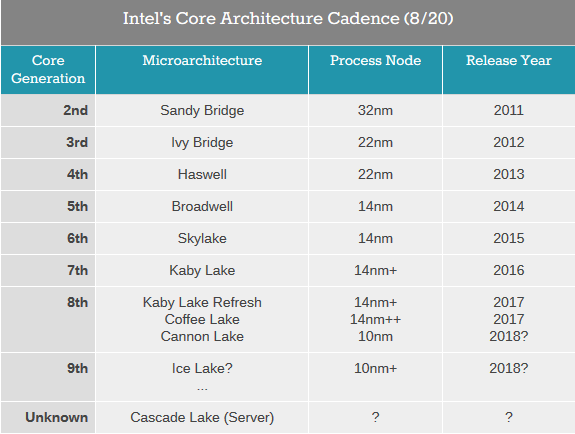 Intel is not disclosing transistor count or die size, but unofficially the die size
is 151 sq.mm. The 8th-gen CPU line is the first one to incorporate 6 cores into
the mainstream. The integrated graphics on the 8700K are the UHD 630 at 1.2 GHz.
See Intel's
Intel is not disclosing transistor count or die size, but unofficially the die size
is 151 sq.mm. The 8th-gen CPU line is the first one to incorporate 6 cores into
the mainstream. The integrated graphics on the 8700K are the UHD 630 at 1.2 GHz.
See Intel's